Shanxi Medical University School and Hospital of Stomatology, Taiyuan 030001, China.
Shanxi Province Key Laboratory of Oral Diseases Prevention and New Materials, Taiyuan 030001, China.
Nanotheranostics. 2021 Mar 10;5(3):321-332. doi: 10.7150/ntno.56401. eCollection 2021.
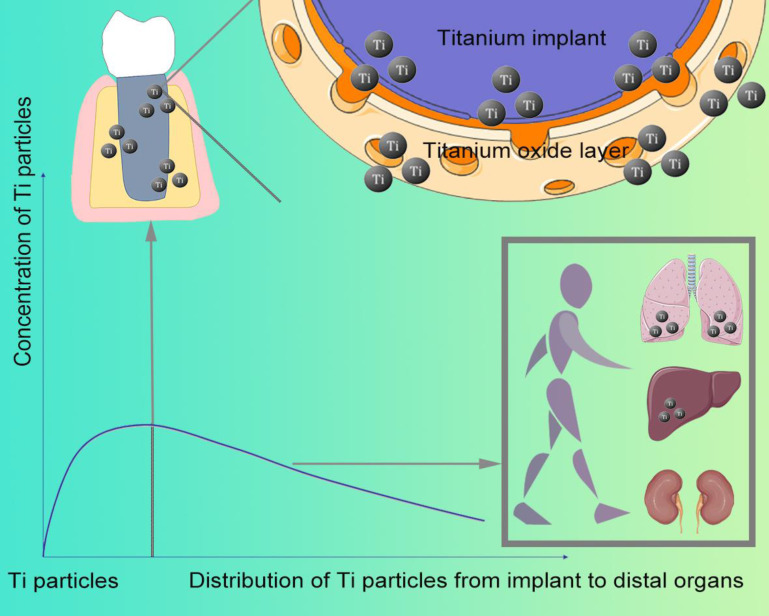
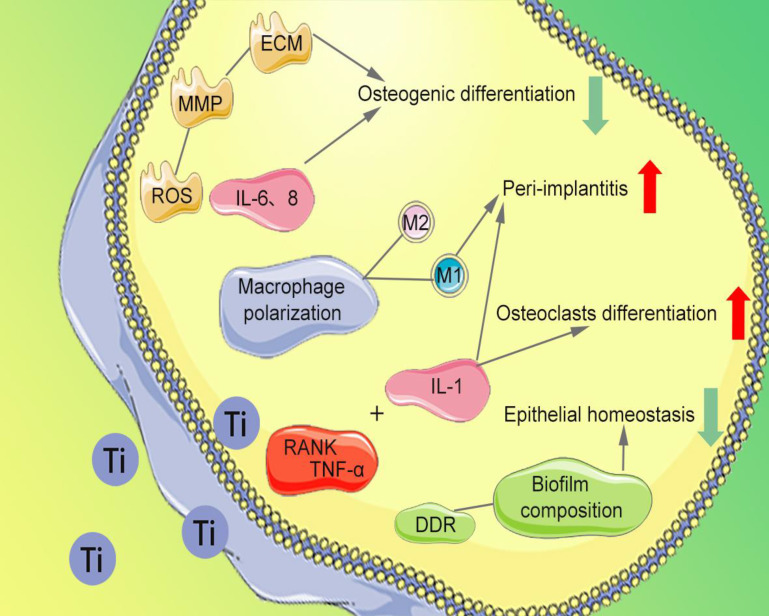
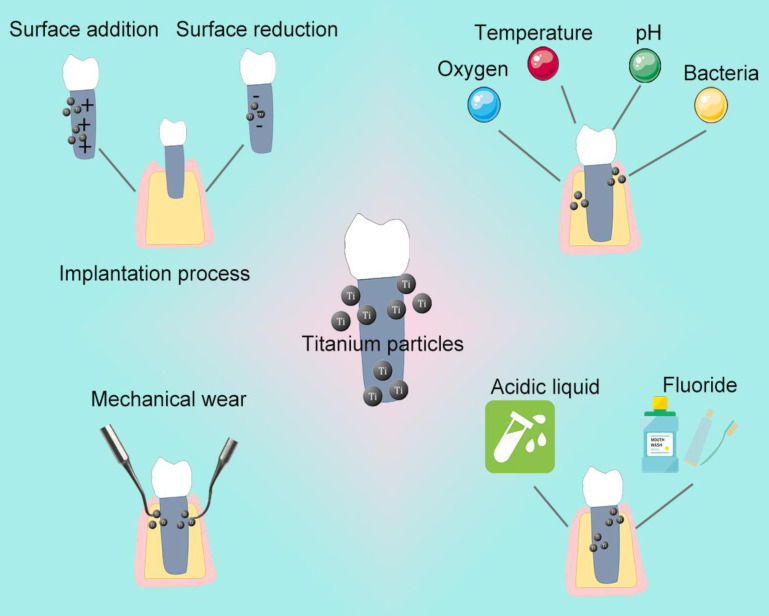
Titanium is considered to be a metal material with the best biological safety. Studies have proved that the titanium implanted in the bone continuously releases titanium particles (Ti particles), significantly increasing the total titanium content in human body. Generally, Ti particles are released slowly without causing a systemic immune response. However, the continuous increased local concentration may result in damage to the intraepithelial homeostasis, aggravation of inflammatory reaction in the surrounding tissues, bone resorption and implant detachment. They also migrate with blood flow and aggregate in the distal organ. The release of Ti particles is affected by the score of the implant surface structure, microenvironment wear and corrosion, medical operation wear, and so on, but the specific mechanism is not clear. Thus, it difficult to prevent the release completely. This paper reviews the causes of the Ti particles formation, the damage to the surrounding tissue, and its mechanism, in particular, methods for reducing the release and toxicity of the Ti particles.
钛被认为是生物安全性最好的金属材料。研究证明,植入骨内的钛会不断释放出钛颗粒(Ti 颗粒),使人体内的总钛含量明显增加。一般来说,Ti 颗粒释放缓慢,不会引起全身免疫反应。然而,局部浓度的持续增加可能导致上皮内稳态的破坏,周围组织炎症反应加重,骨质吸收和种植体脱落。它们还随血流迁移并在远端器官聚集。Ti 颗粒的释放受种植体表面结构评分、微环境磨损和腐蚀、医疗操作磨损等因素的影响,但具体机制尚不清楚。因此,很难完全防止其释放。本文综述了 Ti 颗粒形成的原因、对周围组织的损伤及其机制,特别是减少 Ti 颗粒释放和毒性的方法。