• 文献检索
  • 文档翻译
  • 深度研究
  • 学术资讯
  • Suppr Zotero 插件Zotero 插件
  • 邀请有礼
  • 套餐&价格
  • 历史记录
应用&插件
Suppr Zotero 插件Zotero 插件浏览器插件Mac 客户端Windows 客户端微信小程序
定价
高级版会员购买积分包购买API积分包
服务
文献检索文档翻译深度研究API 文档MCP 服务
关于我们
关于 Suppr公司介绍联系我们用户协议隐私条款
关注我们

Suppr 超能文献

核心技术专利:CN118964589B侵权必究
粤ICP备2023148730 号-1Suppr @ 2026

文献检索

告别复杂PubMed语法,用中文像聊天一样搜索,搜遍4000万医学文献。AI智能推荐,让科研检索更轻松。

立即免费搜索

文件翻译

保留排版,准确专业,支持PDF/Word/PPT等文件格式,支持 12+语言互译。

免费翻译文档

深度研究

AI帮你快速写综述,25分钟生成高质量综述,智能提取关键信息,辅助科研写作。

立即免费体验

医护人员对人工智能的认知:一项定性调查研究。

Perceptions of Artificial Intelligence Among Healthcare Staff: A Qualitative Survey Study.

作者信息

Castagno Simone, Khalifa Mohamed

机构信息

Department of Interventional Radiology, Royal Free Hospital, London, United Kingdom.

出版信息

Front Artif Intell. 2020 Oct 21;3:578983. doi: 10.3389/frai.2020.578983. eCollection 2020.

DOI:10.3389/frai.2020.578983
PMID:33733219
原文链接:https://pmc.ncbi.nlm.nih.gov/articles/PMC7861214/
Abstract

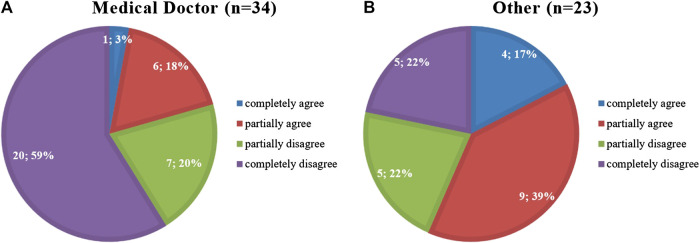
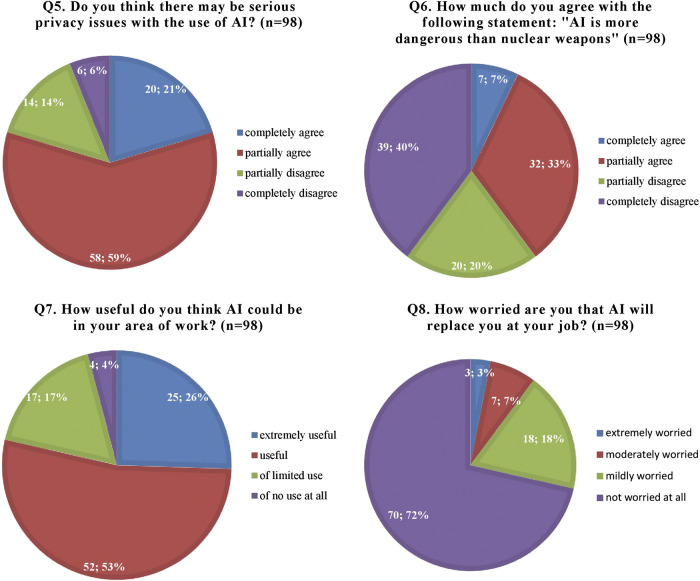
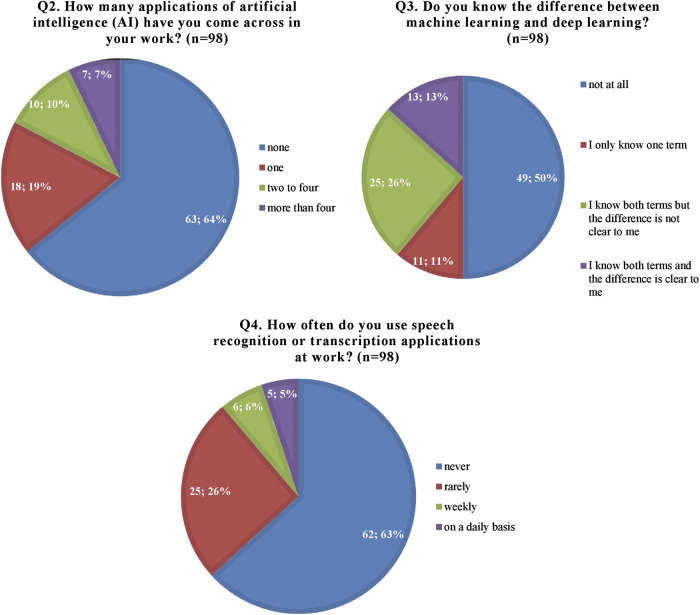
The medical community is in agreement that artificial intelligence (AI) will have a radical impact on patient care in the near future. The purpose of this study is to assess the awareness of AI technologies among health professionals and to investigate their perceptions toward AI applications in medicine. A web-based Google Forms survey was distributed via the Royal Free London NHS Foundation Trust e-newsletter. Only staff working at the NHS Foundation Trust received an invitation to complete the online questionnaire. 98 healthcare professionals out of 7,538 (response rate 1.3%; CI 95%; margin of error 9.64%) completed the survey, including medical doctors, nurses, therapists, managers, and others. To investigate the prior knowledge of health professionals on the subject of AI as well as their attitudes and worries about its current and future applications. 64% of respondents reported never coming across applications of AI in their work and 87% did not know the difference between machine learning and deep learning, although 50% knew at least one of the two terms. Furthermore, only 5% stated using speech recognition or transcription applications on a daily basis, while 63% never utilize them. 80% of participants believed there may be serious privacy issues associated with the use of AI and 40% considered AI to be potentially even more dangerous than nuclear weapons. However, 79% also believed AI could be useful or extremely useful in their field of work and only 10% were worried AI will replace them at their job. Despite agreeing on the usefulness of AI in the medical field, most health professionals lack a full understanding of the principles of AI and are worried about potential consequences of its widespread use in clinical practice. The cooperation of healthcare workers is crucial for the integration of AI into clinical practice and without it the NHS may miss out on an exceptionally rewarding opportunity. This highlights the need for better education and clear regulatory frameworks.

摘要

医学界一致认为,人工智能(AI)在不久的将来将对患者护理产生根本性影响。本研究的目的是评估卫生专业人员对人工智能技术的认知,并调查他们对人工智能在医学中的应用的看法。通过伦敦皇家自由国民保健服务基金会信托基金的电子通讯分发了一份基于网络的谷歌表单调查问卷。只有在国民保健服务基金会信托基金工作的员工收到了完成在线问卷的邀请。7538名医疗保健专业人员中有98人(回复率1.3%;95%置信区间;误差幅度9.64%)完成了调查,包括医生、护士、治疗师、管理人员和其他人员。为了调查卫生专业人员对人工智能主题的先验知识,以及他们对其当前和未来应用的态度和担忧。64%的受访者表示在工作中从未遇到过人工智能的应用,87%的人不知道机器学习和深度学习之间的区别,尽管50%的人至少知道这两个术语中的一个。此外,只有5%的人表示每天使用语音识别或转录应用程序,而63%的人从未使用过。80%的参与者认为使用人工智能可能存在严重的隐私问题,40%的人认为人工智能可能比核武器更危险。然而,79%的人也认为人工智能在他们的工作领域可能有用或极其有用,只有10%的人担心人工智能会取代他们的工作。尽管大多数卫生专业人员认同人工智能在医疗领域的有用性,但他们对人工智能的原理缺乏全面了解,并担心其在临床实践中的广泛应用可能带来的后果。医护人员的合作对于将人工智能整合到临床实践中至关重要,没有他们的合作,国民保健服务体系可能会错过一个极其有益的机会。这凸显了更好的教育和明确的监管框架的必要性。
https://cdn.ncbi.nlm.nih.gov/pmc/blobs/4c00/7861214/e0c407ad1826/frai-03-578983-g003.jpg
https://cdn.ncbi.nlm.nih.gov/pmc/blobs/4c00/7861214/986acca521da/frai-03-578983-g001.jpg
https://cdn.ncbi.nlm.nih.gov/pmc/blobs/4c00/7861214/685ebff755b6/frai-03-578983-g002.jpg
https://cdn.ncbi.nlm.nih.gov/pmc/blobs/4c00/7861214/e0c407ad1826/frai-03-578983-g003.jpg
https://cdn.ncbi.nlm.nih.gov/pmc/blobs/4c00/7861214/986acca521da/frai-03-578983-g001.jpg
https://cdn.ncbi.nlm.nih.gov/pmc/blobs/4c00/7861214/685ebff755b6/frai-03-578983-g002.jpg
https://cdn.ncbi.nlm.nih.gov/pmc/blobs/4c00/7861214/e0c407ad1826/frai-03-578983-g003.jpg

相似文献

1
Perceptions of Artificial Intelligence Among Healthcare Staff: A Qualitative Survey Study.医护人员对人工智能的认知:一项定性调查研究。
Front Artif Intell. 2020 Oct 21;3:578983. doi: 10.3389/frai.2020.578983. eCollection 2020.
2
Knowledge, attitudes, and perceptions of healthcare students and professionals on the use of artificial intelligence in healthcare in Pakistan.巴基斯坦医学生和医疗专业人员对医疗保健领域使用人工智能的知识、态度和认知。
PLOS Digit Health. 2024 May 10;3(5):e0000443. doi: 10.1371/journal.pdig.0000443. eCollection 2024 May.
3
Knowledge and attitudes toward artificial intelligence in nursing among various categories of professionals in China: a cross-sectional study.中国不同类别专业人员对护理领域人工智能的认知与态度:一项横断面研究
Front Public Health. 2024 Jul 2;12:1433252. doi: 10.3389/fpubh.2024.1433252. eCollection 2024.
4
Physician Confidence in Artificial Intelligence: An Online Mobile Survey.医生对人工智能的信心:一项在线移动调查。
J Med Internet Res. 2019 Mar 25;21(3):e12422. doi: 10.2196/12422.
5
Cancer care at the time of the fourth industrial revolution: an insight to healthcare professionals' perspectives on cancer care and artificial intelligence.第四次工业革命时代的癌症护理:洞察医疗保健专业人员对癌症护理和人工智能的看法。
Radiat Oncol. 2023 Oct 9;18(1):167. doi: 10.1186/s13014-023-02351-z.
6
Beauty Is in the AI of the Beholder: Are We Ready for the Clinical Integration of Artificial Intelligence in Radiography? An Exploratory Analysis of Perceived AI Knowledge, Skills, Confidence, and Education Perspectives of UK Radiographers.美在观察者的人工智能之中:我们是否准备好将人工智能临床整合到放射成像中?对英国放射技师的人工智能知识、技能、信心和教育观点的探索性分析。
Front Digit Health. 2021 Nov 11;3:739327. doi: 10.3389/fdgth.2021.739327. eCollection 2021.
7
Patients' Perceptions Toward Human-Artificial Intelligence Interaction in Health Care: Experimental Study.患者对医疗保健中人机交互的看法:实验研究。
J Med Internet Res. 2021 Nov 25;23(11):e25856. doi: 10.2196/25856.
8
Attitudes and perceptions of dental students towards artificial intelligence.牙科学生对人工智能的态度和看法。
J Dent Educ. 2021 Jan;85(1):60-68. doi: 10.1002/jdd.12385. Epub 2020 Aug 26.
9
Investigating awareness of artificial intelligence in healthcare among medical students and professionals in Pakistan: a cross-sectional study.巴基斯坦医科学生和专业人员对医疗保健领域人工智能的认知调查:一项横断面研究。
Ann Med Surg (Lond). 2024 Mar 18;86(5):2606-2611. doi: 10.1097/MS9.0000000000001957. eCollection 2024 May.
10
Knowledge, attitude, and practice of artificial intelligence among medical students in Sudan: a cross-sectional study.苏丹医学生对人工智能的知识、态度和实践:一项横断面研究。
Ann Med Surg (Lond). 2024 Apr 24;86(7):3917-3923. doi: 10.1097/MS9.0000000000002070. eCollection 2024 Jul.

引用本文的文献

1
Insights Into Perceived Worries Regarding the Adoption of Artificial Intelligence Among Intensive Care Unit Nurses in the West Bank.对约旦河西岸重症监护病房护士在采用人工智能方面所感知担忧的洞察。
SAGE Open Nurs. 2025 Sep 3;11:23779608251376177. doi: 10.1177/23779608251376177. eCollection 2025 Jan-Dec.
2
AI-Based EMG Reporting: A Randomized Controlled Trial.基于人工智能的肌电图报告:一项随机对照试验。
J Neurol. 2025 Aug 22;272(9):586. doi: 10.1007/s00415-025-13261-3.
3
Quo Vadis, AI-Empowered Doctor?人工智能赋能的医生,路在何方?

本文引用的文献

1
Real-time tracking of self-reported symptoms to predict potential COVID-19.实时跟踪自我报告的症状以预测潜在的 COVID-19。
Nat Med. 2020 Jul;26(7):1037-1040. doi: 10.1038/s41591-020-0916-2. Epub 2020 May 11.
2
Perceptions of artificial intelligence in healthcare: findings from a qualitative survey study among actors in France.医疗保健领域对人工智能的看法:法国利益相关者定性调查研究的结果。
J Transl Med. 2020 Jan 9;18(1):14. doi: 10.1186/s12967-019-02204-y.
3
International evaluation of an AI system for breast cancer screening.国际乳腺癌筛查人工智能系统评估。
JMIR Med Educ. 2025 Aug 15;11:e70079. doi: 10.2196/70079.
4
How AI-Based Digital Rehabilitation Improves End-User Adherence: Rapid Review.基于人工智能的数字康复如何提高终端用户的依从性:快速综述。
JMIR Rehabil Assist Technol. 2025 Aug 14;12:e69763. doi: 10.2196/69763.
5
Medical and Paramedical Students' Perspectives on Artificial Intelligence in a Low- and Middle-Income Country: A Cross-Sectional Study.低收入和中等收入国家医学及准医学专业学生对人工智能的看法:一项横断面研究
Health Sci Rep. 2025 Aug 4;8(8):e71046. doi: 10.1002/hsr2.71046. eCollection 2025 Aug.
6
Advancing artificial intelligence ethics in health and genomics: lessons from a public survey in South Korea.推进健康与基因组学领域的人工智能伦理:来自韩国一项公众调查的经验教训。
Front Genet. 2025 Jul 9;16:1563544. doi: 10.3389/fgene.2025.1563544. eCollection 2025.
7
Contrasting attitudes towards current and future artificial intelligence applications for computerised interpretation of electrocardiograms: a clinical stakeholder interview study.对当前及未来用于心电图计算机解读的人工智能应用的不同态度:一项临床利益相关者访谈研究
JAMIA Open. 2025 Jul 21;8(4):ooaf071. doi: 10.1093/jamiaopen/ooaf071. eCollection 2025 Aug.
8
Perceptions, barriers, and risk of artificial intelligence Among healthcare professionals: A cross-sectional study.医疗保健专业人员对人工智能的认知、障碍及风险:一项横断面研究。
Digit Health. 2025 Jul 16;11:20552076251360924. doi: 10.1177/20552076251360924. eCollection 2025 Jan-Dec.
9
Perceived worries in the adoption of artificial intelligence among nurses in neonatal intensive care units.新生儿重症监护病房护士在采用人工智能方面的感知担忧。
BMC Nurs. 2025 Jul 1;24(1):777. doi: 10.1186/s12912-025-03318-z.
10
Insights into the relationship between anxiety and attitudes toward artificial intelligence among nursing students.护理专业学生焦虑情绪与对人工智能态度之间的关系洞察
BMC Nurs. 2025 Jul 1;24(1):812. doi: 10.1186/s12912-025-03490-2.
Nature. 2020 Jan;577(7788):89-94. doi: 10.1038/s41586-019-1799-6. Epub 2020 Jan 1.
4
Impact of artificial intelligence on radiology: a EuroAIM survey among members of the European Society of Radiology.人工智能对放射学的影响:欧洲放射学会成员的一项欧洲人工智能医学影像项目(EuroAIM)调查。
Insights Imaging. 2019 Oct 31;10(1):105. doi: 10.1186/s13244-019-0798-3.
5
Patients' views of wearable devices and AI in healthcare: findings from the ComPaRe e-cohort.患者对医疗保健中可穿戴设备和人工智能的看法:来自ComPaRe电子队列的研究结果。
NPJ Digit Med. 2019 Jun 14;2:53. doi: 10.1038/s41746-019-0132-y. eCollection 2019.
6
Artificial Intelligence in Primary Health Care: Perceptions, Issues, and Challenges.初级卫生保健中的人工智能:认知、问题与挑战
Yearb Med Inform. 2019 Aug;28(1):41-46. doi: 10.1055/s-0039-1677901. Epub 2019 Apr 25.
7
Artificial intelligence in healthcare.人工智能在医疗保健领域的应用。
Nat Biomed Eng. 2018 Oct;2(10):719-731. doi: 10.1038/s41551-018-0305-z. Epub 2018 Oct 10.
8
Physician Confidence in Artificial Intelligence: An Online Mobile Survey.医生对人工智能的信心:一项在线移动调查。
J Med Internet Res. 2019 Mar 25;21(3):e12422. doi: 10.2196/12422.
9
A guide to deep learning in healthcare.深度学习在医疗保健中的应用指南。
Nat Med. 2019 Jan;25(1):24-29. doi: 10.1038/s41591-018-0316-z. Epub 2019 Jan 7.
10
Against the iDoctor: why artificial intelligence should not replace physician judgment.反对智能医生:为何人工智能不应取代医生的判断。
Theor Med Bioeth. 2018 Apr;39(2):91-110. doi: 10.1007/s11017-018-9442-3.