Chen Yi, Huang Jiaping, Liu Jiamei, Wei Yingming, Yang Xianyan, Lei Lihong, Chen Lili, Wu Yanmin, Gou Zhongru
Department of Stomotology, The Second Affiliated Hospital of Zhejiang University School of Medicine, Hangzhou 310009, China.
Zhejiang-California International Nanosystems Institute, Zhejiang University, Hangzhou 310058, China.
Regen Biomater. 2021 Mar 13;8(2):rbab007. doi: 10.1093/rb/rbab007. eCollection 2021 Mar.
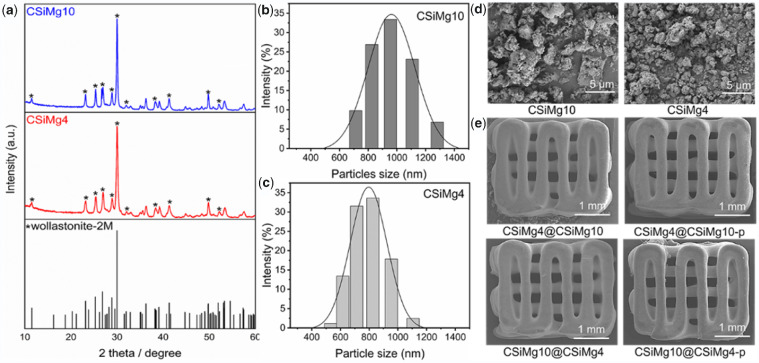
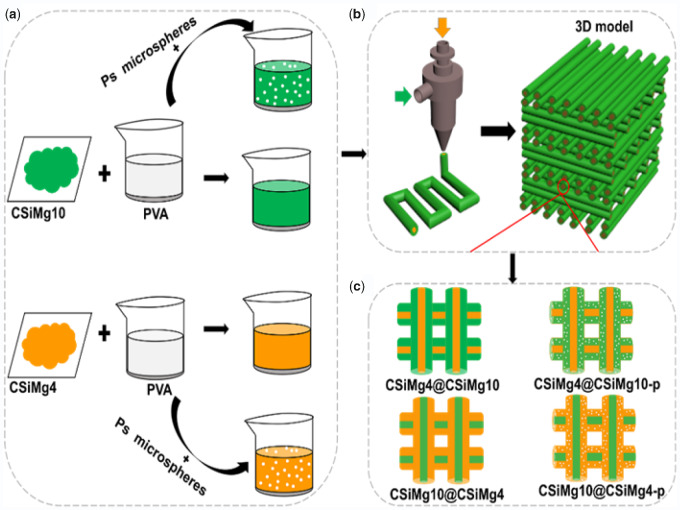
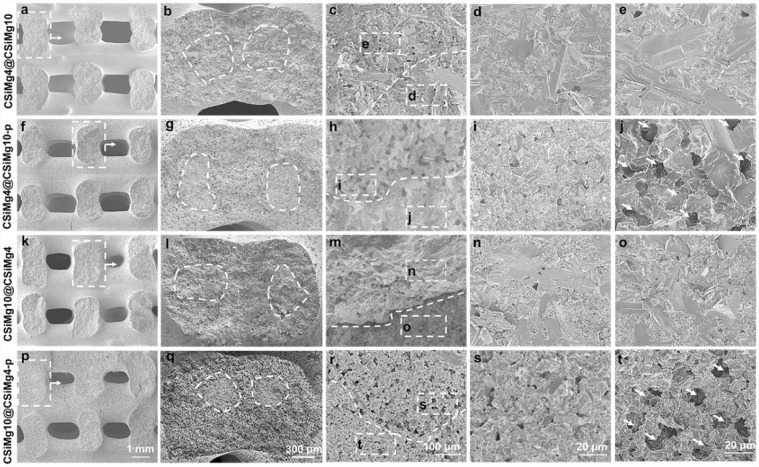
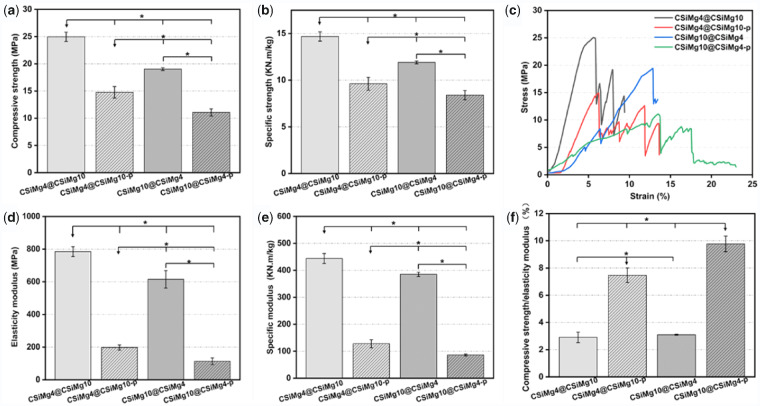
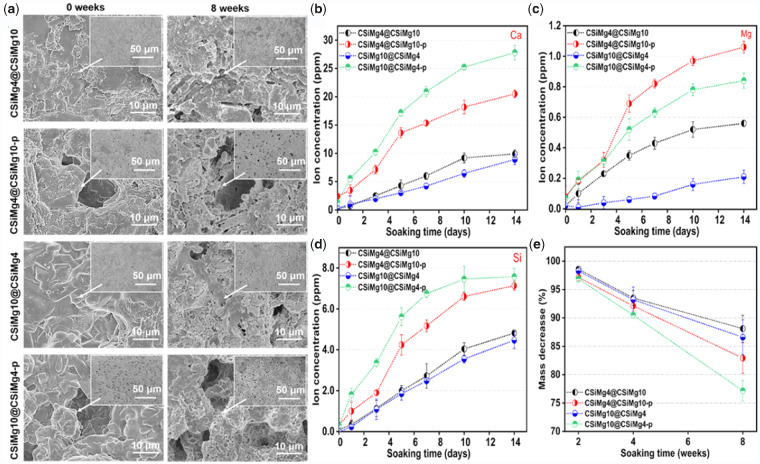
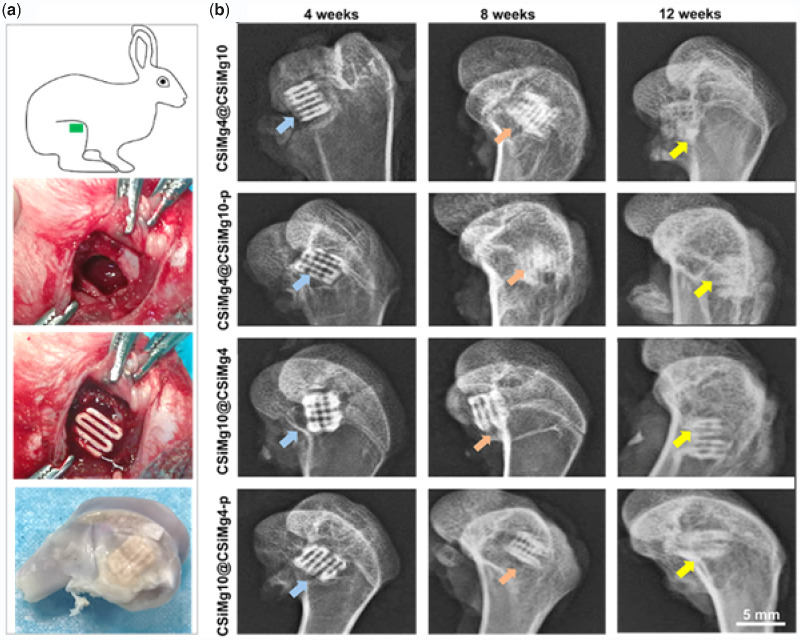
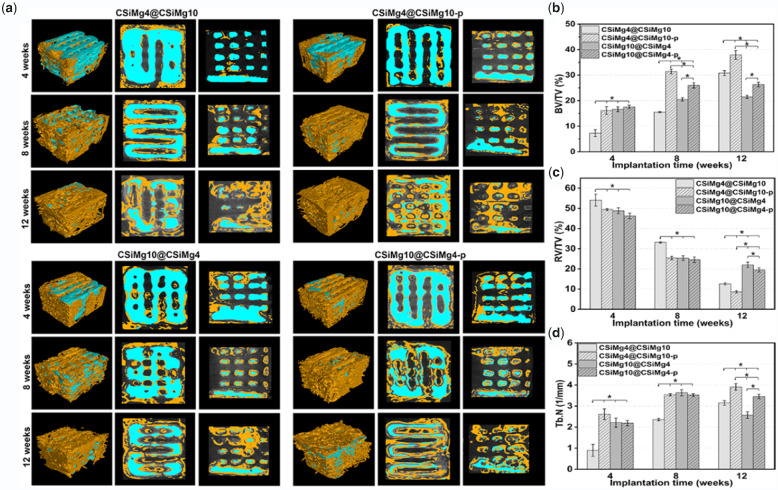
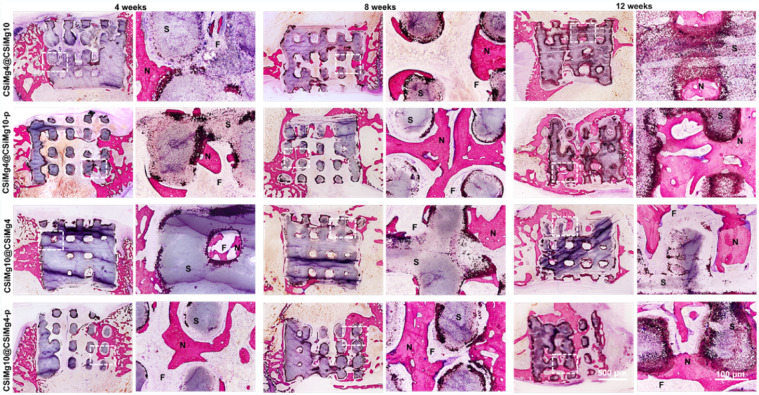
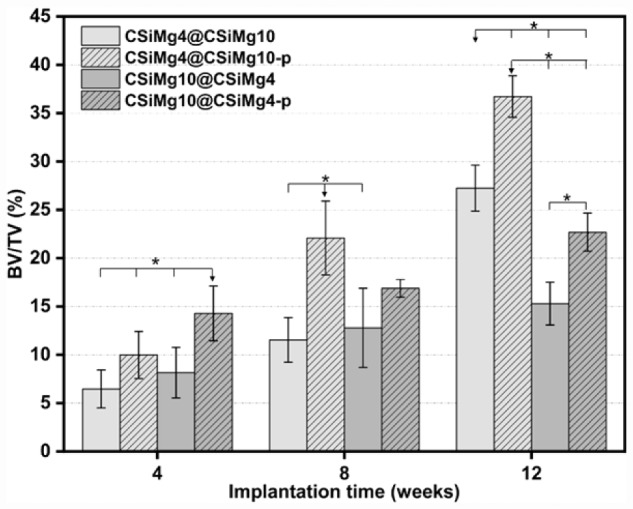
It is still a challenge to optimize the component distribution and microporous structures in scaffolds for tailoring biodegradation (ion releasing) and enhancing bone defect repair within an expected time stage. Herein, the core-shell-typed nonstoichiometric wollastonite (4% and 10% Mg-doping calcium silicate; CSiMg4, CSiMg10) macroporous scaffolds with microporous shells (adding ∼10 μm PS microspheres into shell-layer slurry) were fabricated via 3D printing. The initial mechanical properties and bio-dissolution (ion releasing) , and osteogenic capacity of the bioceramic scaffolds were evaluated systematically. It was shown that endowing high-density micropores in the sparingly dissolvable CSiMg10 or dissolvable CSiMg4 shell layer inevitably led to nearly 30% reduction of compressive strength, but such micropores could readily tune the ion release behaviour of the scaffolds (CSiMg4@CSiMg10 vs. CSiMg4@CSiMg10-p; CSiMg10@CSiMg4 vs. CSiMg10@CSiMg4-p). Based on the in rabbit femoral bone defect repair model, the 3D μCT reconstruction and histological observation demonstrated that the CSiMg4@CSiMg10-p scaffolds displayed markedly higher osteogenic capability than the other scaffolds after 12 weeks of implantation. It demonstrated that core-shell bioceramic 3D printing technique can be developed to fabricate single-phase or biphasic bioactive ceramic scaffolds with accurately tailored filament biodegradation for promoting bone defect regeneration and repair in some specific pathological conditions.
在预期的时间阶段内,优化支架中的成分分布和微孔结构以定制生物降解(离子释放)并增强骨缺损修复仍然是一项挑战。在此,通过3D打印制备了具有微孔壳层(向壳层浆料中添加约10μm聚苯乙烯微球)的核壳型非化学计量硅灰石(4%和10%镁掺杂硅酸钙;CSiMg4、CSiMg10)大孔支架。系统评估了生物陶瓷支架的初始力学性能、生物溶解(离子释放)和成骨能力。结果表明,在难溶性CSiMg10或可溶性CSiMg4壳层中赋予高密度微孔不可避免地导致抗压强度降低近30%,但这种微孔可以很容易地调节支架的离子释放行为(CSiMg4@CSiMg10与CSiMg4@CSiMg10-p;CSiMg10@CSiMg4与CSiMg10@CSiMg4-p)。基于兔股骨骨缺损修复模型,3D μCT重建和组织学观察表明,植入12周后,CSiMg4@CSiMg10-p支架的成骨能力明显高于其他支架。结果表明,可以开发核壳生物陶瓷3D打印技术,以制造具有精确定制长丝生物降解的单相或双相生物活性陶瓷支架,用于在某些特定病理条件下促进骨缺损再生和修复。