Center for Functional Nanomaterials, Brookhaven National Laboratory, Upton, NY 11973, USA.
Department of Chemistry, University of Warsaw, Warsaw, Poland.
Sci Adv. 2021 Mar 19;7(12). doi: 10.1126/sciadv.abf0617. Print 2021 Mar.
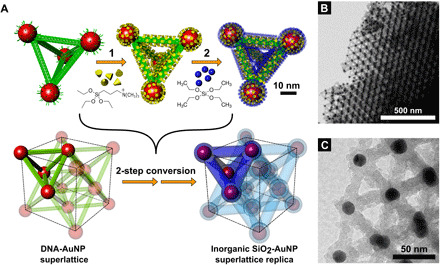
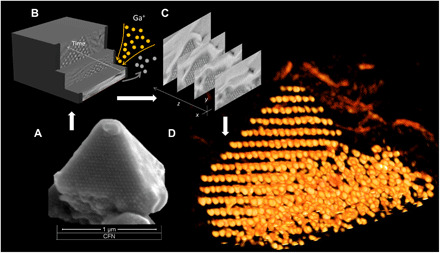
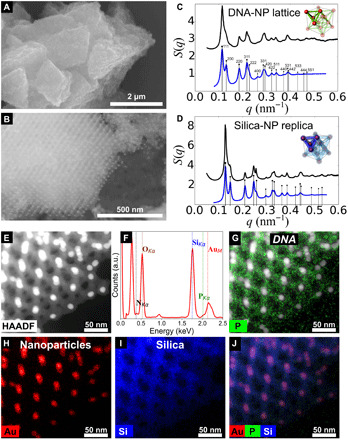
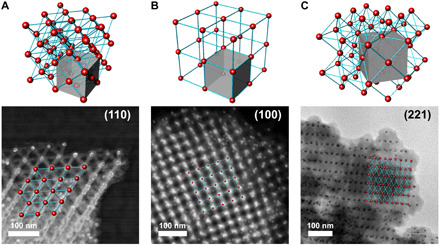
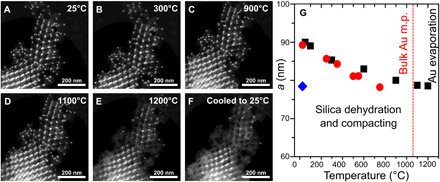
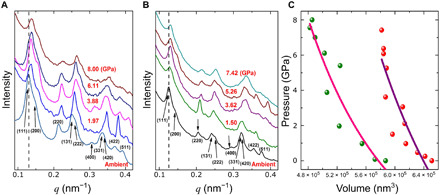
Rapid developments of DNA-based assembly methods provide versatile capabilities in organizing nanoparticles (NPs) in three-dimensional (3D) organized nanomaterials, which is important for optics, catalysis, mechanics, and beyond. However, the use of these nanomaterials is often limited by the narrow range of conditions in which DNA lattices are stable. We demonstrate here an approach to creating an inorganic, silica-based replica of 3D periodic DNA-NP structures with different lattice symmetries. The created ordered nanomaterials, through the precise 3D mineralization, maintain the spatial topology of connections between NPs by DNA struts and exhibit a controllable degree of the porosity. The formed silicated DNA-NP lattices exhibit excellent resiliency. They are stable when exposed to extreme temperatures (>1000°C), pressures (8 GPa), and harsh radiation conditions and can be processed by the conventional nanolithography methods. The presented approach allows the use of a DNA assembly strategy to create organized nanomaterials for a broad range of operational conditions.
基于 DNA 的组装方法的快速发展为在三维(3D)有序纳米材料中组织纳米粒子(NPs)提供了多功能的能力,这对于光学、催化、力学等领域都很重要。然而,这些纳米材料的使用通常受到 DNA 晶格稳定的条件范围狭窄的限制。我们在这里展示了一种方法,可以创建具有不同晶格对称性的 3D 周期性 DNA-NP 结构的无机硅基复制品。通过精确的 3D 矿化,所创建的有序纳米材料保持了 NP 之间通过 DNA 支柱连接的空间拓扑结构,并表现出可控的多孔度。形成的硅化 DNA-NP 晶格具有出色的弹性。它们在暴露于极端温度(>1000°C)、压力(8 GPa)和恶劣的辐射条件下仍然稳定,并且可以通过传统的纳米光刻方法进行处理。所提出的方法允许使用 DNA 组装策略来创建适用于广泛操作条件的有序纳米材料。