Chagas João Victor S das, de A Rodrigues Douglas, Ivo Roberto F, Hassan Mohammad Mehedi, de Albuquerque Victor Hugo C, Filho Pedro P Rebouças
Federal Institute of Education, Science and Technology of Ceará, LAPISCO, Fortaleza, CE 60040-215 Brazil.
Research Chair of Pervasive and Mobile Computing, College of Computer and Information Sciences, King Saud University, 11543 Riyadh, Saudi Arabia.
J Real Time Image Process. 2021;18(4):1099-1114. doi: 10.1007/s11554-021-01086-y. Epub 2021 Mar 16.
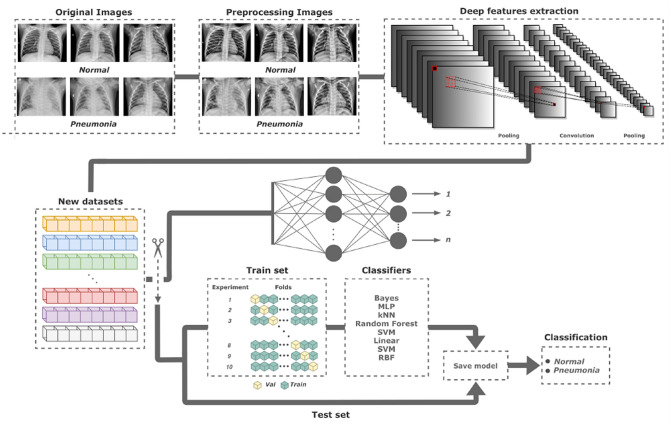
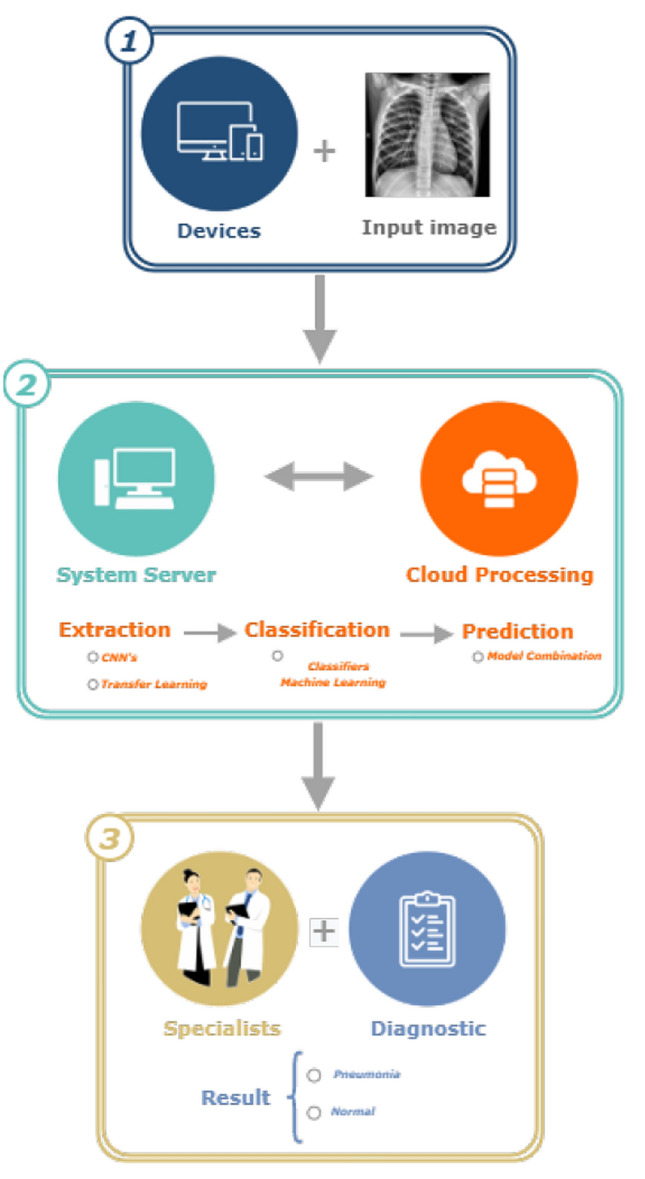
Pneumonia is responsible for high infant morbidity and mortality. This disease affects the small air sacs (alveoli) in the lung and requires prompt diagnosis and appropriate treatment. Chest X-rays are one of the most common tests used to detect pneumonia. In this work, we propose a real-time Internet of Things (IoT) system to detect pneumonia in chest X-ray images. The dataset used has 6000 chest X-ray images of children, and three medical specialists performed the validations. In this work, twelve different architectures of Convolutional Neural Networks (CNNs) trained on ImageNet were adapted to operate as the resource extractors. Subsequently, the CNNs were combined with consolidated learning methods, such as k-Nearest Neighbor (kNN), Naive Bayes, Random Forest, Multilayer Perceptron (MLP), and Support Vector Machine (SVM). The results showed that the VGG19 architecture with the SVM classifier using the RBF kernel was the best model to detect pneumonia in these chest radiographs. This combination reached 96.47%, 96.46%, and 96.46% for Accuracy, F1 score, and Precision values, respectively. Compared to other works in the literature, the proposed approach had better results for the metrics used. These results show that this approach for the detection of pneumonia in children using a real-time IoT system is efficient and is, therefore, a potential tool to aid in medical diagnoses. This approach will allow specialists to obtain faster and more accurate results and thus provide the appropriate treatment.
肺炎是导致婴儿高发病率和高死亡率的原因。这种疾病会影响肺部的小气囊(肺泡),需要及时诊断和适当治疗。胸部X光片是用于检测肺炎的最常见检查之一。在这项工作中,我们提出了一种实时物联网(IoT)系统来检测胸部X光图像中的肺炎。所使用的数据集包含6000张儿童胸部X光图像,并且由三位医学专家进行了验证。在这项工作中,对在ImageNet上训练的十二种不同的卷积神经网络(CNN)架构进行了调整,使其作为资源提取器运行。随后,将这些CNN与合并学习方法相结合,如k近邻(kNN)、朴素贝叶斯、随机森林、多层感知器(MLP)和支持向量机(SVM)。结果表明,使用径向基函数(RBF)核的支持向量机分类器的VGG19架构是检测这些胸部X光片中肺炎的最佳模型。这种组合的准确率、F1分数和精确率值分别达到了96.47%、96.46%和96.46%。与文献中的其他工作相比,所提出的方法在使用的指标方面取得了更好的结果。这些结果表明,这种使用实时物联网系统检测儿童肺炎的方法是有效的,因此是辅助医学诊断的潜在工具。这种方法将使专家能够获得更快、更准确的结果,从而提供适当的治疗。