Department of Oral and Maxillofacial Surgery, Gangnam Severance Hospital, Yonsei University College of Dentistry, Seoul, Republic of Korea.
Department of Oral and Maxillofacial Surgery, Yonsei University College of Dentistry, Seoul, Republic of Korea.
Sci Rep. 2021 Mar 23;11(1):6680. doi: 10.1038/s41598-021-86115-3.
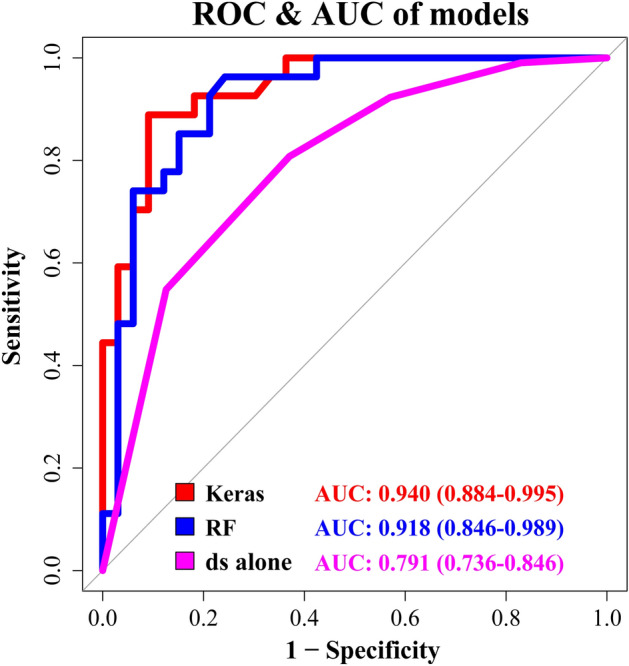
The goal of this study was to develop a deep learning-based algorithm to predict temporomandibular joint (TMJ) disc perforation based on the findings of magnetic resonance imaging (MRI) and to validate its performance through comparison with previously reported results. The study objects were obtained by reviewing medical records from January 2005 to June 2018. 299 joints from 289 patients were divided into perforated and non-perforated groups based on the existence of disc perforation confirmed during surgery. Experienced observers interpreted the TMJ MRI images to extract features. Data containing those features were applied to build and validate prediction models using random forest and multilayer perceptron (MLP) techniques, the latter using the Keras framework, a recent deep learning architecture. The area under the receiver operating characteristic (ROC) curve (AUC) was used to compare the performances of the models. MLP produced the best performance (AUC 0.940), followed by random forest (AUC 0.918) and disc shape alone (AUC 0.791). The MLP and random forest were also superior to previously reported results using MRI (AUC 0.808) and MRI-based nomogram (AUC 0.889). Implementing deep learning showed superior performance in predicting disc perforation in TMJ compared to conventional methods and previous reports.
本研究旨在开发一种基于磁共振成像(MRI)结果预测颞下颌关节(TMJ)盘穿孔的深度学习算法,并通过与先前报道的结果进行比较来验证其性能。研究对象通过回顾 2005 年 1 月至 2018 年 6 月的病历获得。289 名患者的 299 个关节根据手术中确认的盘穿孔分为穿孔组和非穿孔组。有经验的观察者解释 TMJ MRI 图像以提取特征。包含这些特征的数据被应用于构建和验证使用随机森林和多层感知器(MLP)技术的预测模型,后者使用 Keras 框架,这是一种新的深度学习架构。接收器操作特性(ROC)曲线下的面积(AUC)用于比较模型的性能。MLP 产生了最佳性能(AUC 0.940),其次是随机森林(AUC 0.918)和盘形(AUC 0.791)。MLP 和随机森林也优于先前使用 MRI(AUC 0.808)和基于 MRI 的列线图(AUC 0.889)报道的结果。与传统方法和先前的报告相比,深度学习在预测 TMJ 盘穿孔方面表现出更好的性能。