Department of Epidemiology, School of Public Health, University of Washington, Seattle, WA, United States of America.
Swedish Cancer Institute, Seattle, WA, United States of America.
PLoS One. 2021 Mar 24;16(3):e0243042. doi: 10.1371/journal.pone.0243042. eCollection 2021.
As the coronavirus (COVID-19) epidemic passed initial infection peak in Washington State, phased re-opening lifted stay-at-home orders and restrictions leading to increased non-essential work, social activities and gathering, especially among younger persons.
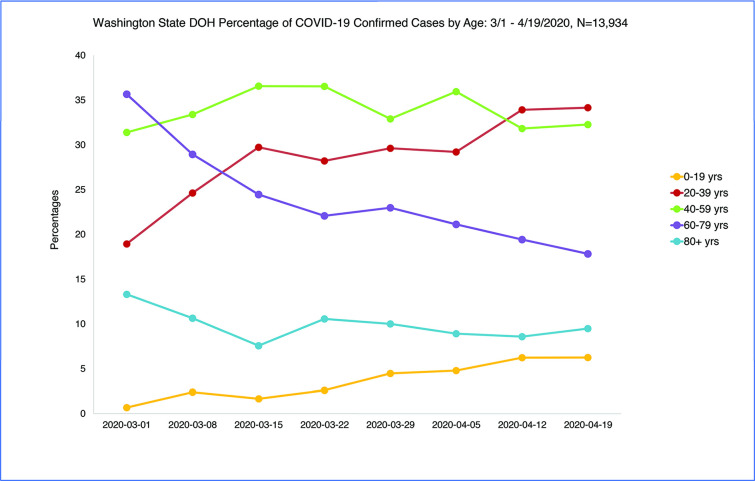
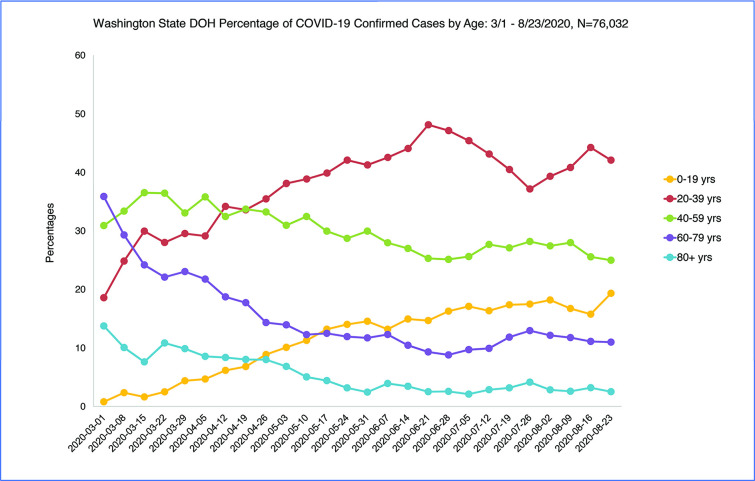
A longitudinal cohort analysis of Washington State Department of Health COVID-19 confirmed case age distribution 1) March-April 2020 (N = 13,934) and 2) March-August 2020 (N = 76,032) for proportional change over time using chi square tests for significance.
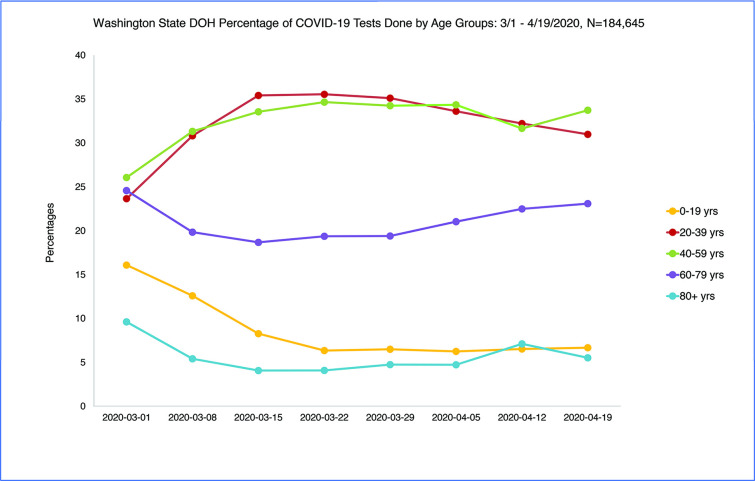
From March 1st to April 19, 2020 COVID-19 age distribution shifted with a 10% decline in cases age 60 years and older and a 20% increase in age 0-19/20-39 years (chi-square = 223.10, p < .001). Number of cases over the initial analysis period were 0-19 years n = 515, 20-39 years n = 4078, 40-59 years n = 4788, 60-79 years n = 3221, 80+ years n = 1332. After the peak (March 22, 2020), incidence declined in older age groups and increased among age 0-19 and 20-39 age groups from 20% to 40% of total cases by April 19 and 50% by May 3. During this time testing expanded with more testing among older age groups and less testing among younger age groups while case positivity shifted young. Percent positive cases age 0-19/20-39 years through August 2020 increased to a consistent average of 60% [age 0-19 increased to 19% (N = 10257), age 20-39 increased to 42% (N = 30215)].
An increased sustained proportion of COVID-19 incidence is present among children (age 0-19) and young adults (age 20-39) indicating an elevated role in disease spread during the epidemic creating a possible reservoir of disease with spillover risk to more vulnerable older persons and those with comorbid conditions. Media savvy age-appropriate messaging to enhance mitigation compliance among less vulnerable, more mobile and lower priority vaccination age groups will be a continued necessity and priority to reduce overall population incidence.
随着冠状病毒(COVID-19)疫情在华盛顿州度过最初的感染高峰,分阶段重新开放取消了居家令和限制,导致非必要的工作、社交活动和聚会增加,尤其是在年轻人中。
对华盛顿州卫生部 COVID-19 确诊病例年龄分布的纵向队列分析 1)2020 年 3 月至 4 月(N = 13934)和 2)2020 年 3 月至 8 月(N = 76032),使用卡方检验进行时间上的比例变化,以确定显著性。
从 2020 年 3 月 1 日至 4 月 19 日,COVID-19 的年龄分布发生了变化,60 岁及以上年龄段的病例减少了 10%,0-19 岁和 20-39 岁年龄段的病例增加了 20%(卡方=223.10,p<0.001)。在最初的分析期间,0-19 岁的病例数为 515 例,20-39 岁的病例数为 4078 例,40-59 岁的病例数为 4788 例,60-79 岁的病例数为 3221 例,80 岁及以上的病例数为 1332 例。在高峰期(2020 年 3 月 22 日)之后,老年人群体的发病率下降,0-19 岁和 20-39 岁年龄组的发病率从 4 月 19 日的 20%增加到 40%,到 5 月 3 日增加到 50%。在此期间,随着老年人群体检测量的增加和年轻人群体检测量的减少,检测范围扩大,而病例阳性率则向年轻人转移。2020 年 8 月之前,0-19/20-39 岁年龄组的阳性病例百分比增加到 60%(0-19 岁增加到 19%(N=10257),20-39 岁增加到 42%(N=30215))。
儿童(0-19 岁)和青年(20-39 岁)COVID-19 发病率持续增加,表明在疫情期间疾病传播中作用上升,可能成为疾病的潜在蓄水池,并有可能向更脆弱的老年人和患有合并症的人溢出风险。针对不同年龄段的媒体明智的、适合年龄的信息传递,以增强对较不易受感染、更活跃和优先接种疫苗年龄组的缓解措施的遵守,将是减少总体人口发病率的持续必要性和优先事项。