Department of Dental Biomaterials, Baktawar Amin Medical and Dental College, Multan, Pakistan; Department of Dental Materials, Riphah International University, Islamabad, Pakistan.
Department of Dental Materials, Riphah International University, Islamabad, Pakistan.
Eur Endod J. 2021 Apr;6(1):98-109. doi: 10.14744/eej.2020.36349. Epub 2021 Mar 15.
The objective of this study was to evaluate the in vitro performance of endodontic sealers in their freshly mixed and set forms.
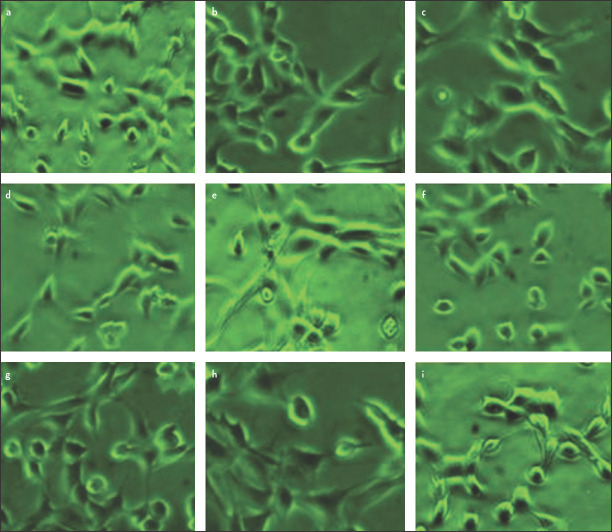
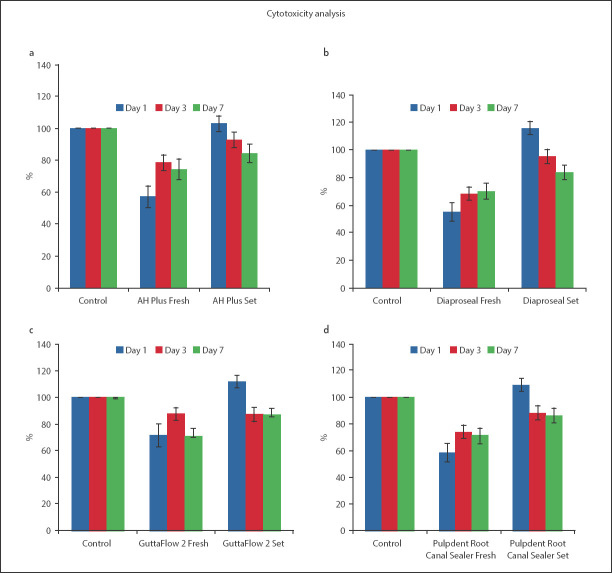
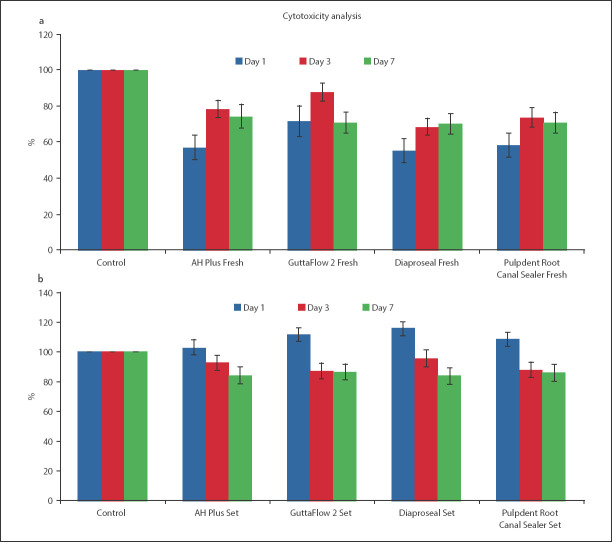
The commercially used endodontic sealers (AH Plus, Dia-ProSeal, GuttaFlow 2, and Pulpdent Root Canal Sealer) were investigated and the chemical structure of freshly mixed and set sealers were assessed with Fourier transform infrared spectroscopy (FTIR). The surface morphology and elemental analysis were assessed with a scanning electron microscope (SEM) equipped with energy-dispersive X-ray spectroscopy. The pH and solubility analysis were performed and the cytotoxicity was done on extracts of freshly mixed and set materials using Alamar blue assay. One way ANOVA and Post Hoc Tukey analysis was used to do multiple comparison analysis of the mean values and standard deviation results through SPSS version 20 (IBM Software, NY, USA) for pH, solubility, and cytotoxicity analysis.
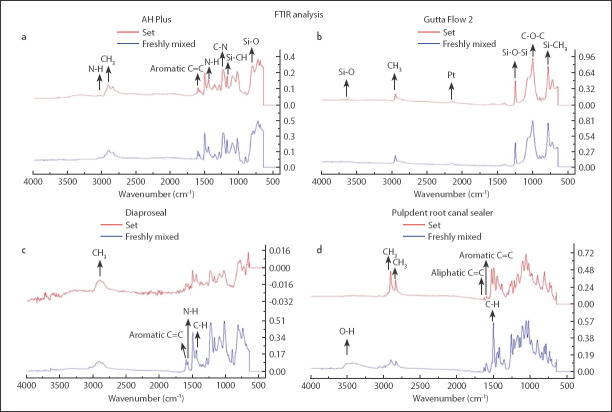
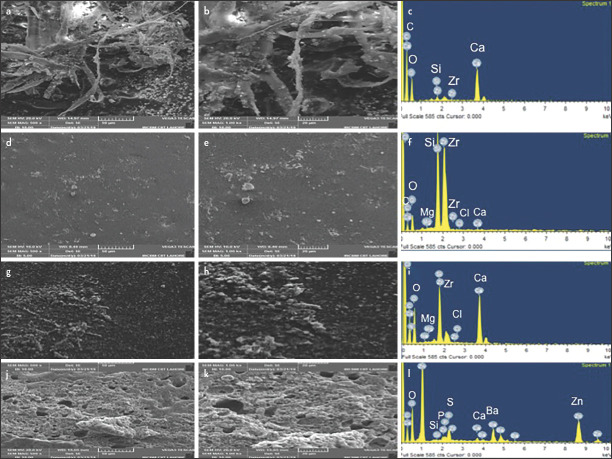
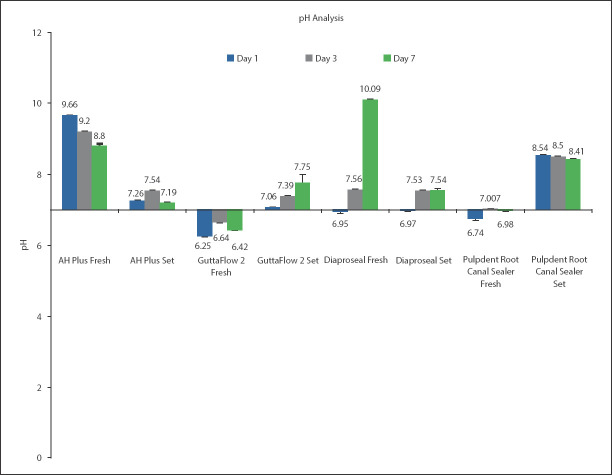
FTIR analysis revealed the structural pattern and the difference in freshly mixed and set samples was observed with the change in intensities of the peaks. The morphological pattern revealed the presence of micro/nano-particles with pores distributed throughout their structure. The sealer with the least solubility was AH Plus (0.10±0.01) followed by Dia-ProSeal (0.77±0.25), GuttaFlow 2 (1.88±0.82) and Pulpdent Root Canal Sealer (3.03±0.18). The solubility of AH plus was significantly lower (P<0.05) in comparison to GuttaFlow 2 and Pulpdent Root Canal Sealer. The highest pH (10.09±0.034) in the freshly mixed state and highest cytotoxicity in the freshly mixed (70.08±5.852) and set sealers (83.87±5.409) (P<0.05) at day 7 was observed in Dia-ProSeal. GuttaFlow 2 was the most biocompatible sealer in the set state and AH Plus was the most biocompatible sealer in the freshly mixed state at day 7.
Clinically, the sealer is applied in fresh state, whereby this study signifies that which material is more biocompatible in fresh state and provides insight information to clinicians. AH Plus showed least solubility and cytocompatibility in fresh state compared to other groups.
本研究旨在评估牙根管封闭剂在新鲜混合和凝固状态下的体外性能。
对市售的牙根管封闭剂(AH Plus、Dia-ProSeal、GuttaFlow 2 和 Pulpdent Root Canal Sealer)进行了研究,并采用傅里叶变换红外光谱(FTIR)评估新鲜混合和凝固状态下封闭剂的化学结构。采用扫描电子显微镜(SEM)结合能量色散 X 射线光谱仪评估表面形貌和元素分析。对新鲜混合和凝固材料的提取物进行 pH 值和溶解度分析,并采用 Alamar blue 测定法进行细胞毒性分析。采用 SPSS 20 版(IBM Software,NY,USA)进行单因素方差分析和事后 Tukey 分析,对 pH 值、溶解度和细胞毒性分析的平均值和标准差结果进行多重比较分析。
FTIR 分析显示出结构模式,并且随着峰强度的变化观察到新鲜混合和凝固样品之间的差异。形态模式显示存在带有分布在其结构中的微孔/纳米颗粒的微结构。溶解度最低的封闭剂是 AH Plus(0.10±0.01),其次是 Dia-ProSeal(0.77±0.25)、GuttaFlow 2(1.88±0.82)和 Pulpdent Root Canal Sealer(3.03±0.18)。与 GuttaFlow 2 和 Pulpdent Root Canal Sealer 相比,AH Plus 的溶解度显著较低(P<0.05)。在新鲜混合状态下 pH 值最高(10.09±0.034),在新鲜混合和凝固状态下细胞毒性最高(70.08±5.852 和 83.87±5.409)(P<0.05)的是 Dia-ProSeal。GuttaFlow 2 是凝固状态下最具生物相容性的封闭剂,而在第 7 天的新鲜混合状态下,AH Plus 是最具生物相容性的封闭剂。
临床上,封闭剂以新鲜状态应用,因此本研究表明哪种材料在新鲜状态下更具生物相容性,并为临床医生提供了有价值的信息。与其他组相比,AH Plus 在新鲜状态下显示出最低的溶解度和细胞相容性。