Arora Leena, Pal Durba
Tissue Engineering and Regenerative Medicine Lab, Indian Institute of Technology Ropar, Rupnagar, India.
Front Oncol. 2021 Mar 8;11:596798. doi: 10.3389/fonc.2021.596798. eCollection 2021.
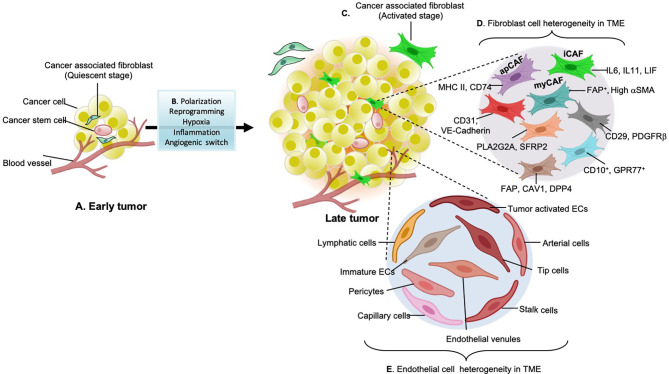
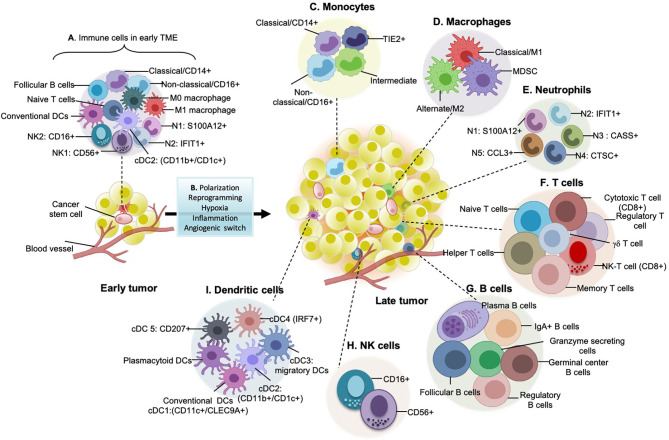
The molecular understanding of carcinogenesis and tumor progression rests in intra and inter-tumoral heterogeneity. Solid tumors confined with vast diversity of genetic abnormalities, epigenetic modifications, and environmental cues that differ at each stage from tumor initiation, progression, and metastasis. Complexity within tumors studied by conventional molecular techniques fails to identify different subclasses in stromal and immune cells in individuals and that affects immunotherapies. Here we focus on diversity of stromal cell population and immune inhabitants, whose subtypes create the complexity of tumor microenvironment (TME), leading primary tumors towards advanced-stage cancers. Recent advances in single-cell sequencing (epitope profiling) approach circumscribes phenotypic markers, molecular pathways, and evolutionary trajectories of an individual cell. We discussed the current knowledge of stromal and immune cell subclasses at different stages of cancer development with the regulatory role of non-coding RNAs. Finally, we reported the current therapeutic options in immunotherapies, advances in therapies targeting heterogeneity, and possible outcomes.
对癌症发生和肿瘤进展的分子理解取决于肿瘤内和肿瘤间的异质性。实体瘤存在大量不同的基因异常、表观遗传修饰以及在肿瘤起始、进展和转移的每个阶段都不同的环境线索。通过传统分子技术研究的肿瘤内部的复杂性未能识别个体中基质细胞和免疫细胞的不同亚类,而这会影响免疫疗法。在这里,我们关注基质细胞群体和免疫细胞群的多样性,其亚型造成了肿瘤微环境(TME)的复杂性,导致原发性肿瘤发展为晚期癌症。单细胞测序(表位分析)方法的最新进展界定了单个细胞的表型标记、分子途径和进化轨迹。我们讨论了癌症发展不同阶段基质细胞和免疫细胞亚类的当前知识以及非编码RNA的调节作用。最后,我们报告了免疫疗法中的当前治疗选择、针对异质性的治疗进展以及可能的结果。