Key Lab for Immunology in Universities of Shandong Province, School of Basic Medical Sciences, Weifang Medical University, Weifang, China.
School of Pharmaceutical Sciences, Cheeloo College of Medicine, Institute of Immunopharmaceutical Sciences, Shandong University, Jinan, China.
Front Immunol. 2021 Mar 12;12:624687. doi: 10.3389/fimmu.2021.624687. eCollection 2021.
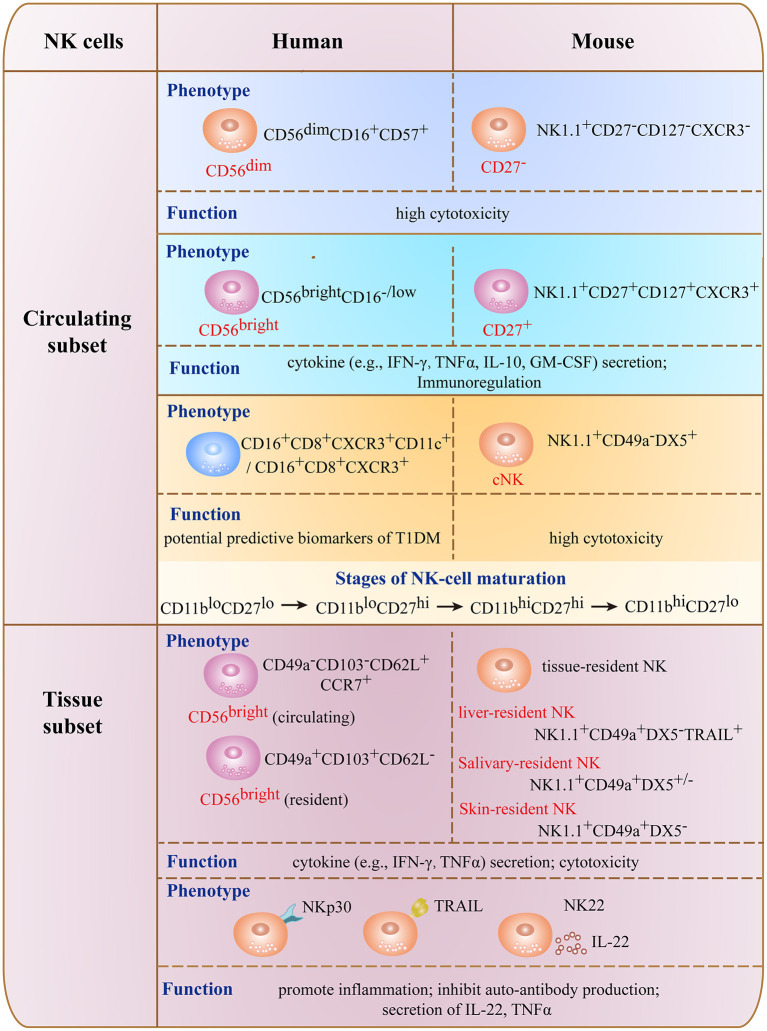
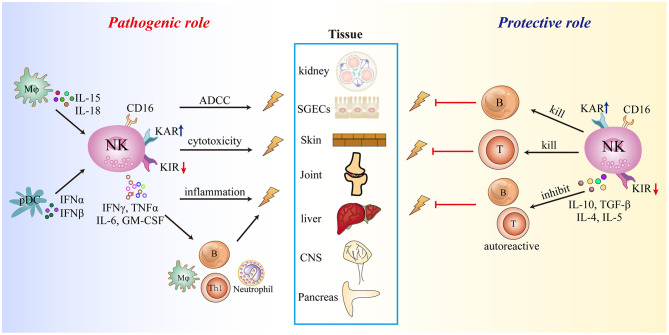
Autoimmune diseases generally result from the loss of self-tolerance (i.e., failure of the immune system to distinguish self from non-self), and are characterized by autoantibody production and hyperactivation of T cells, which leads to damage of specific or multiple organs. Thus, autoimmune diseases can be classified as organ-specific or systemic. Genetic and environmental factors contribute to the development of autoimmunity. Recent studies have demonstrated the contribution of innate immunity to the onset of autoimmune diseases. Natural killer (NK) cells, which are key components of the innate immune system, have been implicated in the development of multiple autoimmune diseases such as systemic lupus erythematosus, type I diabetes mellitus, and autoimmune liver disease. However, NK cells have both protective and pathogenic roles in autoimmunity depending on the NK cell subset, microenvironment, and disease type or stage. In this work, we review the current knowledge of the varied roles of NK cell subsets in systemic and organic-specific autoimmune diseases and their clinical potential as therapeutic targets.
自身免疫性疾病通常是由于自身耐受丧失(即免疫系统无法区分自身和非自身)引起的,其特征是自身抗体的产生和 T 细胞的过度激活,导致特定或多个器官的损伤。因此,自身免疫性疾病可以分为器官特异性或系统性。遗传和环境因素有助于自身免疫的发展。最近的研究表明,先天免疫对自身免疫性疾病的发病有贡献。自然杀伤 (NK) 细胞是先天免疫系统的关键组成部分,已被牵连到多种自身免疫性疾病的发展中,如系统性红斑狼疮、1 型糖尿病和自身免疫性肝病。然而,NK 细胞在自身免疫中具有保护和致病作用,这取决于 NK 细胞亚群、微环境以及疾病类型或阶段。在这项工作中,我们综述了 NK 细胞亚群在系统性和器官特异性自身免疫性疾病中的不同作用及其作为治疗靶点的临床潜力。