Department of Community & Mental Health, College of Nursing, Sultan Qaboos University, Muscat, Oman.
Department of Psychiatry, Kasturba Medical College, Manipal Academy of Higher Education, Udupi, India.
Sultan Qaboos Univ Med J. 2021 Feb;21(1):e58-e65. doi: 10.18295/squmj.2021.21.01.008. Epub 2021 Mar 15.
Patients with chronic kidney disease (CKD) undergoing haemodialysis often experience a myriad of psychosocial problems, resulting in poor adherence to their therapeutic regimen. This study aimed to examine the effect of cognitive behaviour therapy (CBT) on dialysis, fluid, drug and diet adherence among a previously reported sample of CKD patients undergoing haemodialysis.
A randomised controlled trial was conducted between January 2013 to Febrary 2014 on a random selection of 67 CKD patients attending a tertiary multispecialty hospital in India. The experimental group (n = 33) was exposed to CBT, whereas the control group (n = 34) received non-directive counselling. A haemodialysis adherence scale was developed and used to assess adherence to the treatment regimen. The effect size was calculated using Cohen's d statistics.
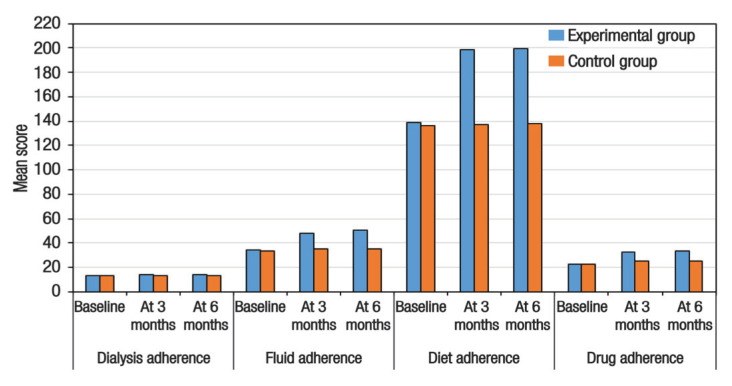
At six months, mean reductions from baseline were observed in the experimental group in terms of interdialytic weight gain (-1.23 kg; effect size: 0.57), systolic blood pressure (-22.18 mmHg; effect size: 0.71) and diastolic blood pressure (-10.06 mmHg; effect size: 0.72), whereas mean increases were noted in haemoglobin (+0.75 g/dL; effect size: 0.31) and adherence to dialysis (+0.94; effect size: 0.51), fluids (+16.34; effect size: 2.30), diet (+61.19; effect size: 4.75) and drugs (+10.73; effect size: 1.3). Differences from baseline were significantly higher in the experimental group compared to the control group ( = 0.001 each).
These results show that CBT is more effective than non-directive counselling for improving therapeutic adherence and physiological, clinical parameters among CKD patients undergoing haemodialysis.
患有慢性肾脏病(CKD)并接受血液透析的患者经常会经历各种心理社会问题,导致他们对治疗方案的依从性较差。本研究旨在检查认知行为疗法(CBT)对先前报告的接受血液透析的 CKD 患者样本中的透析、液体、药物和饮食依从性的影响。
2013 年 1 月至 2014 年 2 月期间,在印度一家三级多专科医院,对随机选择的 67 名 CKD 患者进行了一项随机对照试验。实验组(n = 33)接受 CBT,对照组(n = 34)接受非指导咨询。开发了一种血液透析依从性量表,用于评估治疗方案的依从性。使用 Cohen's d 统计计算效应大小。
在六个月时,实验组从基线观察到的平均减少是透间体重增加(-1.23 公斤;效应大小:0.57)、收缩压(-22.18 毫米汞柱;效应大小:0.71)和舒张压(-10.06 毫米汞柱;效应大小:0.72),而血红蛋白(+0.75 克/分升;效应大小:0.31)和透析(+0.94;效应大小:0.51)、液体(+16.34;效应大小:2.30)、饮食(+61.19;效应大小:4.75)和药物(+10.73;效应大小:1.3)的平均增加。与对照组相比,实验组从基线开始的差异具有统计学意义(均为 P < 0.001)。
这些结果表明,CBT 比非指导咨询更有效,可以提高接受血液透析的 CKD 患者的治疗依从性和生理、临床参数。