2LPN-CEMA Group (Cognition-EMotion-Action), Lorraine University, EA 7489, F-57070 Metz, France.
Department of Neuroscience & Movement Science, University of Fribourg, CH-1700 Fribourg, Switzerland.
Sensors (Basel). 2021 Mar 11;21(6):1957. doi: 10.3390/s21061957.
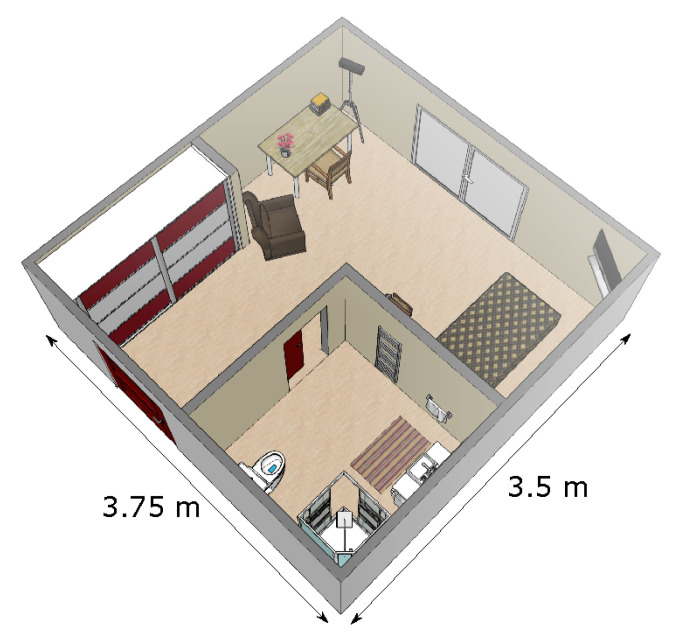
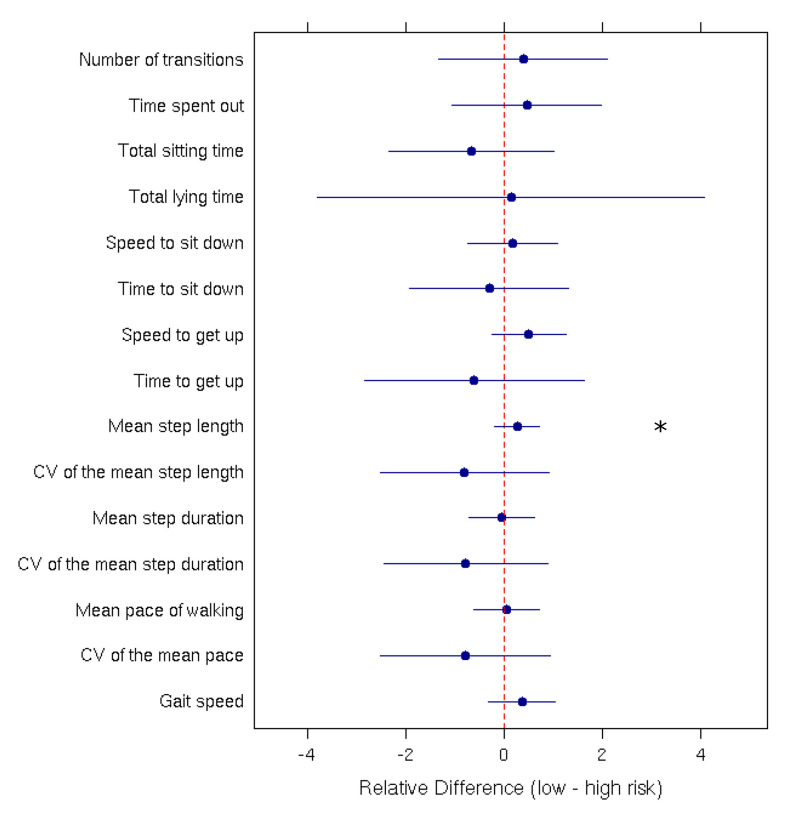
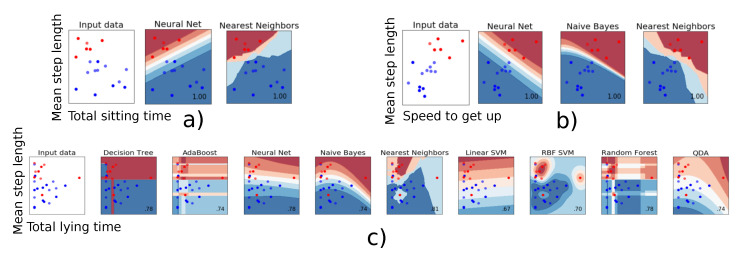
Because of population ageing, fall prevention represents a human, economic, and social issue. Currently, fall-risk is assessed infrequently, and usually only after the first fall occurrence. Home monitoring could improve fall prevention. Our aim was to monitor daily activities at home in order to identify the behavioral parameters that best discriminate high fall risk from low fall risk individuals. Microsoft Kinect sensors were placed in the room of 30 patients temporarily residing in a rehabilitation center. The sensors captured the patients' movements while they were going about their daily activities. Different behavioral parameters, such as speed to sit down, gait speed or total sitting time were extracted and analyzed combining statistical and machine learning algorithms. Our algorithms classified the patients according to their estimated fall risk. The automatic fall risk assessment performed by the algorithms was then benchmarked against fall risk assessments performed by clinicians using the Tinetti test and the Timed Up and Go test. Step length, sit-stand transition and total sitting time were the most discriminant parameters to classify patients according to their fall risk. Coupling step length to the speed required to stand up or the total sitting time gave rise to an error-less classification of the patients, i.e., to the same classification as that of the clinicians. A monitoring system extracting step length and sit-stand transitions at home could complement the clinicians' assessment toolkit and improve fall prevention.
由于人口老龄化,跌倒预防成为了一个涉及人类、经济和社会的问题。目前,跌倒风险评估的频率较低,通常仅在首次跌倒发生后进行。家庭监测可以改善跌倒预防。我们的目的是监测家庭中的日常活动,以确定能够最好地区分高跌倒风险和低跌倒风险个体的行为参数。我们在 30 名暂时居住在康复中心的患者的房间内放置了 Microsoft Kinect 传感器。传感器在患者进行日常活动时捕捉他们的动作。提取并分析了不同的行为参数,如坐下的速度、步态速度或总坐姿时间等,并结合统计和机器学习算法进行分析。我们的算法根据患者的跌倒风险对其进行分类。然后,将算法自动进行的跌倒风险评估与临床医生使用 Tinetti 测试和计时起立行走测试进行的跌倒风险评估进行基准比较。步长、坐站转换和总坐姿时间是根据跌倒风险对患者进行分类的最具判别力的参数。将步长与站立所需的速度或总坐姿时间相结合,可以实现对患者的无错误分类,即与临床医生的分类相同。在家中提取步长和坐站转换的监测系统可以补充临床医生的评估工具包并改善跌倒预防。