
网络受害与青少年网络成瘾:一个有调节的中介模型
Cybervictimization and Adolescent Internet Addiction: A Moderated Mediation Model.
作者信息
Xin Mucheng, Chen Pei, Liang Qiao, Yu Chengfu, Zhen Shuangju, Zhang Wei
机构信息
Department of Psychology and Research Center of Adolescent Psychology and Behavior, School of Education, Guangzhou University, Guangzhou 510006, China.
School of Psychology and Center for Studies of Psychological Application, South China Normal University, Guangzhou 510631, China.
出版信息
Int J Environ Res Public Health. 2021 Mar 2;18(5):2427. doi: 10.3390/ijerph18052427.
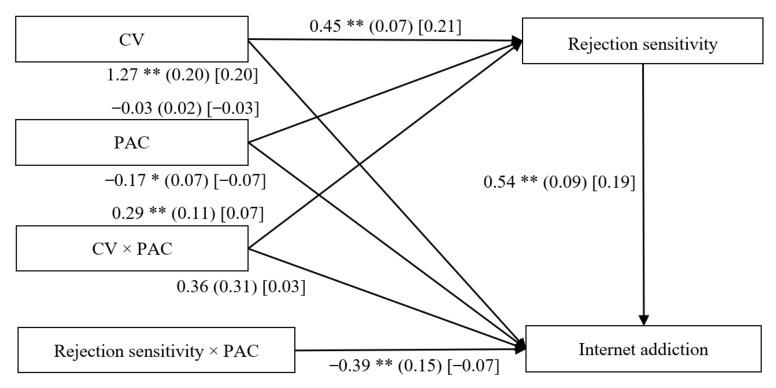
Previous research indicates that cybervictimization can lead to adolescent Internet addiction; however, there is a gap in the knowledge about the mediating and moderating variables facilitating this relationship. This study examines the role of rejection sensitivity as a mediator in this relationship and the role of parent-adolescent communication as a moderator for this mediation effect among Chinese adolescents. Participants were 1006 adolescents (M = 13.16 years, SD = 0.67), who completed the questionnaires anonymously. The questionnaires assessed the four variables of interest. Descriptive statistics and structural equation modeling were used for data analysis. The results show that the positive association between cybervictimization and adolescent Internet addiction is mediated by rejection sensitivity. Moreover, this indirect effect is stronger for adolescents with low parent-adolescent communication than for those with high parent-adolescent communication.
以往的研究表明,网络欺凌会导致青少年网络成瘾;然而,在促进这种关系的中介变量和调节变量方面,我们的认知还存在差距。本研究考察了拒绝敏感性在这种关系中作为中介变量的作用,以及亲子沟通在这种中介效应中作为调节变量在中国青少年中的作用。研究参与者为1006名青少年(M = 13.16岁,SD = 0.67),他们以匿名方式完成了问卷。问卷评估了四个感兴趣的变量。数据分析采用描述性统计和结构方程模型。结果表明,网络欺凌与青少年网络成瘾之间的正相关关系是由拒绝敏感性介导的。此外,对于亲子沟通较少的青少年,这种间接效应比亲子沟通较多的青少年更强。



 Zotero 插件