Amri Chaima, Shukla Arvind Kumar, Lee Jin-Ho
Department of Convergence Medical Sciences, School of Medicine, Pusan National University, Yangsan 50612, Korea.
School of Biomedical Convergence Engineering, Pusan National University, Yangsan 50612, Korea.
Materials (Basel). 2021 Mar 10;14(6):1339. doi: 10.3390/ma14061339.
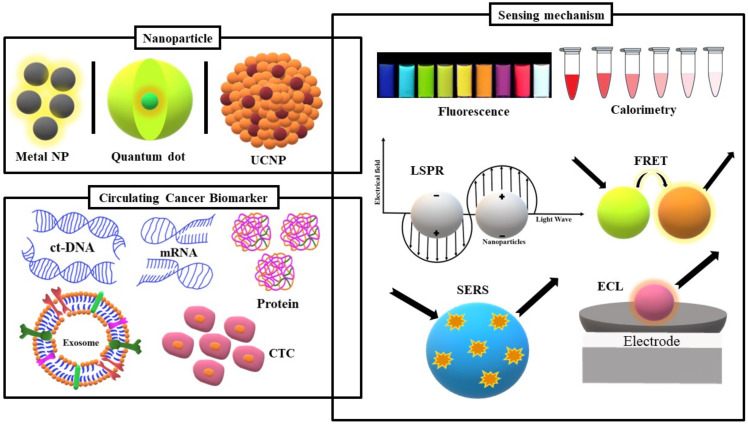
The effectiveness of cancer treatment strongly depends on the early detection of the disease. Currently, the most common diagnostic method, tissue biopsy, takes time and can be damaging to the patient. Circulating cancer biomarkers such as circulating tumor DNA, micro-RNA (miRNA), tumor proteins, exosomes, and circulating tumor cells have repeatedly demonstrated their viability as targets for minimally invasive cancer detection through liquid biopsies. However, among other things, achieving a great sensitivity of detection is still challenging due to the very low concentration of biomarkers in fluid samples. This review will discuss how the recent advances in nanoparticle-based biosensors are overcoming these practical difficulties. This report will be focusing mainly on optical transduction mechanisms of metal nanoparticles (M-NPs), quantum dots (QDs), and upconversion nanoparticles (UCNPs).
癌症治疗的有效性很大程度上取决于疾病的早期检测。目前,最常见的诊断方法——组织活检,耗时较长且可能对患者造成损害。循环肿瘤DNA、微小RNA(miRNA)、肿瘤蛋白、外泌体和循环肿瘤细胞等循环癌症生物标志物已多次证明,它们作为通过液体活检进行微创癌症检测的靶点具有可行性。然而,除其他因素外,由于液体样本中生物标志物的浓度极低,实现高检测灵敏度仍具有挑战性。本综述将讨论基于纳米颗粒的生物传感器的最新进展如何克服这些实际困难。本报告将主要聚焦于金属纳米颗粒(M-NP)、量子点(QD)和上转换纳米颗粒(UCNP)的光学转导机制。