Tang Kai, Xin Ying, Li Keming, Chen Xi, Tan Youhua
Shenzhen Research Institute, The Hong Kong Polytechnic University, Shenzhen 518000, China.
Department of Biomedical Engineering, The Hong Kong Polytechnic University, Hong Kong 999077, China.
Biology (Basel). 2021 Mar 25;10(4):259. doi: 10.3390/biology10040259.
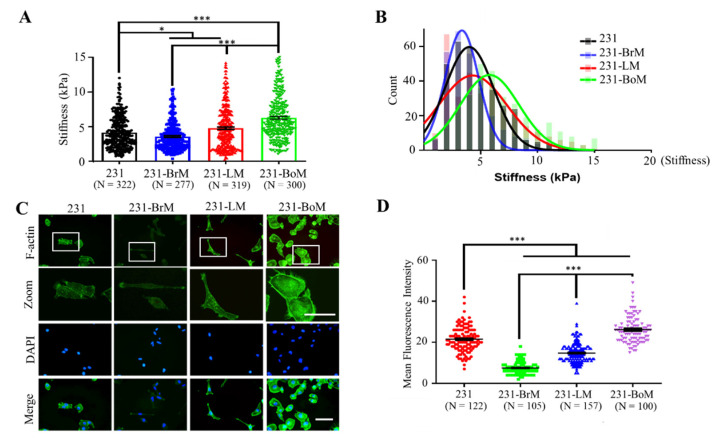
Tumor metastasis involves the dissemination of tumor cells from the primary lesion to other organs and the subsequent formation of secondary tumors, which leads to the majority of cancer-related deaths. Clinical findings show that cancer cell dissemination is not random but exhibits organ preference or organotropism. While intrinsic biochemical factors of cancer cells have been extensively studied in organotropism, much less is known about the role of cell cytoskeleton and mechanics. Herein, we demonstrate that cell cytoskeleton and mechanics are correlated with organotropism. The result of cell stiffness measurements shows that breast cancer cells with bone tropism are much stiffer with enhanced F-actin, while tumor cells with brain tropism are softer with lower F-actin than their parental cells. The difference in cellular stiffness matches the difference in the rigidity of their metastasized organs. Further, disrupting the cytoskeleton of breast cancer cells with bone tropism not only elevates the expressions of brain metastasis-related genes but also increases cell spreading and proliferation on soft substrates mimicking the stiffness of brain tissue. Stabilizing the cytoskeleton of cancer cells with brain tropism upregulates bone metastasis-related genes while reduces the mechanoadaptation ability on soft substrates. Taken together, these findings demonstrate that cell cytoskeleton and biophysical properties of breast cancer subpopulations correlate with their metastatic preference in terms of gene expression pattern and mechanoadaptation ability, implying the potential role of cell cytoskeleton in organotropism.
肿瘤转移涉及肿瘤细胞从原发灶扩散到其他器官并随后形成继发性肿瘤,这导致了大多数与癌症相关的死亡。临床研究结果表明,癌细胞的扩散并非随机发生,而是表现出器官偏好性或器官趋向性。虽然癌细胞的内在生化因素在器官趋向性方面已得到广泛研究,但关于细胞细胞骨架和力学的作用却知之甚少。在此,我们证明细胞细胞骨架和力学与器官趋向性相关。细胞硬度测量结果显示,具有骨趋向性的乳腺癌细胞硬度更高,F-肌动蛋白增强,而具有脑趋向性的肿瘤细胞比其亲代细胞更软,F-肌动蛋白含量更低。细胞硬度的差异与其转移器官的硬度差异相匹配。此外,破坏具有骨趋向性的乳腺癌细胞的细胞骨架不仅会提高脑转移相关基因的表达,还会增加细胞在模拟脑组织硬度的软基质上的铺展和增殖。稳定具有脑趋向性的癌细胞的细胞骨架会上调骨转移相关基因,同时降低在软基质上的机械适应能力。综上所述,这些发现表明乳腺癌亚群的细胞细胞骨架和生物物理特性在基因表达模式和机械适应能力方面与其转移偏好相关,这意味着细胞细胞骨架在器官趋向性中具有潜在作用。