Faculté de Pharmacie, Université Laval, Québec, QC G1V 0A6, Canada.
Axe Neurosciences, Centre de Recherche du CHU de Québec-Université Laval, Québec, QC G1V 4G2, Canada.
Int J Mol Sci. 2021 Mar 25;22(7):3356. doi: 10.3390/ijms22073356.
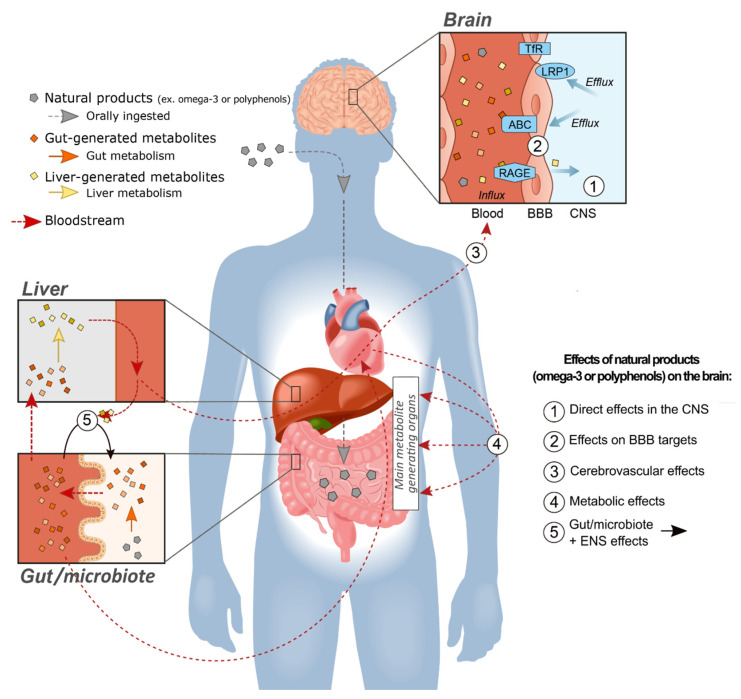
The scope of evidence on the neuroprotective impact of natural products has been greatly extended in recent years. However, a key question that remains to be answered is whether natural products act directly on targets located in the central nervous system (CNS), or whether they act indirectly through other mechanisms in the periphery. While molecules utilized for brain diseases are typically bestowed with a capacity to cross the blood-brain barrier, it has been recently uncovered that peripheral metabolism impacts brain functions, including cognition. The gut-microbiota-brain axis is receiving increasing attention as another indirect pathway for orally administered compounds to act on the CNS. In this review, we will briefly explore these possibilities focusing on two classes of natural products: omega-3 polyunsaturated fatty acids (n-3 PUFAs) from marine sources and polyphenols from plants. The former will be used as an example of a natural product with relatively high brain bioavailability but with tightly regulated transport and metabolism, and the latter as an example of natural compounds with low brain bioavailability, yet with a growing amount of preclinical and clinical evidence of efficacy. In conclusion, it is proposed that bioavailability data should be sought early in the development of natural products to help identifying relevant mechanisms and potential impact on prevalent CNS disorders, such as Alzheimer's disease.
近年来,关于天然产物的神经保护作用的证据范围已经大大扩展。然而,一个仍然需要回答的关键问题是,天然产物是直接作用于中枢神经系统(CNS)中的靶标,还是通过外周的其他机制间接作用。虽然用于脑部疾病的分子通常被赋予穿过血脑屏障的能力,但最近发现外周代谢会影响包括认知在内的大脑功能。肠道微生物群-大脑轴作为另一种间接途径,越来越受到关注,口服化合物通过该途径作用于中枢神经系统。在这篇综述中,我们将简要探讨这些可能性,重点关注两类天然产物:来自海洋的ω-3 多不饱和脂肪酸(n-3 PUFAs)和来自植物的多酚。前者将被用作具有相对较高脑生物利用度但受严格调控的运输和代谢的天然产物的示例,后者则被用作脑生物利用度较低但具有越来越多的临床前和临床疗效证据的天然化合物的示例。总之,建议在天然产物的开发早期就寻求生物利用度数据,以帮助确定相关机制以及对常见中枢神经系统疾病(如阿尔茨海默病)的潜在影响。