Park Jiyong, Park Sangbae, Kim Jae Eun, Jang Kyoung-Je, Seonwoo Hoon, Chung Jong Hoon
Department of Biosystems Engineering, College of Agriculture and Life Sciences, Seoul National University, Seoul 08826, Korea.
Department of Biosystems & Biomaterials Science and Engineering, Seoul National University, Seoul 08826, Korea.
Polymers (Basel). 2021 Mar 5;13(5):797. doi: 10.3390/polym13050797.
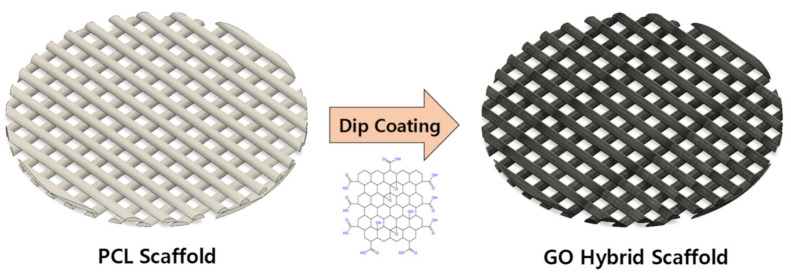
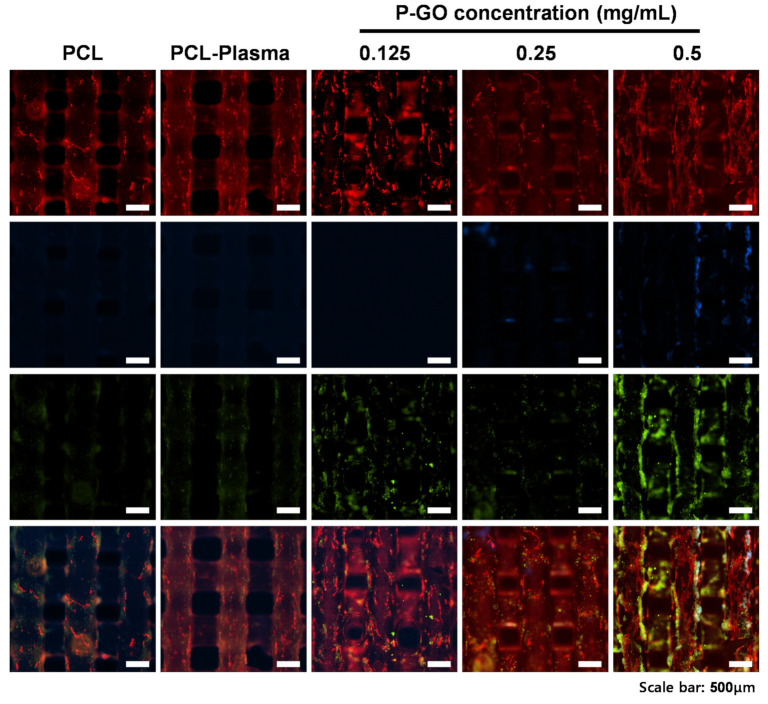
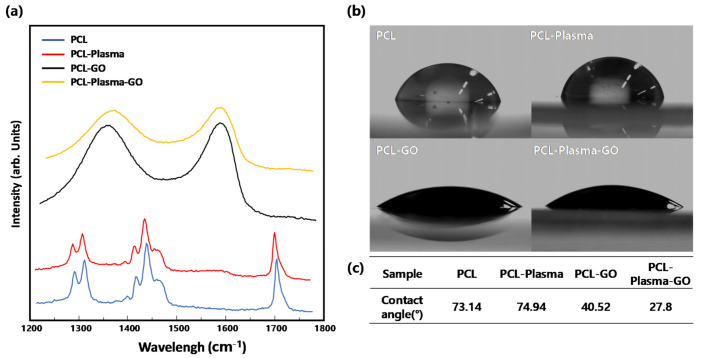
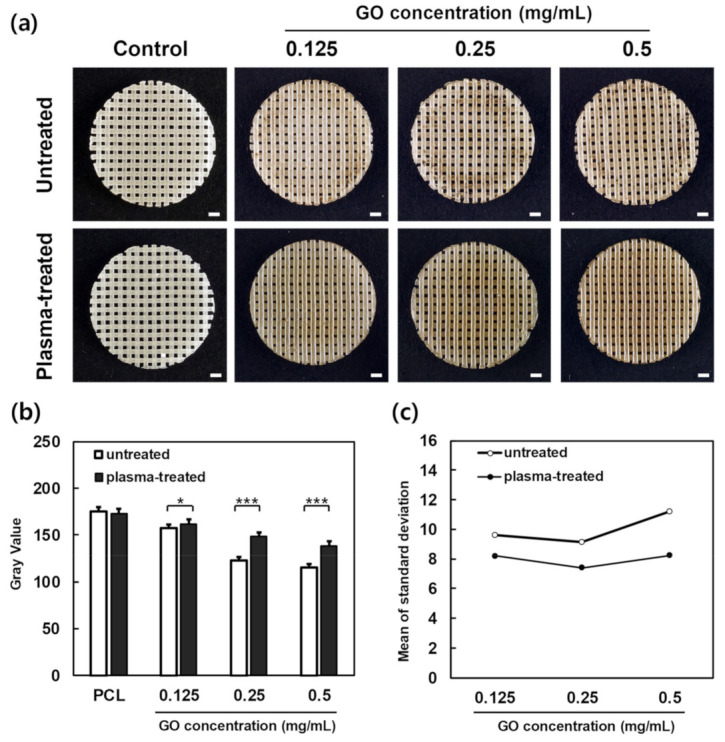
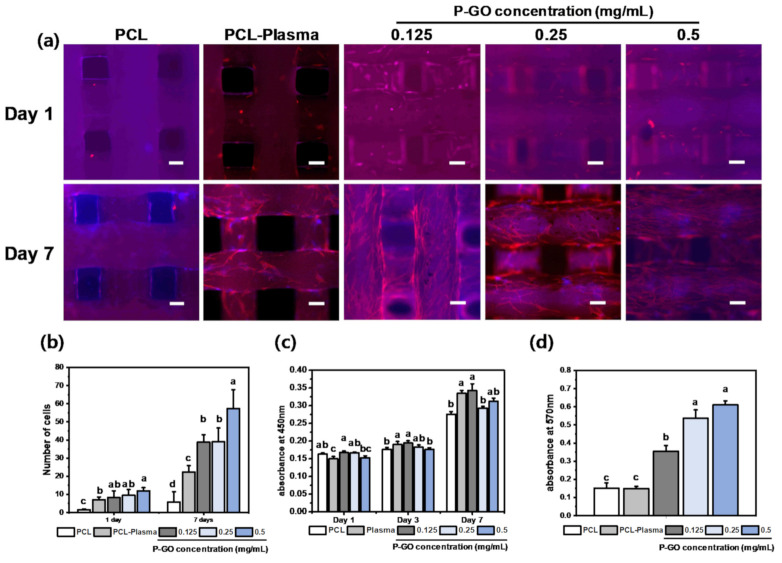
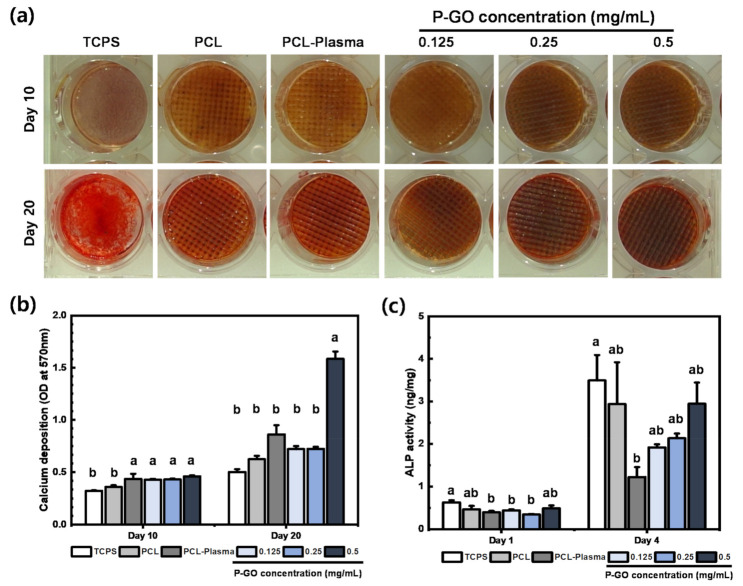
Periodontal diseases occur through bacterial infection in the oral cavity, which can cause alveolar bone loss. Several efforts have been made to reconstruct alveolar bone, such as grafting bone substitutes and 3D-printed scaffolds. Poly(ε-caprolactone) (PCL) is biocompatible and biodegradable, thus demonstrating its potential as a biomaterial substitute; however, it is difficult for cells to adhere to PCL because of its strong hydrophobicity. Therefore, its use as a biomaterial has limitations. In this study, we used graphene oxide (GO) as a coating material to promote the osteogenic differentiation ability of PCL scaffolds. First, 3D-printed PCL scaffolds were fabricated, and the oxygen plasma treatment and coating conditions were established according to the concentration of GO. The physical and chemical properties of the prepared scaffolds were evaluated through water contact angle analysis, Raman spectroscopy, and image analysis. In addition, the adhesion and proliferation of periodontal ligament stem cells (PDLSCs) on the GO scaffolds were assessed via the water-soluble tetrazolium salt-1 (WST-1) assay, and the osteogenic differentiation ability was evaluated through alizarin red S staining. The results confirmed that the cell proliferation and osteogenic differentiation of the PDLSCs were enhanced in the scaffolds coated with oxygen plasma and GO. In conclusion, the plasma-treated GO-coating method that we developed can be used to promote the cell proliferation and osteogenic differentiation of the scaffolds.
牙周疾病通过口腔中的细菌感染发生,这会导致牙槽骨丧失。人们已经做出了多项努力来重建牙槽骨,例如移植骨替代物和3D打印支架。聚(ε-己内酯)(PCL)具有生物相容性和可生物降解性,因此显示出其作为生物材料替代品的潜力;然而,由于其强疏水性,细胞很难附着在PCL上。因此,它作为生物材料的应用存在局限性。在本研究中,我们使用氧化石墨烯(GO)作为涂层材料来促进PCL支架的成骨分化能力。首先,制备了3D打印的PCL支架,并根据GO的浓度确定了氧等离子体处理和涂层条件。通过水接触角分析、拉曼光谱和图像分析对制备的支架的物理和化学性质进行了评估。此外,通过水溶性四氮唑盐-1(WST-1)测定评估了牙周膜干细胞(PDLSCs)在GO支架上的粘附和增殖,并通过茜素红S染色评估了成骨分化能力。结果证实,在涂有氧等离子体和GO的支架中,PDLSCs的细胞增殖和成骨分化得到了增强。总之,我们开发的等离子体处理的GO涂层方法可用于促进支架的细胞增殖和成骨分化。