Park Sangbae, Kim Jae Eun, Han Jinsub, Jeong Seung, Lim Jae Woon, Lee Myung Chul, Son Hyunmok, Kim Hong Bae, Choung Yun-Hoon, Seonwoo Hoon, Chung Jong Hoon, Jang Kyoung-Je
Department of Biosystems & Biomaterials Science and Engineering, Seoul National University, Seoul 08826, Korea.
Department of Biosystems Engineering, Seoul National University, Seoul 08826, Korea.
Polymers (Basel). 2021 Jan 14;13(2):257. doi: 10.3390/polym13020257.
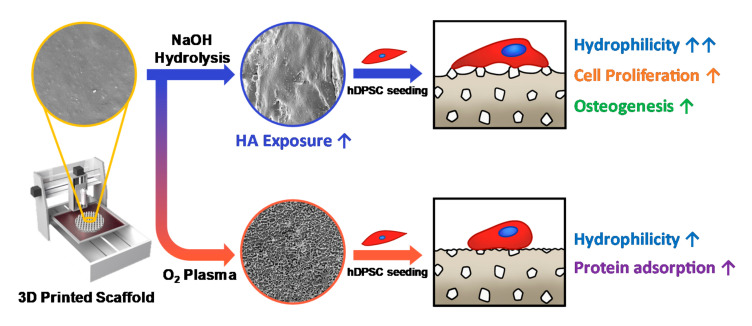
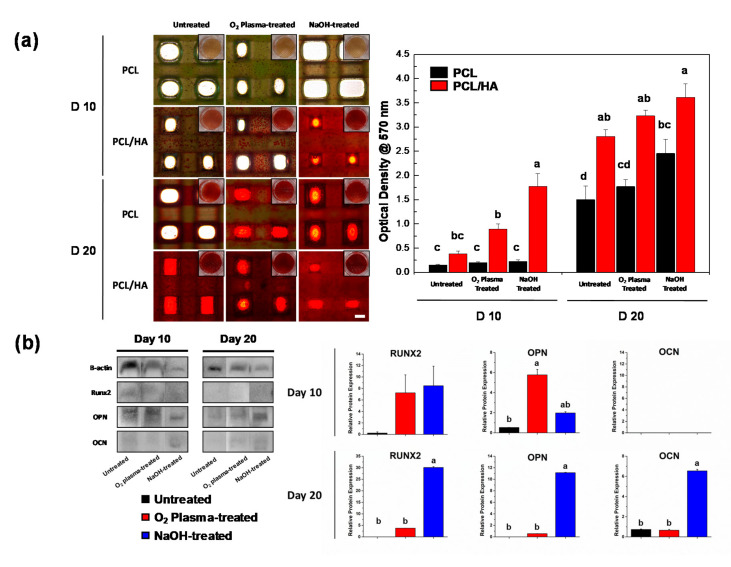
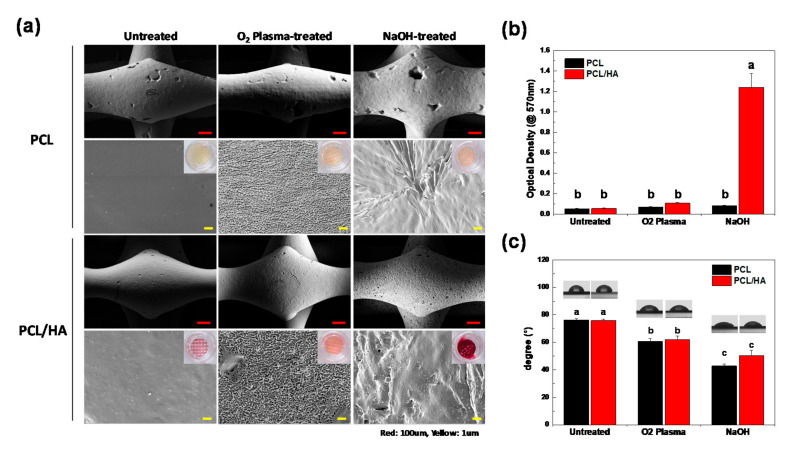
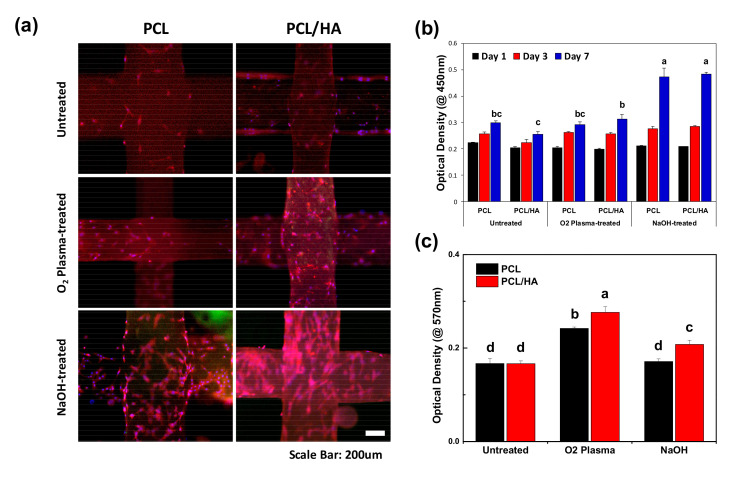
The 3D-printed bioactive ceramic incorporated Poly(ε-caprolactone) (PCL) scaffolds show great promise as synthetic bone graft substitutes. However, 3D-printed scaffolds still lack adequate surface properties for cells to be attached to them. In this study, we modified the surface characteristics of 3D-printed poly(ε-caprolactone)/hydroxyapatite scaffolds using O2 plasma and sodium hydroxide. The surface property of the alkaline hydrolyzed and O2 plasma-treated PCL/HA scaffolds were evaluated using field-emission scanning microscopy (FE-SEM), Alizarin Red S (ARS) staining, and water contact angle analysis, respectively. The in vitro behavior of the scaffolds was investigated using human dental pulp-derived stem cells (hDPSCs). Cell proliferation of hDPSCs on the scaffolds was evaluated via immunocytochemistry (ICC) and water-soluble tetrazolium salt (WST-1) assay. Osteogenic differentiation of hDPSCs on the scaffolds was further investigated using ARS staining and Western blot analysis. The result of this study shows that alkaline treatment is beneficial for exposing hydroxyapatite particles embedded in the scaffolds compared to O2 plasma treatment, which promotes cell proliferation and differentiation of hDPSCs.
3D打印的生物活性陶瓷增强聚己内酯(PCL)支架作为合成骨移植替代物显示出巨大的潜力。然而,3D打印的支架仍然缺乏足够的表面特性以供细胞附着。在本研究中,我们使用氧气等离子体和氢氧化钠对3D打印的聚己内酯/羟基磷灰石支架的表面特性进行了改性。分别使用场发射扫描显微镜(FE-SEM)、茜素红S(ARS)染色和水接触角分析对经碱水解和氧气等离子体处理的PCL/HA支架的表面性能进行了评估。使用人牙髓来源的干细胞(hDPSCs)研究了支架的体外行为。通过免疫细胞化学(ICC)和水溶性四唑盐(WST-1)测定评估了hDPSCs在支架上的细胞增殖。使用ARS染色和蛋白质印迹分析进一步研究了hDPSCs在支架上的成骨分化。本研究结果表明,与氧气等离子体处理相比,碱处理有利于暴露嵌入支架中的羟基磷灰石颗粒,从而促进hDPSCs的细胞增殖和分化。