Seo Dong-Woo, Yi Hahn, Bae Hyun-Jin, Kim Youn-Jung, Sohn Chang-Hwan, Ahn Shin, Lim Kyoung-Soo, Kim Namkug, Kim Won-Young
Asan Medical Center, Department of Emergency Medicine, College of Medicine, University of Ulsan, Seoul 05505, Korea.
Asan Medical Center, Department of Information Medicine, College of Medicine, University of Ulsan, Seoul 05505, Korea.
J Clin Med. 2021 Mar 5;10(5):1089. doi: 10.3390/jcm10051089.
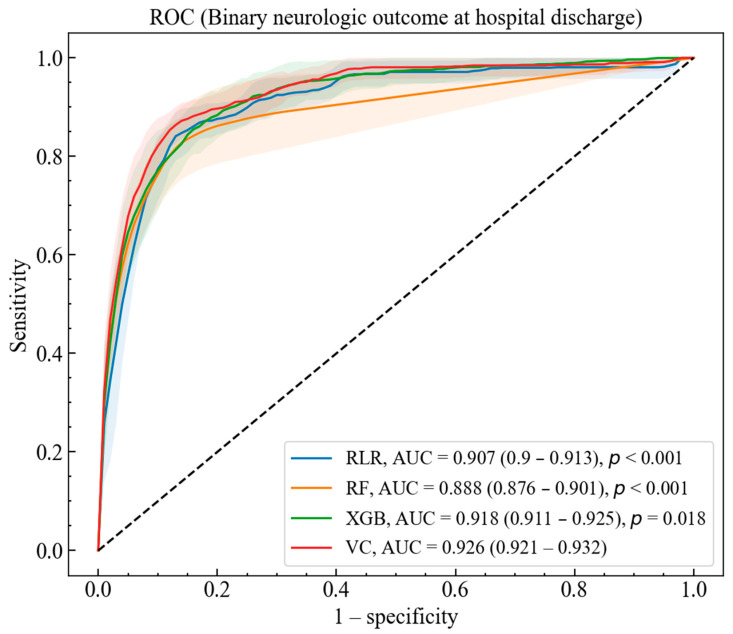
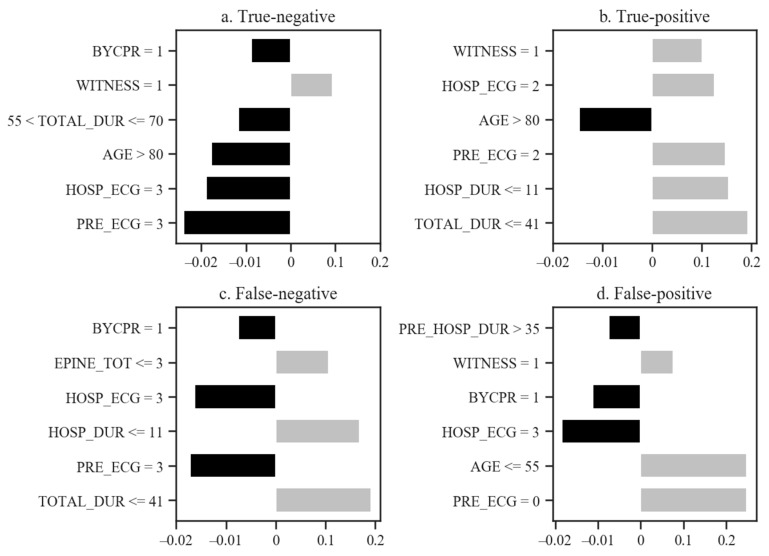
Current multimodal approaches for the prognostication of out-of-hospital cardiac arrest (OHCA) are based mainly on the prediction of poor neurological outcomes; however, it is challenging to identify patients expected to have a favorable outcome, especially before the return of spontaneous circulation (ROSC). We developed and validated a machine learning-based system to predict good outcome in OHCA patients before ROSC. This prospective, multicenter, registry-based study analyzed non-traumatic OHCA data collected between October 2015 and June 2017. We used information available before ROSC as predictor variables, and the primary outcome was neurologically intact survival at discharge, defined as cerebral performance category 1 or 2. The developed models' robustness were evaluated and compared with various score metrics to confirm their performance. The model using a voting classifier had the best performance in predicting good neurological outcome (area under the curve = 0.926). We confirmed that the six top-weighted variables predicting neurological outcomes, such as several duration variables after the instant of OHCA and several electrocardiogram variables in the voting classifier model, showed significant differences between the two neurological outcome groups. These findings demonstrate the potential utility of a machine learning model to predict good neurological outcome of OHCA patients before ROSC.
目前用于院外心脏骤停(OHCA)预后评估的多模态方法主要基于对不良神经学预后的预测;然而,识别预期有良好预后的患者具有挑战性,尤其是在自主循环恢复(ROSC)之前。我们开发并验证了一种基于机器学习的系统,用于预测ROSC前OHCA患者的良好预后。这项前瞻性、多中心、基于注册登记的研究分析了2015年10月至2017年6月期间收集的非创伤性OHCA数据。我们将ROSC前可用的信息用作预测变量,主要结局是出院时神经功能完好存活,定义为脑功能分级为1或2级。对所开发模型的稳健性进行评估,并与各种评分指标进行比较以确认其性能。使用投票分类器的模型在预测良好神经学预后方面表现最佳(曲线下面积 = 0.926)。我们证实,预测神经学预后的六个权重最高的变量,如OHCA发生瞬间后的几个持续时间变量以及投票分类器模型中的几个心电图变量,在两个神经学预后组之间存在显著差异。这些发现证明了机器学习模型在预测ROSC前OHCA患者良好神经学预后方面的潜在效用。