Department of Sport Sciences, University of Beira Interior, 6201-001 Covilhã, Portugal.
Research Centre in Sports, Health and Human Development, CIDESD, 6201-001 Covilhã, Portugal.
Int J Environ Res Public Health. 2021 Mar 30;18(7):3569. doi: 10.3390/ijerph18073569.
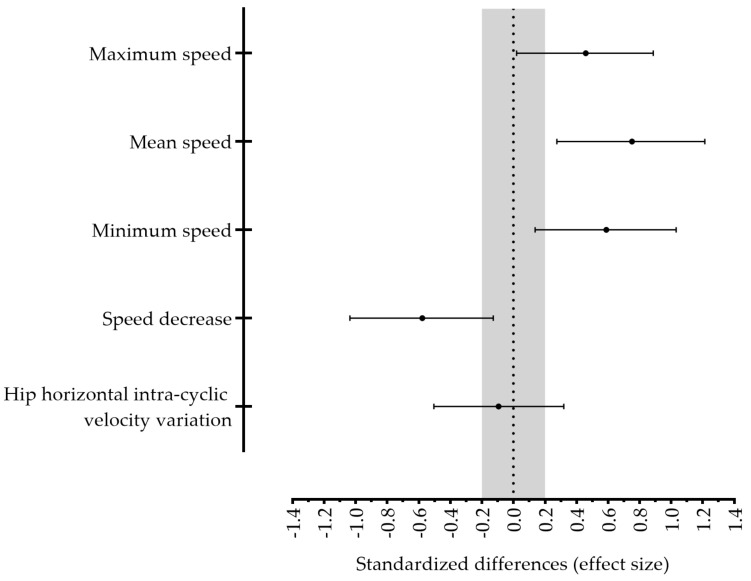
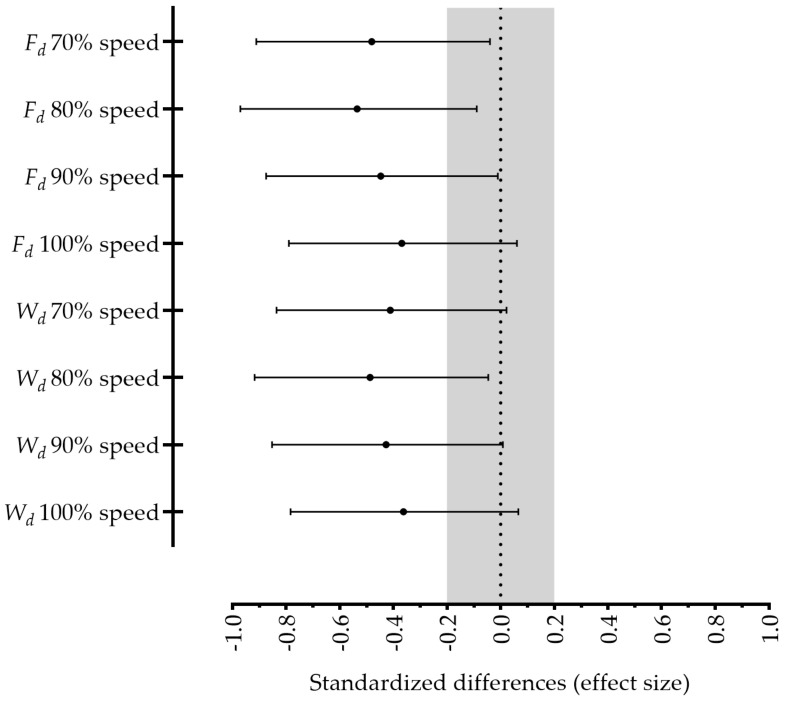
This study aimed to analyze the effects of a swimming training mesocycle in master swimmers' performance and active drag. Twenty-two 39.87 ± 6.10 year-old master swimmers performed a 25 m front crawl at maximal intensity before and after a typical four-week training mesocycle. Maximum, mean and minimum speeds, speed decrease and hip horizontal intra-cyclic velocity variation were assessed using an electromechanical speedometer, and the active drag and power to overcome drag were determined using the measuring active drag system. Maximum, mean and minimum front crawl speeds improved from pre- to post-training (mean ± 95% CI: 3.1 ± 2.8%, = 0.04; 2.9 ± 1.6%, = 0.01; and 4.6 ± 3.1%, = 0.01; respectively) and the speed decrease along the 25 m test lowered after the training period (82.5 ± 76.3%, = 0.01). The training mesocycle caused a reduction in the active drag at speeds corresponding to 70% (5.0 ± 3.9%), 80% (5.6 ± 4.0%), and 90% (5.9 ± 4.0%), but not at 100% (5.9 ± 6.7%), of the swimmers' maximal exertions in the 25 m test. These results showed that four weeks of predominantly aerobic training could improve master swimmers' performance and reduce their hydrodynamic drag while swimming mainly at submaximal speeds.
本研究旨在分析游泳训练周期对游泳运动员表现和主动阻力的影响。22 名 39.87 ± 6.10 岁的游泳运动员在典型的四周训练周期前后以最大强度进行 25 米自由泳冲刺。使用电动速度计评估最大、平均和最小速度、速度下降以及髋关节水平周期内速度变化,使用测量主动阻力系统确定主动阻力和克服阻力的功率。最大、平均和最小自由泳速度从训练前到训练后均有所提高(平均 ± 95%置信区间:3.1 ± 2.8%, = 0.04;2.9 ± 1.6%, = 0.01;4.6 ± 3.1%, = 0.01;分别),并且在训练期间 25 米测试中的速度下降减少(82.5 ± 76.3%, = 0.01)。训练周期导致在速度对应于 70%(5.0 ± 3.9%)、80%(5.6 ± 4.0%)和 90%(5.9 ± 4.0%)的情况下,游泳运动员最大努力的 25 米测试中主动阻力降低,但在 100%(5.9 ± 6.7%)的情况下没有降低。这些结果表明,四周主要以有氧训练为主的训练可以提高游泳运动员的表现,并在主要以次最大速度游泳时降低他们的水动力阻力。