ILFOMER, Université de Limoges, Limoges, France; HAVAE, EA 6310, Université de Limoges, Limoges, France.
HAVAE, EA 6310, Université de Limoges, Limoges, France.
Mult Scler Relat Disord. 2021 Jun;51:102928. doi: 10.1016/j.msard.2021.102928. Epub 2021 Mar 28.
The current coronavirus disease (COVID-19) pandemic makes it difficult to obtain physical therapy in rehabilitation centres, particularly for persons with multiple sclerosis (pwMS), who are a population at high risk, since viral infections may contribute to MS exacerbations and relapses. Active video games could be a way to maintain physical therapy at home as part of the rehabilitation. The aim of this review is to summarise the current best evidence for the effectiveness of home-based active video games on gait and balance, user compliance, feasibility and safety for pwMS.
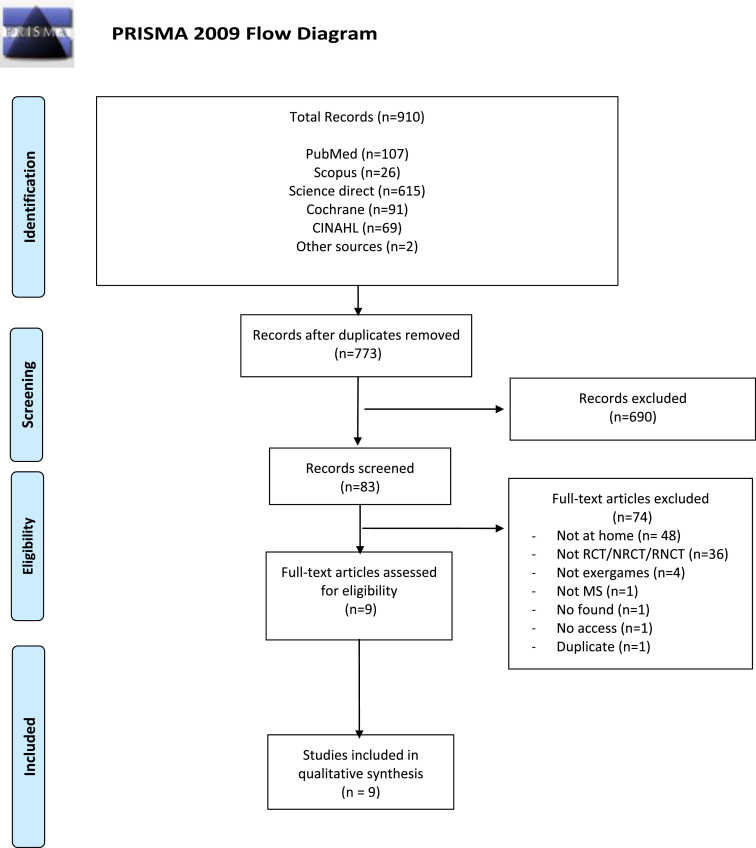
We searched for studies in five databases (PubMed, Scopus, Cochrane, CINAHL and Science direct) up to October 2020. Selection of studies, extraction of data and methodological quality assessment through the PEDro scale were made independently by two authors and discussed with a third author.
Nine studies were included in this systematic review. We found significant improvements in balance; results were mixed concerning mobility, physical activity and gait. Home-based active video games are feasible and safe, with good compliance and adherence. The methodological quality of the studies was moderate (PEDro scale: 5.3 ± 2).
Overall, home-based active video games were found safe and effective improving static and dynamic balance in pwMS. Compliance was good, probably because it is a motivating and enjoyable training. Active video games can be a relevant alternative for physical rehabilitation at home in pwMS. Future studies should follow more rigorous methodological standards (larger sample sizes, more randomised controlled trials) to improve the quality of evidence and include cost-effectiveness in the analysis.
当前的冠状病毒病(COVID-19)大流行使得在康复中心获得物理治疗变得困难,特别是对于多发性硬化症(pwMS)患者,因为病毒感染可能导致 MS 恶化和复发,他们是高危人群。积极的视频游戏可能是一种在家中维持物理治疗的方法,作为康复的一部分。本综述的目的是总结目前在家中进行积极视频游戏对 pwMS 的步态和平衡、用户依从性、可行性和安全性的最佳证据。
我们在五个数据库(PubMed、Scopus、Cochrane、CINAHL 和 Science direct)中搜索了截至 2020 年 10 月的研究。两名作者独立选择研究、提取数据并通过 PEDro 量表评估方法学质量,并与第三名作者讨论。
本系统综述纳入了 9 项研究。我们发现平衡有显著改善;关于移动性、身体活动和步态,结果则不一致。家庭积极视频游戏具有可行性和安全性,依从性和坚持性良好。研究的方法学质量为中等(PEDro 量表:5.3±2)。
总体而言,家庭积极视频游戏被发现是安全有效的,可以改善 pwMS 的静态和动态平衡。依从性良好,可能是因为它是一种有激励性和趣味性的训练。积极的视频游戏可以成为 pwMS 在家中进行物理康复的一种相关替代方法。未来的研究应遵循更严格的方法学标准(更大的样本量、更多的随机对照试验),以提高证据质量,并在分析中纳入成本效益。