Li Xueyu, Cui Kunpeng, Kurokawa Takayuki, Ye Ya Nan, Sun Tao Lin, Yu Chengtao, Creton Costantino, Gong Jian Ping
Global Station for Soft Matter, Global Institution for Collaborative Research and Education (GSS, GI-CoRE), Hokkaido University, Sapporo, Japan.
Institute for Chemical Reaction Design and Discovery (WPI-ICReDD), Hokkaido University, Sapporo, Japan.
Sci Adv. 2021 Apr 14;7(16). doi: 10.1126/sciadv.abe8210. Print 2021 Apr.
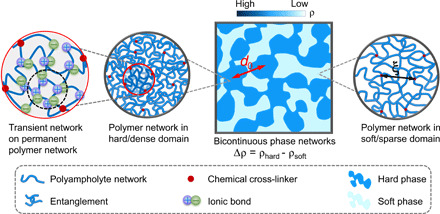
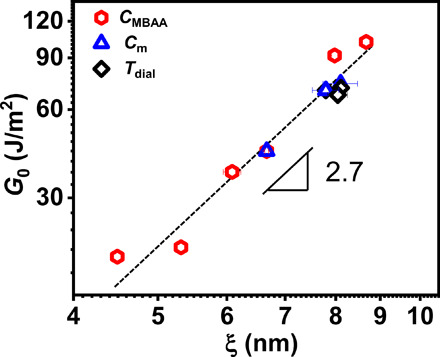
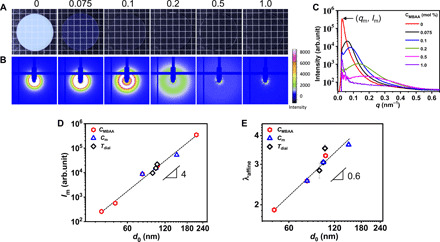
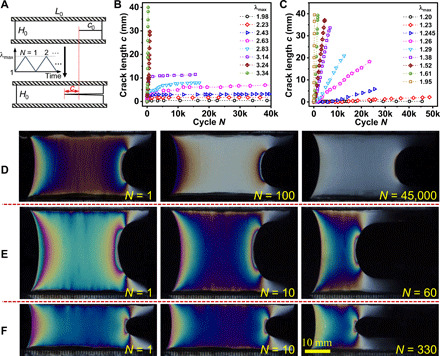
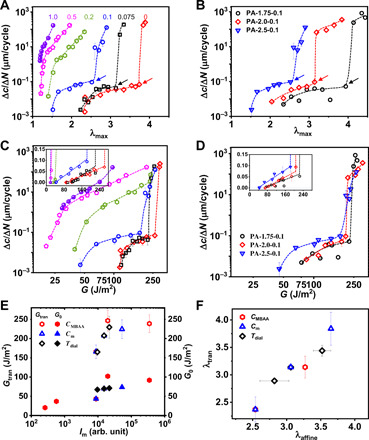
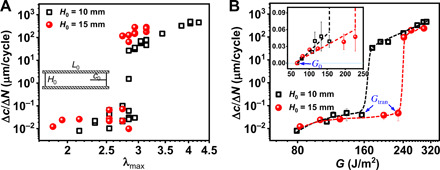
We investigate the fatigue resistance of chemically cross-linked polyampholyte hydrogels with a hierarchical structure due to phase separation and find that the details of the structure, as characterized by SAXS, control the mechanisms of crack propagation. When gels exhibit a strong phase contrast and a low cross-linking level, the stress singularity around the crack tip is gradually eliminated with increasing fatigue cycles and this suppresses crack growth, beneficial for high fatigue resistance. On the contrary, the stress concentration persists in weakly phase-separated gels, resulting in low fatigue resistance. A material parameter, λ, is identified, correlated to the onset of non-affine deformation of the mesophase structure in a hydrogel without crack, which governs the slow-to-fast transition in fatigue crack growth. The detailed role played by the mesoscale structure on fatigue resistance provides design principles for developing self-healing, tough, and fatigue-resistant soft materials.
我们研究了由于相分离而具有分级结构的化学交联聚两性电解质水凝胶的抗疲劳性能,发现由小角X射线散射(SAXS)表征的结构细节控制着裂纹扩展机制。当凝胶呈现出强烈的相对比度和低交联水平时,随着疲劳循环次数的增加,裂纹尖端周围的应力奇异性逐渐消除,这抑制了裂纹扩展,有利于高抗疲劳性。相反,在弱相分离的凝胶中应力集中持续存在,导致抗疲劳性较低。确定了一个材料参数λ,它与无裂纹水凝胶中间相结构的非仿射变形的起始相关,该参数控制着疲劳裂纹扩展从缓慢到快速的转变。中尺度结构在抗疲劳方面所起的详细作用为开发自愈合、坚韧和抗疲劳的软材料提供了设计原则。