Gnetchejo Patrick Juvet, Ndjakomo Essiane Salomé, Dadjé Abdouramani, Ele Pierre
Laboratory of Technologies and Applied Sciences, University of Douala, Cameroon.
Signal, Image and Systems Laboratory, Higher Technical Teacher Training College of Ebolowa, University of Yaounde 1, Cameroon.
Heliyon. 2021 Apr 8;7(4):e06673. doi: 10.1016/j.heliyon.2021.e06673. eCollection 2021 Apr.
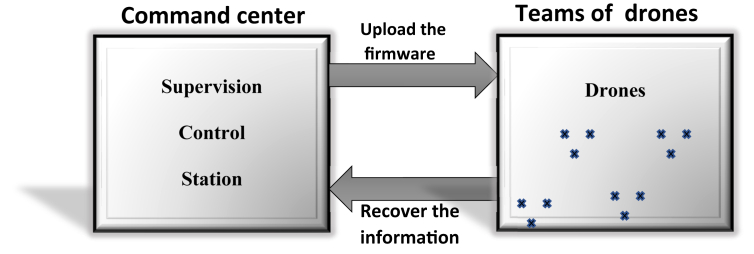
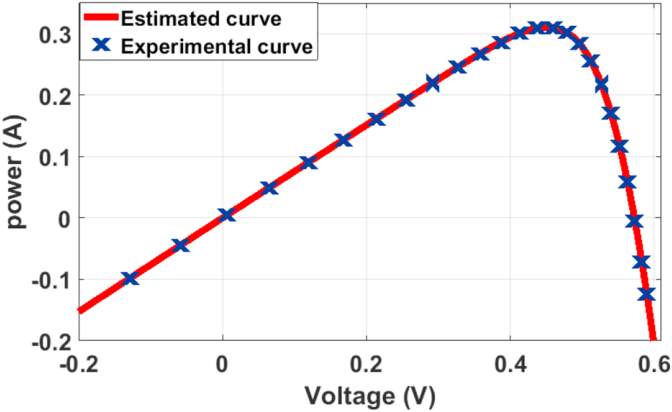
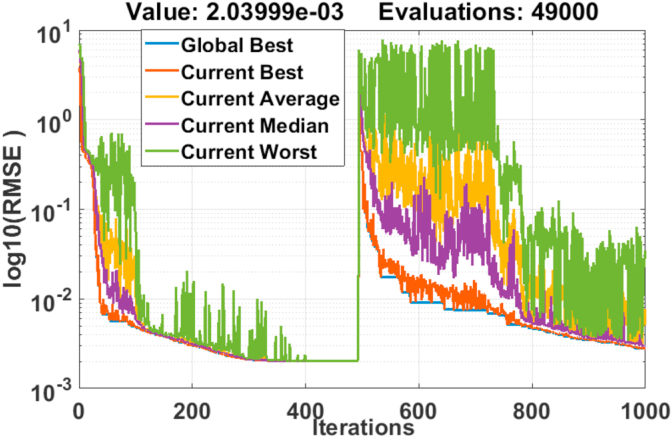
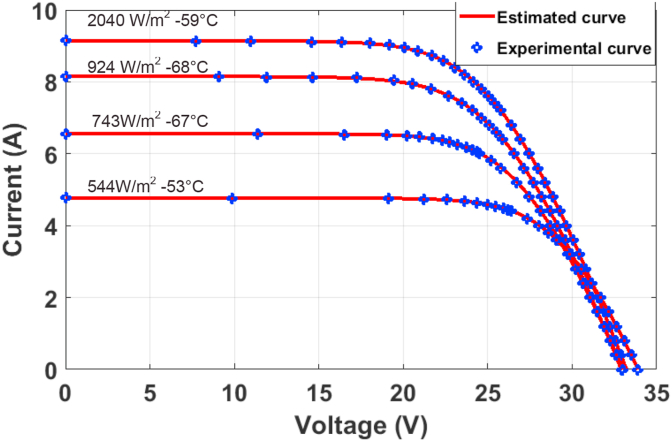
Parameters extraction is instrumental to standard PV cells design. Reports indicates that heuristic algorithms are the most effective methods for accurately determinining the values of parameters. However, local concentration is against recent heuristic methods, and they are inhibited producing optimal results. This paper seeks to show that combining the heuristics algorithms with the Newton Raphson method can considerably increased the accuracy of results. An inspired artifact technique from the drone squadron simulation from control center is proposed for the extraction of the best constitutive parameters. This study equally provides clarifications on the approaches recently reported and proposed to build objective function. Furthermore, comparative evaluation of the current ten best heuristics algorithms that are published in the PV estimation domain is also undertaken. Moreover, this study investigates the convergence of algorithms when points of the number of current-voltage characteristics are varied. The results from this study highlight the differences between the two formulation, and it shows the best formulation accuracy. The results obtained from seven study cases that are considered in this present study, with the combined Newton Raphson performance method and Drone Squadron optimisation, were employed to extract precise PV module parameters.The study of the numbers of points reveals that the algorithm converges and is more precise when the numbers of points of the I-V characteristic are reduced. However, if these points are minimal, the algorithm will be hindered from returning optimal results.
参数提取对标准光伏电池设计至关重要。报告表明,启发式算法是准确确定参数值的最有效方法。然而,局部收敛不利于近期的启发式方法,它们难以产生最优结果。本文旨在表明,将启发式算法与牛顿-拉弗森方法相结合可以显著提高结果的准确性。为提取最佳本构参数,提出了一种受控制中心无人机中队模拟启发的人工技术。本研究同样对最近报道和提出的构建目标函数的方法进行了说明。此外,还对光伏估计领域目前发表的十种最佳启发式算法进行了比较评估。此外,本研究还研究了电流-电压特性点数变化时算法的收敛性。本研究结果突出了两种公式之间的差异,并显示了最佳公式精度。本研究中考虑的七个研究案例的结果,采用牛顿-拉弗森性能方法和无人机中队优化相结合的方式,用于提取精确的光伏模块参数。对点数的研究表明,当电流-电压特性的点数减少时,算法收敛且更精确。然而,如果这些点数极少,算法将无法返回最优结果。