Chauvineau Maxime, Pasquier Florane, Guyot Vincent, Aloulou Anis, Nedelec Mathieu
Laboratory of Sport, Expertise and Performance (EA 7370), French National Institute of Sport (INSEP), Paris, France.
Front Sports Act Living. 2021 Mar 31;3:659990. doi: 10.3389/fspor.2021.659990. eCollection 2021.
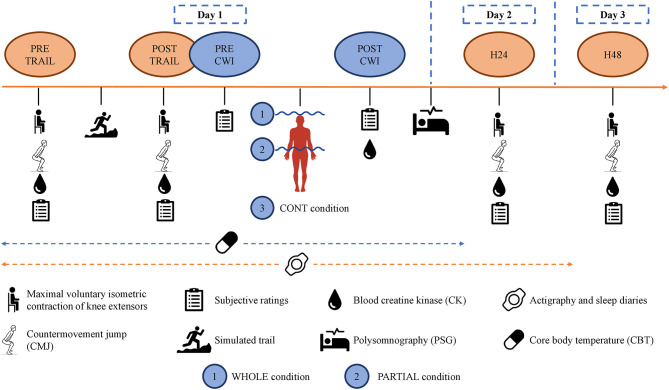
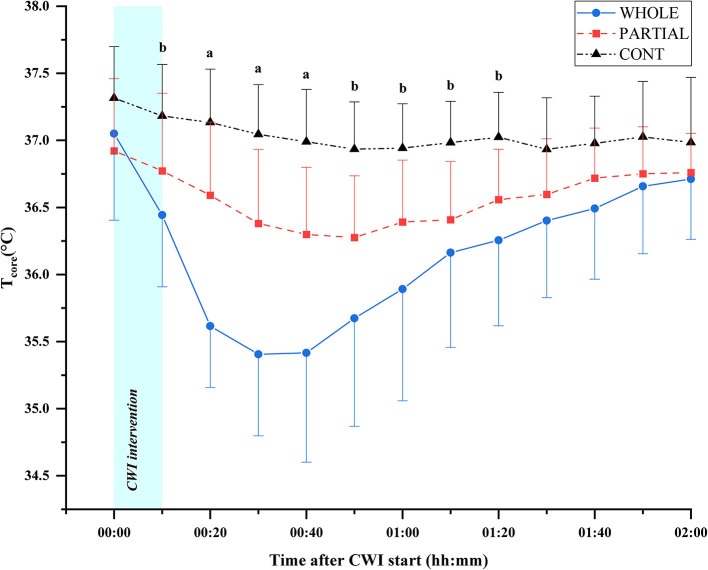
The aim of the present study was to investigate the effect of the depth of cold water immersion (CWI) (whole-body with head immersed and partial-body CWI) after high-intensity, intermittent running exercise on sleep architecture and recovery kinetics among well-trained runners. In a randomized, counterbalanced order, 12 well-trained male endurance runners ( Omax = 66.0 ± 3.9 ml·min·kg) performed a simulated trail (≈18:00) on a motorized treadmill followed by CWI (13.3 ± 0.2°C) for 10 min: whole-body immersion including the head (WHOLE; = 12), partial-body immersion up to the iliac crest (PARTIAL; = 12), and, finally, an out-of-water control condition (CONT; = 10). Markers of fatigue and muscle damage-maximal voluntary isometric contraction (MVIC), countermovement jump (CMJ), plasma creatine kinase [CK], and subjective ratings-were recorded until 48 h after the simulated trail. After each condition, nocturnal core body temperature ( ) was measured, whereas sleep and heart rate variability were assessed using polysomnography. There was a lower induced by WHOLE than CONT from the end of immersion to 80 min after the start of immersion ( < 0.05). Slow-wave sleep (SWS) proportion was higher ( < 0.05) during the first 180 min of the night in WHOLE compared with PARTIAL. WHOLE and PARTIAL induced a significant ( < 0.05) decrease in arousal for the duration of the night compared with CONT, while only WHOLE decreased limb movements compared with CONT ( < 0.01) for the duration of the night. Heart rate variability analysis showed a significant reduction ( < 0.05) in RMSSD, low frequency (LF), and high frequency (HF) in WHOLE compared with both PARTIAL and CONT during the first sequence of SWS. No differences between conditions were observed for any markers of fatigue and muscle damage ( > 0.05) throughout the 48-h recovery period. WHOLE reduced arousal and limb movement and enhanced SWS proportion during the first part of the night, which may be particularly useful in the athlete's recovery process after exercise. Future studies are, however, required to assess whether such positive sleep outcomes may result in overall recovery optimization.
本研究的目的是调查高强度间歇跑步运动后,冷水浸泡(CWI)(头部浸入的全身浸泡和半身CWI)深度对训练有素的跑步者睡眠结构和恢复动力学的影响。12名训练有素的男性耐力跑者( Omax = 66.0 ± 3.9 ml·min·kg)按照随机、平衡的顺序,在电动跑步机上进行模拟 trail(≈18:00),随后进行10分钟的CWI(13.3 ± 0.2°C):包括头部的全身浸泡(WHOLE; = 12)、至髂嵴的半身浸泡(PARTIAL; = 12),最后是无水中对照条件(CONT; = 10)。记录疲劳和肌肉损伤的标志物——最大自主等长收缩(MVIC)、反向运动跳跃(CMJ)、血浆肌酸激酶[CK]和主观评分,直至模拟 trail 后48小时。每种条件后,测量夜间核心体温( ),而使用多导睡眠图评估睡眠和心率变异性。从浸泡结束到浸泡开始后80分钟,WHOLE诱导的 低于CONT( < 0.05)。与PARTIAL相比,WHOLE组夜间前180分钟的慢波睡眠(SWS)比例更高( < 0.05)。与CONT相比,WHOLE和PARTIAL在夜间持续时间内均显著( < 0.05)降低了觉醒,而仅WHOLE在夜间持续时间内比CONT减少了肢体运动( < 0.01)。心率变异性分析显示,与PARTIAL和CONT相比,WHOLE在SWS的第一个序列期间RMSSD、低频(LF)和高频(HF)显著降低( < 0.05)。在整个48小时的恢复期内,各条件之间在任何疲劳和肌肉损伤标志物方面均未观察到差异( > 0.05)。WHOLE在夜间的第一部分减少了觉醒和肢体运动,并提高了SWS比例,这在运动员运动后的恢复过程中可能特别有用。然而,未来的研究需要评估这种积极的睡眠结果是否可能导致整体恢复优化。