Kilimanjaro Christian Medical University College (KCMUCo), P.O. Box 2240, Moshi, Tanzania.
School of Public Health and Family Medicine, University of Cape Town, Cape Town, South Africa.
Malar J. 2021 Apr 20;20(1):193. doi: 10.1186/s12936-021-03730-1.
High altitude settings in Eastern Africa have been reported to experience increased malaria burden due to vector habitat expansion. This study explored possible associations between malaria test positivity rates and its predictors including malaria control measures and meteorological factors at a high-altitude, low malaria transmission setting, south of Mount Kilimanjaro.
Malaria cases reported at the Tanganyika Plantation Company (TPC) hospital's malaria registers, meteorological data recorded at TPC sugar factory and data on bed nets distributed in Lower Moshi from 2009 to 2018 were studied. Correlation between bed nets distributed and malaria test positivity rates were explored by using Pearson correlation analysis and the associations between malaria test positivity rates and demographic and meteorological variables were determined by logistic regression and negative binomial regression analyses, respectively.
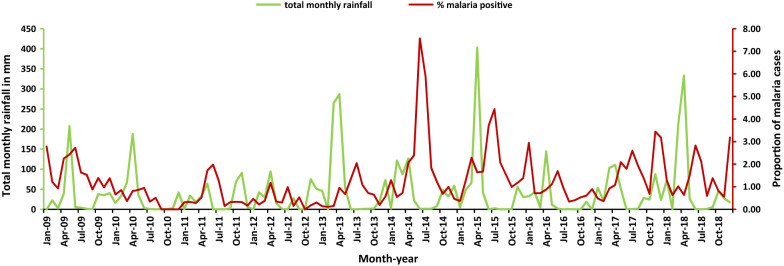
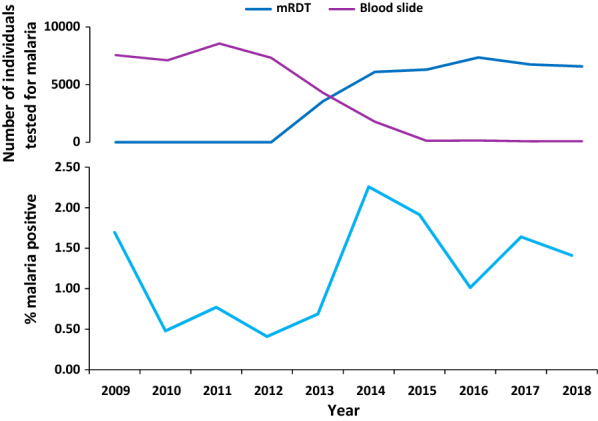
Malaria cases reported at TPC hospital ranged between 0.48 and 2.26% per year and increased slightly at the introduction of malaria rapid diagnostic tests. The risk of testing positive for malaria were significantly highest among individuals aged between 6 and 15 years (OR = 1.65; 1.65 CI = 1.28-2.13; p = 0.001) and 16-30 years (OR = 1.49; CI = 1.17-1.89; p = 0.001) and when adjusted for age, the risk were significantly higher among male individuals when compared to female individuals (OR = 1.54; 1.00-1.31; p = 0.044). Malaria test positivity rates were positively associated with average monthly minimum temperatures and negatively associated with average monthly maximum temperatures (incidence rate ratio (IRR) = 1.37, 95% confidence interval (CI) = 1.05-1.78, p = 0.019 and IRR = 0.72, 95% CI = 0.58-0.91, p = 0.005, respectively). When analysed with one month lag for predictor variables, malaria test positivity rates were still significantly associated with average monthly minimum and maximum temperatures (IRR = 1.67, 95% CI = 1.28-2.19, p = 0.001 and IRR = 0.68, 95% CI = 0.54-0.85, p = 0.001, respectively). Average monthly rainfall and relative humidity with or without a one month lag was not associated with malaria test positivity rates in the adjusted models. Explopring possible associations between distribution of long-lasting insecticidal nets, (LLINs) and malaria test positivity rates showed no apparent correlation between numbers of LLINs distributed in a particular year and malaria test positivity rates.
In Lower Moshi, the risk of being tested positive for malaria was highest for older children and male individuals. Higher minimum and lower maximum temperatures were the strongest climatic predictors for malaria test positivity rates. In areas with extensive irrigation activity as in Lower Moshi, vector abundance and thus malaria transmission may be less dependent on rainfall patterns and humidity. Mass distribution of LLINs did not have an effect in this area with already very low malaria transmission.
东非的高海拔地区由于媒介栖息地的扩大,疟疾负担有所增加。本研究在乞力马扎罗山以南的一个高海拔、低疟疾传播地区探索了疟疾检测阳性率与疟疾控制措施和气象因素之间可能存在的联系。
研究了坦桑尼亚种植园公司(TPC)医院疟疾登记处报告的疟疾病例、TPC 糖厂记录的气象数据以及 2009 年至 2018 年在Lower Moshi 分发的蚊帐数据。通过皮尔逊相关分析探讨了分发的蚊帐与疟疾检测阳性率之间的相关性,并通过逻辑回归和负二项回归分析分别确定了疟疾检测阳性率与人口统计学和气象变量之间的关联。
TPC 医院报告的疟疾病例每年在 0.48%至 2.26%之间波动,在引入疟疾快速诊断检测后略有增加。在年龄为 6 至 15 岁(OR=1.65;1.65 CI=1.28-2.13;p=0.001)和 16 至 30 岁(OR=1.49;CI=1.17-1.89;p=0.001)的个体中,检测出疟疾阳性的风险最高,而在调整年龄后,与女性个体相比,男性个体的风险显著更高(OR=1.54;1.00-1.31;p=0.044)。疟疾检测阳性率与平均月最低温度呈正相关,与平均月最高温度呈负相关(发病率比(IRR)=1.37,95%置信区间(CI)=1.05-1.78,p=0.019 和 IRR=0.72,95%CI=0.58-0.91,p=0.005)。当分析预测变量的一个月滞后时,疟疾检测阳性率仍与平均月最低和最高温度显著相关(IRR=1.67,95%CI=1.28-2.19,p=0.001 和 IRR=0.68,95%CI=0.54-0.85,p=0.001)。平均月降雨量和相对湿度无论是否有一个月的滞后,与疟疾检测阳性率均无关联。在调整后的模型中,探索长效杀虫蚊帐(LLINs)的分布与疟疾检测阳性率之间的可能关联,表明在特定年份分发的 LLINs 数量与疟疾检测阳性率之间没有明显的相关性。
在Lower Moshi,儿童和男性个体检测出疟疾阳性的风险最高。最低温度升高和最高温度降低是疟疾检测阳性率最强的气候预测因素。在像Lower Moshi 这样有广泛灌溉活动的地区,媒介的丰度以及疟疾的传播可能较少依赖于降雨模式和湿度。在疟疾传播率已经很低的地区,大规模分发 LLINs 并没有效果。