Department of Human Ecology, University of California, Davis, Davis, CA, United States.
Intermountain Healthcare, Clinical Operations, Salt Lake City, UT, United States.
Front Public Health. 2021 Apr 6;9:581497. doi: 10.3389/fpubh.2021.581497. eCollection 2021.
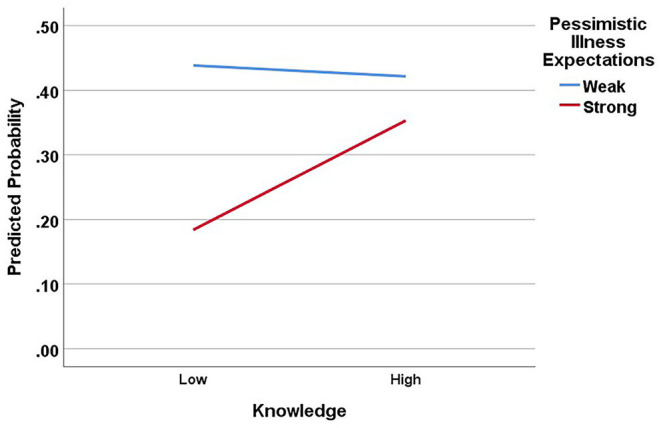
Past research suggests that knowledge supports- but strong illness expectations thwart- adoption of protective behaviors (e.g., handwashing). Strong illness expectations may place COVID-19 essential workers at risk. It is unclear, however, whether knowledge can moderate the negative effects of pessimistic illness expectations on protective behaviors. We test COVID-19 knowledge as a moderator of the effects of (1) pessimistic illness expectations and (2) essential worker status on adherence to protective behaviors. Participants ( = 350) completed measures of knowledge, illness expectations, and protective behaviors. We used chi-square tests to examine associations between variables and logistic regressions to test the moderation models predicting adherence (low, high) while controlling for demographics. Knowledge, illness expectations, and adherence were significantly associated with each other ( < 0.05). Essential workers had stronger illness expectations and lower knowledge than did non-essential workers ( < 0.001). Logistic regressions showed a non-significant Worker Status × Knowledge interaction ( = 0.59) but a significant Knowledge × Illness Expectations interaction ( < 0.05) indicating that those with strong illness expectations and low knowledge were disproportionately at risk of failing to adhere to recommended behaviors. Knowledge promotes protective behaviors by buffering the negative effects of pessimistic illness expectations. Essential workers are more likely to have low levels of knowledge with strong illness expectations, suggesting that educational policies may be warranted.
过去的研究表明,知识支持——但强烈的疾病预期会阻碍——采取保护行为(例如,洗手)。强烈的疾病预期可能使 COVID-19 一线工作人员面临风险。然而,目前尚不清楚知识是否可以减轻悲观疾病预期对保护行为的负面影响。我们检验了 COVID-19 知识是否可以调节(1)悲观疾病预期和(2)一线工作人员身份对遵守保护行为的影响。参与者(=350)完成了知识、疾病预期和保护行为的测量。我们使用卡方检验来检验变量之间的关联,使用逻辑回归来检验预测遵守(低、高)的调节模型,同时控制人口统计学因素。知识、疾病预期和遵守情况彼此显著相关(<0.05)。一线工作人员的疾病预期比非一线工作人员更强,知识水平更低(<0.001)。逻辑回归显示,工作状态×知识的交互作用不显著(=0.59),但知识×疾病预期的交互作用显著(<0.05),表明那些疾病预期强烈但知识水平低的人特别有可能无法遵守推荐的行为。知识通过缓冲悲观疾病预期的负面影响来促进保护行为。一线工作人员更有可能知识水平低而疾病预期强烈,这表明可能需要制定教育政策。