Department of Medicine, University of Chicago, Chicago, Illinois, United States of America.
NORC, Chicago, Illinois, United States of America.
PLoS One. 2021 Nov 5;16(11):e0259257. doi: 10.1371/journal.pone.0259257. eCollection 2021.
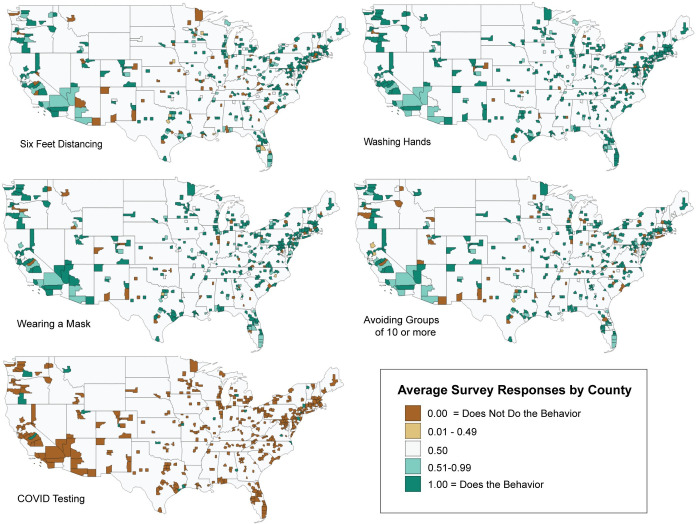
Protective behaviors such as mask wearing and physical distancing are critical to slow the spread of COVID-19, even in the context of vaccine scale-up. Understanding the variation in self-reported COVID-19 protective behaviors is critical to developing public health messaging. The purpose of the study is to provide nationally representative estimates of five self-reported COVID-19 protective behaviors and correlates of such behaviors. In this cross-sectional survey study of US adults, surveys were administered via internet and telephone. Adults were surveyed from April 30-May 4, 2020, a time of peaking COVID-19 incidence within the US. Participants were recruited from the probability-based AmeriSpeak® national panel. Brief surveys were completed by 994 adults, with 73.0% of respondents reported mask wearing, 82.7% reported physical distancing, 75.1% reported crowd avoidance, 89.8% reported increased hand-washing, and 7.7% reported having prior COVID-19 testing. Multivariate analysis (p critical value .05) indicates that women were more likely to report protective behaviors than men, as were those over age 60. Respondents who self-identified as having low incomes, histories of criminal justice involvement, and Republican Party affiliation, were less likely to report four protective behaviors, though Republicans and individuals with criminal justice histories were more likely to report having received COVID-19 testing. The majority of Americans engaged in COVID-19 protective behaviors, with low-income Americans, those with histories of criminal justice involvement, and self-identified Republicans less likely to engage in these preventive behaviors. Culturally competent public health messaging and interventions might focus on these latter groups to prevent future infections. These findings will remain highly relevant even with vaccines widely available, given the complementarities between vaccines and protective behaviors, as well as the many challenges in delivering vaccines.
保护行为,如戴口罩和保持身体距离,对于减缓 COVID-19 的传播至关重要,即使在疫苗大规模推广的情况下也是如此。了解自我报告的 COVID-19 保护行为的变化对于制定公共卫生信息传递策略至关重要。本研究的目的是提供全国代表性的五项自我报告的 COVID-19 保护行为的估计数,以及这些行为的相关因素。在这项针对美国成年人的横断面调查研究中,通过互联网和电话进行了调查。在美国 COVID-19 发病率达到高峰期间(2020 年 4 月 30 日至 5 月 4 日)进行了调查。参与者是从基于概率的 AmeriSpeak®全国小组中招募的。有 994 名成年人完成了简短的调查,其中 73.0%的受访者报告戴口罩,82.7%报告保持身体距离,75.1%报告避免人群,89.8%报告增加洗手,7.7%报告之前接受过 COVID-19 检测。多变量分析(p 临界值.05)表明,女性比男性更有可能报告保护行为,年龄在 60 岁以上的人也是如此。自我报告收入低、有刑事司法记录和共和党成员身份的受访者不太可能报告四种保护行为,尽管共和党人和有刑事司法记录的人更有可能报告接受过 COVID-19 检测。大多数美国人采取了 COVID-19 保护行为,低收入美国人、有刑事司法记录的人和自我认同的共和党人不太可能采取这些预防行为。具有文化能力的公共卫生信息传递和干预措施可能会针对这些群体,以防止未来的感染。即使疫苗广泛可用,这些发现仍将具有高度相关性,因为疫苗和保护行为之间存在互补性,以及在提供疫苗方面存在许多挑战。