Division of Pulmonary and Critical Care Medicine, Department of Internal Medicine, University of Michigan Medical School, Ann Arbor, MI, USA; Center for Computational Medicine and Bioinformatics, University of Michigan Medical School, Ann Arbor, MI, USA; Michigan Center for Integrative Research in Critical Care; Ann Arbor, MI, USA; Institute for Healthcare Policy and Innovation, University of Michigan, Ann Arbor, MI, USA.
Michigan Center for Integrative Research in Critical Care; Ann Arbor, MI, USA.
Lancet Digit Health. 2021 Jun;3(6):e340-e348. doi: 10.1016/S2589-7500(21)00056-X. Epub 2021 Apr 20.
Acute respiratory distress syndrome (ARDS) is a common, but under-recognised, critical illness syndrome associated with high mortality. An important factor in its under-recognition is the variability in chest radiograph interpretation for ARDS. We sought to train a deep convolutional neural network (CNN) to detect ARDS findings on chest radiographs.
CNNs were pretrained on 595 506 radiographs from two centres to identify common chest findings (eg, opacity and effusion), and then trained on 8072 radiographs annotated for ARDS by multiple physicians using various transfer learning approaches. The best performing CNN was tested on chest radiographs in an internal and external cohort, including a subset reviewed by six physicians, including a chest radiologist and physicians trained in intensive care medicine. Chest radiograph data were acquired from four US hospitals.
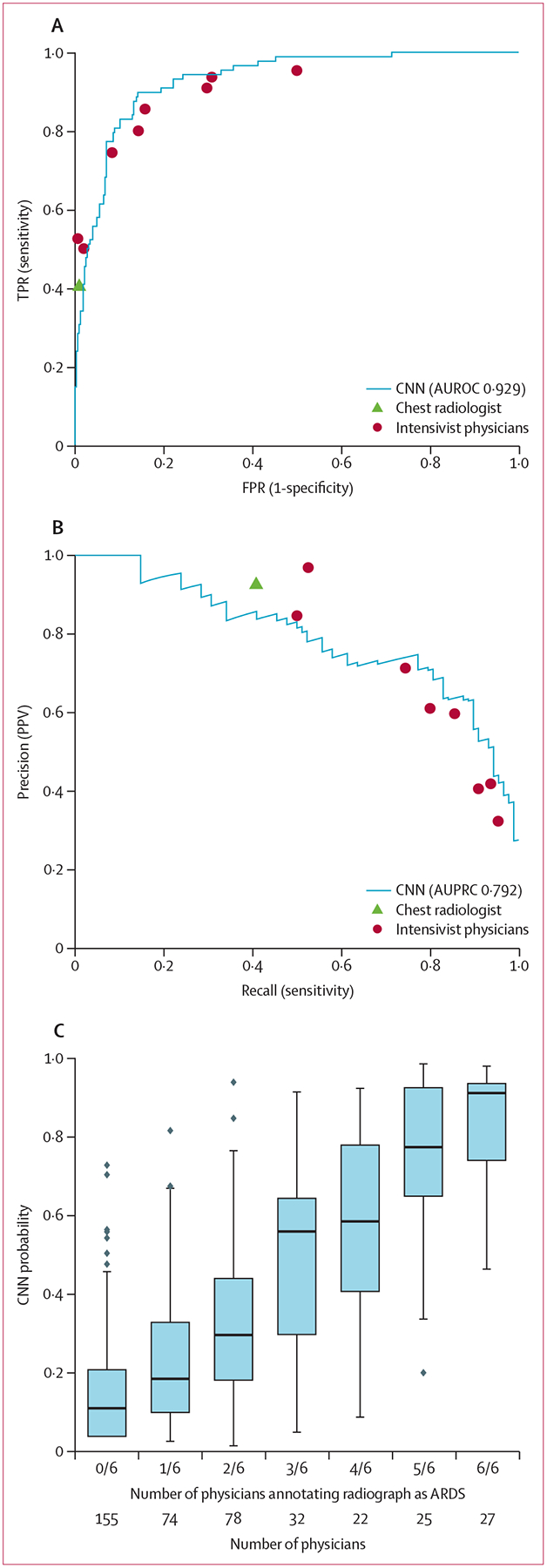
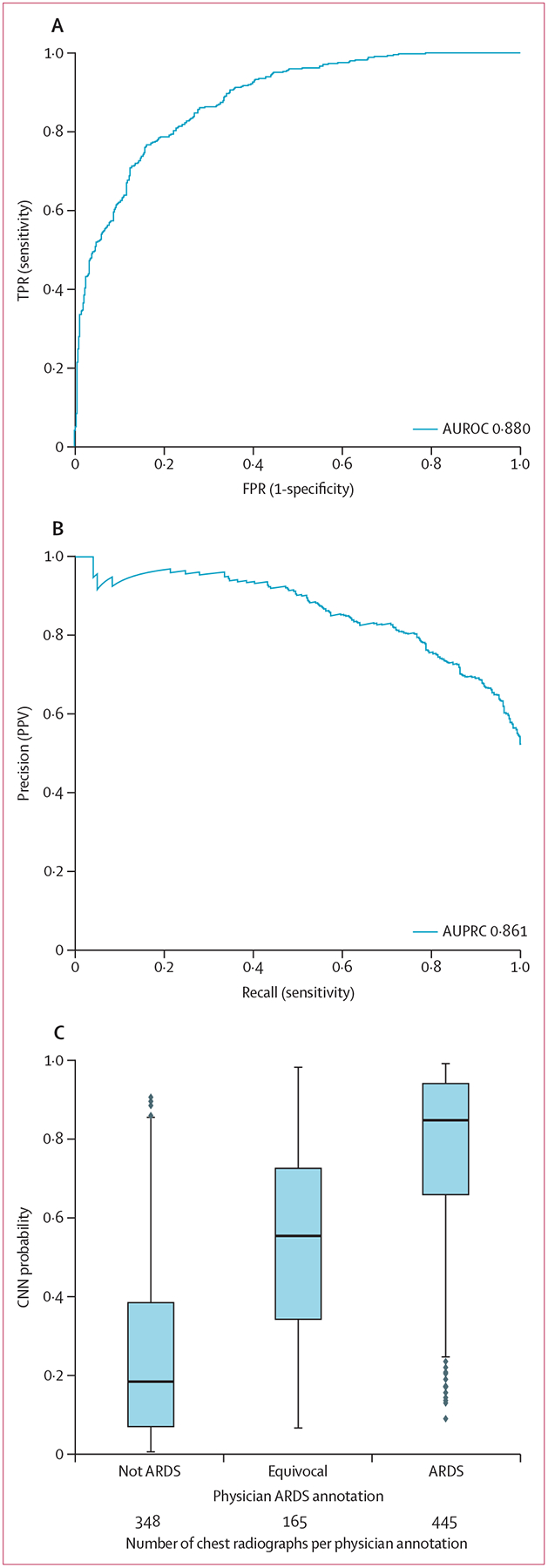
In an internal test set of 1560 chest radiographs from 455 patients with acute hypoxaemic respiratory failure, a CNN could detect ARDS with an area under the receiver operator characteristics curve (AUROC) of 0·92 (95% CI 0·89-0·94). In the subgroup of 413 images reviewed by at least six physicians, its AUROC was 0·93 (95% CI 0·88-0·96), sensitivity 83·0% (95% CI 74·0-91·1), and specificity 88·3% (95% CI 83·1-92·8). Among images with zero of six ARDS annotations (n=155), the median CNN probability was 11%, with six (4%) assigned a probability above 50%. Among images with six of six ARDS annotations (n=27), the median CNN probability was 91%, with two (7%) assigned a probability below 50%. In an external cohort of 958 chest radiographs from 431 patients with sepsis, the AUROC was 0·88 (95% CI 0·85-0·91). When radiographs annotated as equivocal were excluded, the AUROC was 0·93 (0·92-0·95).
A CNN can be trained to achieve expert physician-level performance in ARDS detection on chest radiographs. Further research is needed to evaluate the use of these algorithms to support real-time identification of ARDS patients to ensure fidelity with evidence-based care or to support ongoing ARDS research.
National Institutes of Health, Department of Defense, and Department of Veterans Affairs.
急性呼吸窘迫综合征(ARDS)是一种常见但未被充分认识的严重疾病综合征,死亡率高。其识别不足的一个重要因素是对 ARDS 胸片的解读存在差异。我们试图训练深度卷积神经网络(CNN)来检测胸片上的 ARDS 发现。
使用来自两个中心的 595506 张 X 光片对 CNN 进行预训练,以识别常见的胸部发现(例如,不透明和渗出),然后使用各种转移学习方法对 8072 张由多名医生注释为 ARDS 的 X 光片进行训练。表现最佳的 CNN 在内部和外部队列的胸片上进行了测试,其中包括由六名医生(包括一名放射科医生和接受过重症监护医学培训的医生)进行的子集回顾。胸部 X 光数据来自美国的四家医院。
在一组来自 455 名急性低氧性呼吸衰竭患者的 1560 张胸片的内部测试集中,CNN 可以检测到 ARDS,其受试者工作特征曲线下面积(AUROC)为 0.92(95%CI 0.89-0.94)。在至少六名医生回顾的 413 张图像亚组中,其 AUROC 为 0.93(95%CI 0.88-0.96),敏感性为 83.0%(95%CI 74.0-91.1),特异性为 88.3%(95%CI 83.1-92.8)。在六张 ARDS 注释均为零的图像中(n=155),CNN 的中位数概率为 11%,其中六张(4%)的概率超过 50%。在六张 ARDS 注释均为六的图像中(n=27),CNN 的中位数概率为 91%,其中两张(7%)的概率低于 50%。在一组来自 431 名脓毒症患者的 958 张胸片的外部队列中,AUROC 为 0.88(95%CI 0.85-0.91)。当排除注释为不确定的 X 光片时,AUROC 为 0.93(0.92-0.95)。
可以训练 CNN 以在胸部 X 光片上实现 ARDS 检测的专家医师水平的性能。需要进一步研究这些算法的使用,以评估其是否可以支持实时识别 ARDS 患者,以确保符合循证护理的标准,或者支持正在进行的 ARDS 研究。
美国国立卫生研究院、美国国防部和美国退伍军人事务部。