Department of Chemistry, University of Cincinnati, Cincinnati, Ohio, USA.
Department of Chemistry and Chemical Biology, NE-CAT APS, Cornell University, Argonne, Illinois, USA.
J Biol Chem. 2021 Jan-Jun;296:100692. doi: 10.1016/j.jbc.2021.100692. Epub 2021 Apr 22.
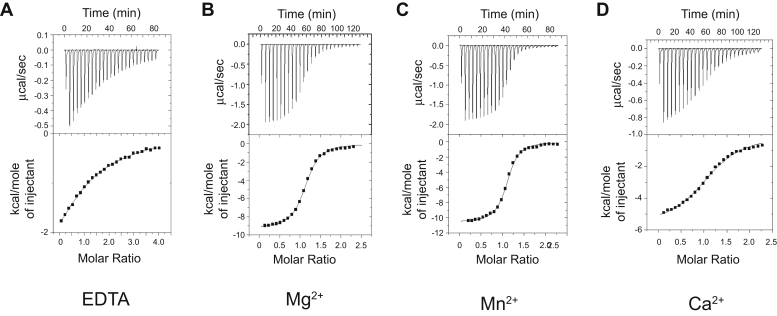
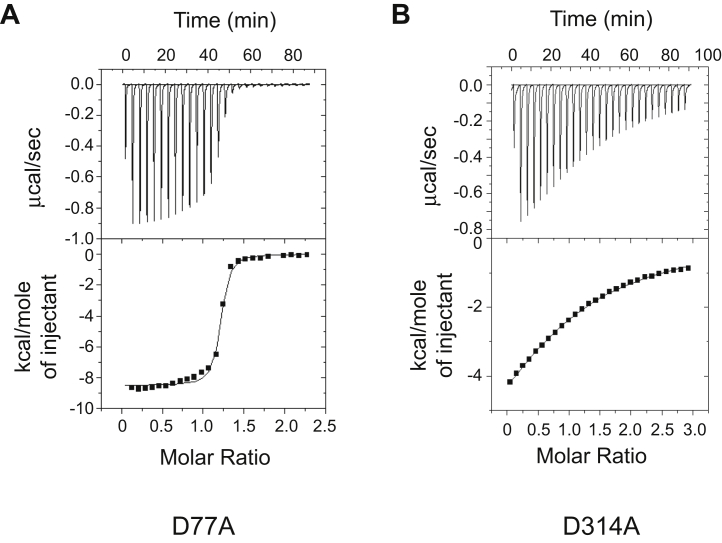
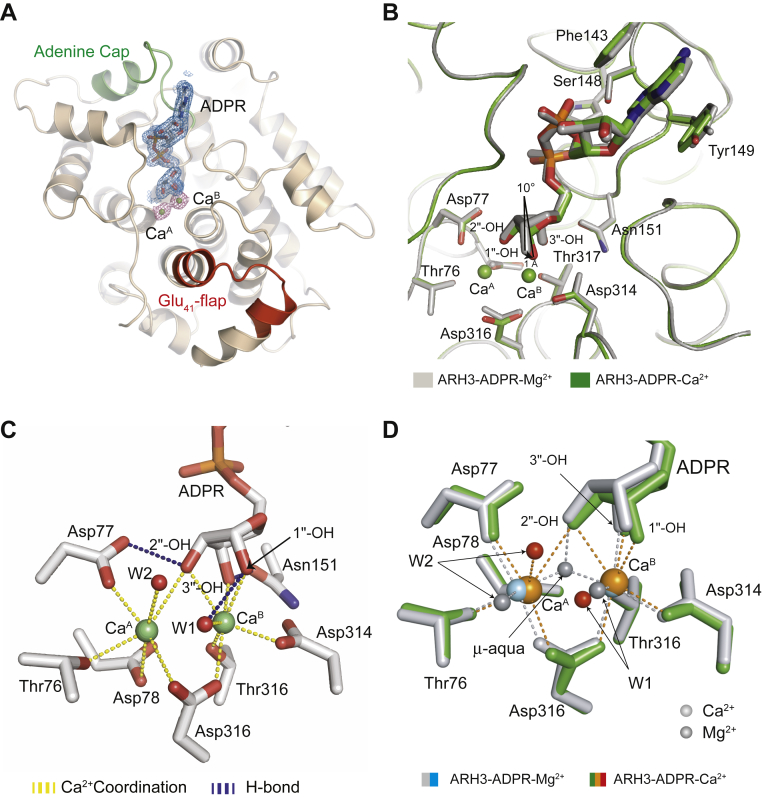
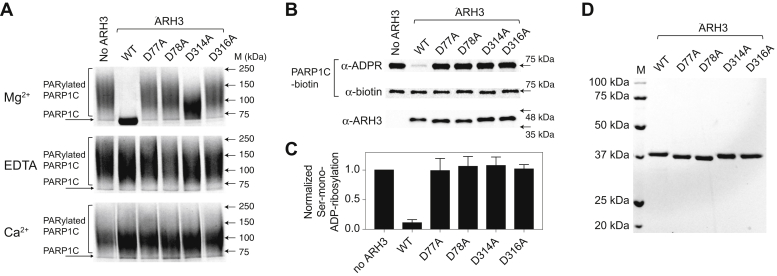
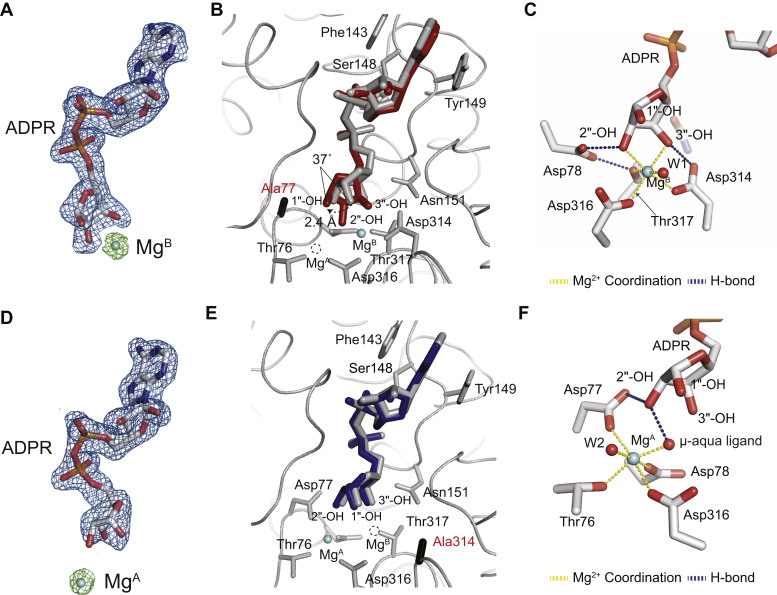
ADP-ribosylation is a reversible and site-specific post-translational modification that regulates a wide array of cellular signaling pathways. Regulation of ADP-ribosylation is vital for maintaining genomic integrity, and uncontrolled accumulation of poly(ADP-ribosyl)ation triggers a poly(ADP-ribose) (PAR)-dependent release of apoptosis-inducing factor from mitochondria, leading to cell death. ADP-ribosyl-acceptor hydrolase 3 (ARH3) cleaves PAR and mono(ADP-ribosyl)ation at serine following DNA damage. ARH3 is also a metalloenzyme with strong metal selectivity. While coordination of two magnesium ions (Mg and Mg) significantly enhances its catalytic efficiency, calcium binding suppresses its function. However, how the coordination of different metal ions affects its catalysis has not been defined. Here, we report a new crystal structure of ARH3 complexed with its product ADP-ribose and calcium. This structure shows that calcium coordination significantly distorts the binuclear metal center of ARH3, which results in decreased binding affinity to ADP-ribose, and suboptimal substrate alignment, leading to impaired hydrolysis of PAR and mono(ADP-ribosyl)ated serines. Furthermore, combined structural and mutational analysis of the metal-coordinating acidic residues revealed that Mg is crucial for optimal substrate positioning for catalysis, whereas Mg plays a key role in substrate binding. Our collective data provide novel insights into the different roles of these metal ions and the basis of metal selectivity of ARH3 and contribute to understanding the dynamic regulation of cellular ADP-ribosylations during the DNA damage response.
ADP-核糖基化是一种可逆且特异性的翻译后修饰,可调节广泛的细胞信号通路。ADP-核糖基化的调节对于维持基因组完整性至关重要,而多聚(ADP-核糖基)化的不受控制的积累会触发凋亡诱导因子从线粒体中以多(ADP-核糖)(PAR)依赖性的方式释放,导致细胞死亡。ADP-核糖基-受体水解酶 3(ARH3)在 DNA 损伤后切割 PAR 和丝氨酸上的单(ADP-核糖基)化。ARH3 也是一种具有强金属选择性的金属酶。虽然两个镁离子(Mg 和 Mg)的配位显着提高了其催化效率,但钙结合会抑制其功能。然而,不同金属离子的配位如何影响其催化作用尚未确定。在这里,我们报告了 ARH3 与其产物 ADP-核糖和钙复合物的新晶体结构。该结构表明,钙配位显着扭曲了 ARH3 的双核金属中心,导致与 ADP-核糖的结合亲和力降低,以及底物的最佳排列,从而导致 PAR 和单(ADP-核糖基)化丝氨酸的水解受损。此外,对金属配位酸性残基的结构和突变分析表明,Mg 对于最佳的底物定位至关重要,而 Mg 在底物结合中起关键作用。我们的综合数据为这些金属离子的不同作用以及 ARH3 的金属选择性提供了新的见解,并有助于理解 DNA 损伤反应期间细胞 ADP-核糖基化的动态调节。