Department of Internal Medicine, University of New Mexico, Albuquerque, NM, United States of America.
Department of Hospital Medicine, Mary Washington Hospital, Fredericksburg, VA, United States of America.
J Neuroimmunol. 2021 Jun 15;355:577577. doi: 10.1016/j.jneuroim.2021.577577. Epub 2021 Apr 18.
The systematic review aimed to determine demographic characteristics, clinical features, lab evaluation, management and complications of the studies focusing on Guillain-Barre syndrome (GBS) as a sequele of novel coronavirus (COVID-19) infection.
After protocol registration, PubMed, Web of Science and Cumulative Index to Nursing & Allied Health Literature (CINHAL) databases were searched for relevant articles using MeSH key-words and imported into referencing/review softwares. The data, regarding demographic and clinical characteristics, diagnostic workup and management, was analyzed in International Business Machines (IBM) Statistics SPSS 21. Many statistical tests, such as t-test and the Mann-Whitney U test, were used. P < 0.05 was considered significant.
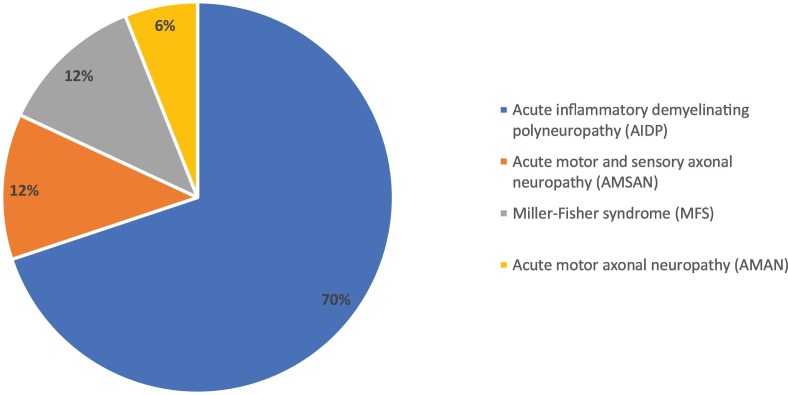
We identified 64 relevant articles. The mean age of the patients was 56 ± 16 years; the majority were males (64.9%). Among the neurological findings, paresthesia was the most typical symptom (48.9%). Most of the patients had been diagnosed by reverse transcriptase-polymerase chain reaction (RT-PCR) (69.2%). Two-third of the patients received immunoglobulins (IVIg) (77.7%). Although functions recovered in most patients, there were four patients with facial diplegia during follow-up (4.26%). Acute inflammatory demyelinating polyneuropathy (AIDP) was more likely to be associated with paresis of the lower extremity (p < 0.05) and higher levels of glucose on cerebrospinal fluid (CSF) analysis (p < 0.05). These patients were more likely to receive IVIg (p < 0.05) and develop respiratory insufficiency, subsequently (p < 0.05).
GBS is being recognized as one of the many presentations of the COVID-19 infection. Although the common form is AIDP that might lead to complications, other variants are possible as well, and more studies are needed to focus on those subvariants.
本系统评价旨在确定以新型冠状病毒(COVID-19)感染后格林-巴利综合征(GBS)为表现的研究的人口统计学特征、临床特征、实验室评估、治疗和并发症。
在方案注册后,使用 MeSH 关键词在 PubMed、Web of Science 和 Cumulative Index to Nursing & Allied Health Literature(CINHAL)数据库中搜索相关文章,并将其导入参考文献/综述软件。使用 IBM Statistics SPSS 21 分析人口统计学和临床特征、诊断方法和管理的数据。许多统计检验,如 t 检验和曼-惠特尼 U 检验,都被使用。P<0.05 被认为具有统计学意义。
我们确定了 64 篇相关文章。患者的平均年龄为 56±16 岁;大多数为男性(64.9%)。在神经系统表现中,感觉异常是最典型的症状(48.9%)。大多数患者通过逆转录酶-聚合酶链反应(RT-PCR)(69.2%)确诊。三分之二的患者接受了免疫球蛋白(IVIg)(77.7%)治疗。虽然大多数患者的功能都得到了恢复,但在随访中仍有 4 例患者出现面瘫(4.26%)。急性炎症性脱髓鞘性多发性神经病(AIDP)更可能与下肢瘫痪(p<0.05)和脑脊液(CSF)分析中葡萄糖水平升高(p<0.05)相关。这些患者更可能接受 IVIg 治疗(p<0.05),并随后出现呼吸功能不全(p<0.05)。
GBS 被认为是 COVID-19 感染的多种表现之一。尽管常见的形式是 AIDP,可能会导致并发症,但也可能存在其他变体,需要进一步研究来关注这些变体。