Katsarou Alexia L, Katsilambros Nicholas L, Koliaki Chrysi C
Third Surgical Clinic, Hygeia Hospital, 15123 Athens, Greece.
Research Laboratory Christeas Hall, Medical Faculty, National Kapodistrian University of Athens, 11527 Athens, Greece.
Healthcare (Basel). 2021 Apr 22;9(5):495. doi: 10.3390/healthcare9050495.
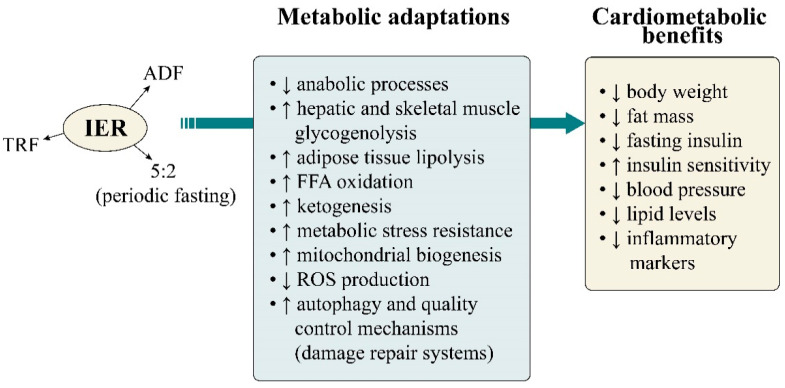
Dietary patterns with intermittent energy restriction (IER) have been proposed as an attractive alternative to continuous energy restriction (CER) for the management of obesity and its associated comorbidities. The most widely studied regimens of IER comprise energy restriction on two days per week (5:2), alternate-day energy restriction by 60-70% (ADF), and timely restriction of energy intake during a specific time window within the day (TRF; time-restricted feeding). Although there is some evidence to suggest that IER can exert beneficial effects on human cardiometabolic health, yet is apparently not superior compared to CER, there are still some critical issues/questions that warrant further investigation: (i) high-quality robust scientific evidence regarding the long-term effects of IER (safety, efficacy, compliance) is limited since the vast majority of intervention studies had a duration of less than 6 months; (ii) whether the positive effects of IER are independent of or actually mediated by weight loss remains elusive; (iii) it remains unknown whether IER protocols are a safe recommendation for the general population; (iv) data concerning the impact of IER on ectopic fat stores, fat-free mass, insulin resistance and metabolic flexibility are inconclusive; (v) the cost-effectiveness of IER dietary regimens has not been adequately addressed; (vi) direct head-to-head studies comparing different IER patterns with variable macronutrient composition in terms of safety and efficacy are scarce; and (vii) evidence is limited with regard to the efficacy of IER in specific populations, including males, the elderly and patients with morbid obesity and diabetes mellitus. Until more solid evidence is available, individualization and critical perspective are definitely warranted to determine which patients might benefit the most from an IER intervention, depending on their personality traits and most importantly comorbid health conditions.
间歇性能量限制(IER)的饮食模式已被提议作为持续能量限制(CER)的一种有吸引力的替代方案,用于管理肥胖及其相关合并症。研究最广泛的IER方案包括每周两天的能量限制(5:2)、隔日能量限制60 - 70%(ADF)以及在一天内特定时间窗口内适时限制能量摄入(TRF;限时进食)。尽管有一些证据表明IER可对人类心脏代谢健康产生有益影响,但显然并不优于CER,仍有一些关键问题值得进一步研究:(i)关于IER长期影响(安全性、有效性、依从性)的高质量有力科学证据有限,因为绝大多数干预研究持续时间不足6个月;(ii)IER的积极作用是独立于体重减轻还是实际上由体重减轻介导仍不明确;(iii)IER方案对普通人群是否是安全的建议仍未知;(iv)关于IER对异位脂肪储存、去脂体重、胰岛素抵抗和代谢灵活性影响的数据尚无定论;(v)IER饮食方案的成本效益尚未得到充分探讨;(vi)比较不同宏量营养素组成的IER模式在安全性和有效性方面的直接头对头研究很少;(vii)关于IER在特定人群(包括男性、老年人以及病态肥胖和糖尿病患者)中的疗效证据有限。在获得更多确凿证据之前,根据患者的个性特征,尤其是合并的健康状况,进行个体化并持批判性观点来确定哪些患者可能从IER干预中获益最大绝对是必要的。