Department of Clinical Biochemistry, Faculty of Medicine, King Abdulaziz University, Jeddah 21465, Saudi Arabia.
Medical Biochemistry and Molecular Biology, Faculty of Medicine, Mansoura University, Mansoura 35516, Egypt.
Cells. 2021 Apr 16;10(4):920. doi: 10.3390/cells10040920.
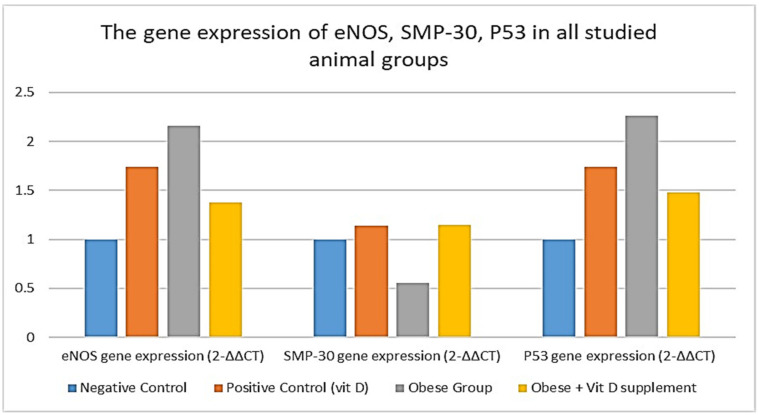
The exact link between obesity, vitamin D deficiency, and their relation to cellular senescence in the pathogenesis of subclinical atherosclerosis is still under debate. Therefore, the current study aims to verify the possible role of vitamin D deficiency and cellular senescence in the pathogenesis of obesity-related subclinical atherosclerosis. Moreover, it aims to investigate the possible protective role of vitamin D supplementation. Fifty-seven male albino rats were enrolled in the study and classified into four groups: negative (10) and positive control groups (10), an obese model group (24), and a vitamin-D-supplemented obese group (13). Aortic tissue samples and fasting blood samples were collected. The following biochemical investigations were performed: serum cholesterol, triglycerides, HDL-C, LDL-C, ALT, AST, CPK, CK-MB, and hs-cTnt. HOMA-IR was calculated. Moreover, serum SMP-30, 25 (OH)Vitamin D, and eNOS were determined by the ELISA technique. Aortic gene expression of eNOS, SMP-30, and P53 was estimated by real-time qRT-PCR. Serum 25(OH) D and SMP-30 were lower in the obese group. In addition, the obese group showed higher serum lipid profile, HOMA-IR, eNOS, ALT, AST, CPK, CK-MB, and hs-cTnt than the control groups, while decreased levels were found in the vitamin-D-treated obese group. Gene expression of eNOS and SMP-30 were in accordance with their serum levels. A positive correlation was found between vitamin D level and SMP-30. In conclusion, obesity is associated with vitamin D deficiency and enhanced cellular senescence. They could play a role in the pathogenesis of obesity-associated subclinical atherosclerosis and endothelial dysfunction. Vitamin D supplements could play a protective role against such obesity-related comorbidity.
肥胖、维生素 D 缺乏与细胞衰老在亚临床动脉粥样硬化发病机制中的确切联系仍存在争议。因此,本研究旨在验证维生素 D 缺乏和细胞衰老在肥胖相关亚临床动脉粥样硬化发病机制中的可能作用。此外,还旨在研究维生素 D 补充的可能保护作用。
将 57 只雄性白化大鼠纳入研究并分为 4 组:阴性(10 只)和阳性对照组(10 只)、肥胖模型组(24 只)和维生素 D 补充肥胖组(13 只)。收集主动脉组织样本和空腹血样。进行了以下生化研究:血清胆固醇、甘油三酯、HDL-C、LDL-C、ALT、AST、CPK、CK-MB 和 hs-cTnt。计算 HOMA-IR。此外,通过 ELISA 技术测定血清 SMP-30、25(OH)维生素 D 和 eNOS。通过实时 qRT-PCR 估计主动脉中 eNOS、SMP-30 和 P53 的基因表达。
肥胖组血清 25(OH)D 和 SMP-30 水平降低。此外,肥胖组的血清脂质谱、HOMA-IR、eNOS、ALT、AST、CPK、CK-MB 和 hs-cTnt 均高于对照组,而维生素 D 治疗肥胖组的水平则降低。eNOS 和 SMP-30 的基因表达与其血清水平一致。发现维生素 D 水平与 SMP-30 之间存在正相关。
综上所述,肥胖与维生素 D 缺乏和增强的细胞衰老有关。它们可能在肥胖相关亚临床动脉粥样硬化和内皮功能障碍的发病机制中发挥作用。维生素 D 补充剂可能对这种肥胖相关的合并症起到保护作用。