Muros Nora I, García Arturo S, Forner Cristina, López-Arcas Pablo, Lahera Guillermo, Rodriguez-Jimenez Roberto, Nieto Karen N, Latorre José Miguel, Fernández-Caballero Antonio, Fernández-Sotos Patricia
Servicio de Salud Mental, Complejo Hospitalario Universitario de Albacete, 02006 Albacete, Spain.
Departamento de Sistemas Informáticos, Universidad de Castilla-La Mancha, 02071 Albacete, Spain.
J Clin Med. 2021 Apr 28;10(9):1904. doi: 10.3390/jcm10091904.
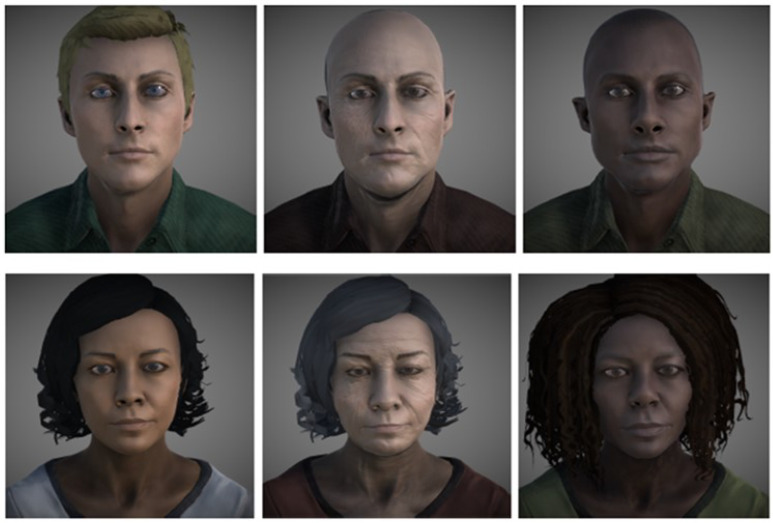
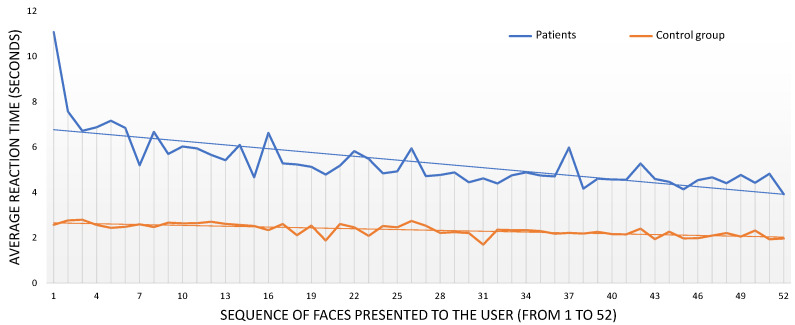
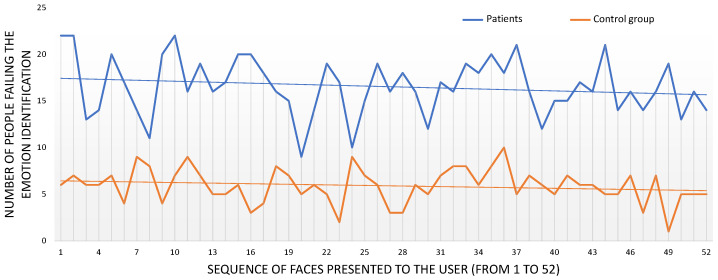
People with schizophrenia have difficulty recognizing the emotions in the facial expressions of others, which affects their social interaction and functioning in the community. Static stimuli such as photographs have been used traditionally to examine deficiencies in the recognition of emotions in patients with schizophrenia, which has been criticized by some authors for lacking the dynamism that real facial stimuli have. With the aim of overcoming these drawbacks, in recent years, the creation and validation of virtual humans has been developed. This work presents the results of a study that evaluated facial recognition of emotions through a new set of dynamic virtual humans previously designed by the research team, in patients diagnosed of schizophrenia. The study included 56 stable patients, compared with 56 healthy controls. Our results showed that patients with schizophrenia present a deficit in facial affect recognition, compared to healthy controls (average hit rate 71.6% for patients vs 90.0% for controls). Facial expressions with greater dynamism (compared to less dynamic ones), as well as those presented from frontal view (compared to profile view) were better recognized in both groups. Regarding clinical and sociodemographic variables, the number of hospitalizations throughout life did not correlate with recognition rates. There was also no correlation between functioning or quality of life and recognition. A trend showed a reduction in the emotional recognition rate as a result of increases in Positive and Negative Syndrome Scale (PANSS), being statistically significant for negative PANSS. Patients presented a learning effect during the progression of the task, slightly greater in comparison to the control group. This finding is relevant when designing training interventions for people with schizophrenia. Maintaining the attention of patients and getting them to improve in the proposed tasks is a challenge for today's psychiatry.
精神分裂症患者在识别他人面部表情中的情绪方面存在困难,这影响了他们的社交互动以及在社区中的功能。传统上,诸如照片之类的静态刺激物被用于检查精神分裂症患者在情绪识别方面的缺陷,但一些作者批评这种方法缺乏真实面部刺激所具有的动态性。为了克服这些缺点,近年来虚拟人的创建和验证得到了发展。这项工作展示了一项研究的结果,该研究通过研究团队之前设计的一组新的动态虚拟人,评估了被诊断为精神分裂症的患者对情绪的面部识别能力。该研究纳入了56名病情稳定的患者,并与56名健康对照者进行比较。我们的结果显示,与健康对照者相比,精神分裂症患者在面部情感识别方面存在缺陷(患者的平均命中率为71.6%,而对照者为90.0%)。两组对动态性更强的面部表情(与动态性较弱的表情相比)以及从正面呈现的表情(与侧面呈现的表情相比)识别得更好。关于临床和社会人口统计学变量,终生住院次数与识别率无关。功能或生活质量与识别率之间也没有相关性。一种趋势表明,随着阳性和阴性症状量表(PANSS)得分的增加,情绪识别率会降低,其中阴性PANSS得分的影响具有统计学意义。在任务进行过程中,患者表现出学习效应,与对照组相比略大。在为精神分裂症患者设计训练干预措施时,这一发现具有重要意义。保持患者的注意力并使他们在所提出的任务中取得进步,是当今精神病学面临的一项挑战。