Department of Neuropsychiatry, Graduate School of Medicine, The University of Tokyo, 7-3-1 Hongo, Tokyo, Bunkyo, 113-8655, Japan.
Department of Health Policy, National Center for Child Health and Development, 2-10-1, Okura, Tokyo, Setagaya, 157-8535, Japan.
BMC Psychiatry. 2021 Apr 29;21(1):218. doi: 10.1186/s12888-021-03218-x.
Child and adolescent mental health problems are urgent health issues in low- and middle-income countries. To promote child and adolescent mental health services, simple validated screening tools are helpful. In Mongolia, the Strengths and Difficulties Questionnaire (SDQ), an internationally used child and adolescent mental health screening tool for children aged 4-17, was translated but not yet validated. To use the questionnaire appropriately, validation is necessary.
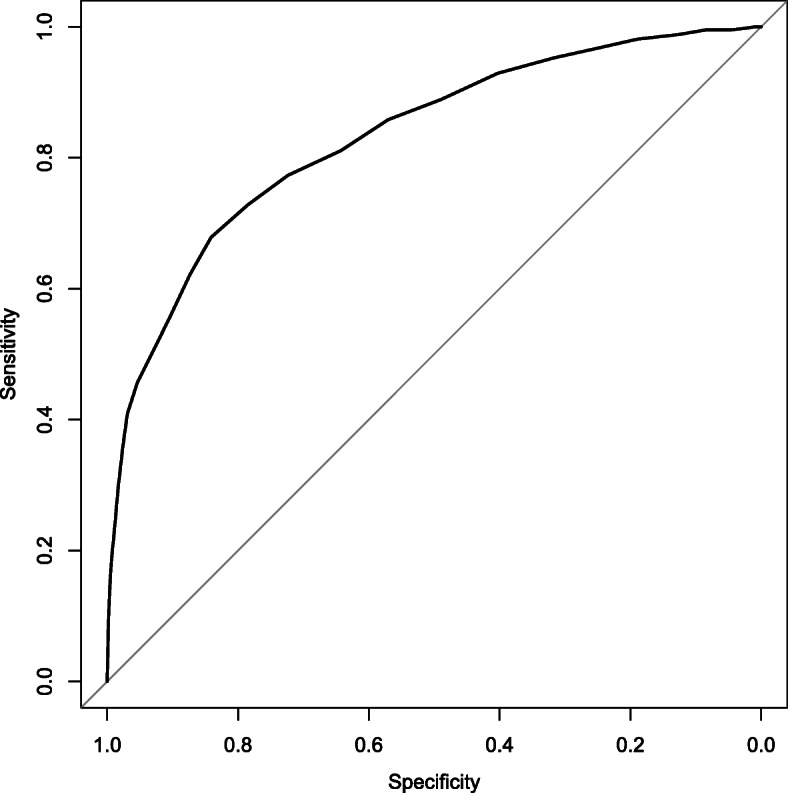
Children at 4th year at elementary school (community sample) and children visited psychiatric outpatient service (clinical sample) were recruited and their parental version of the SDQ was compared. The discriminating ability of the parental version of the SDQ was examined using Receiver Operating Characteristics (ROC) analysis on the SDQ total difficulties score. The area under the ROC curve (AUC) was used as a measure. Cut-off score was determined by normative banding that categorizes children with the highest 10% score range as abnormal and the second highest 10% as borderline following the original method; this cut-off score was compared with the cut-off score candidates with good balance between sensitivity and specificity using ROC analysis.
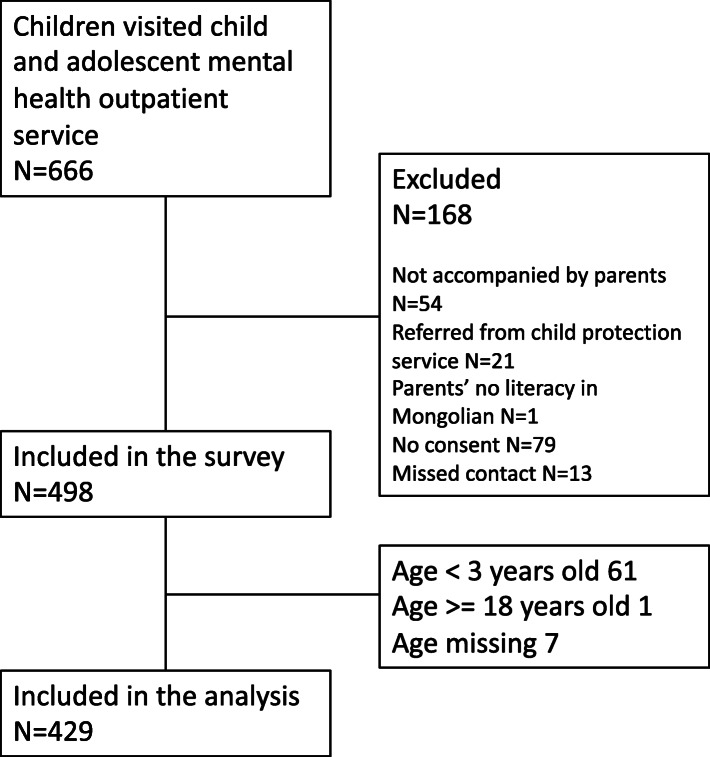
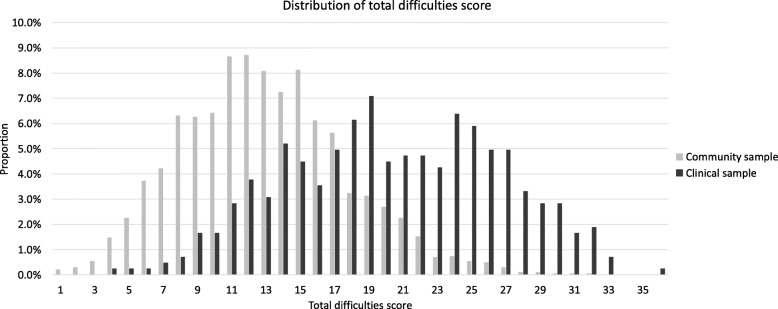
We included 2301 children in the community sample, and 429 children in the clinical sample. Mean age was 9.7 years (SD 0.4, range 8.3-12.0) among the community sample and 10.4 years (SD 3.8, range 4.0-17.8) among the clinical sample. The mean total difficulties score was 12.9 (SD 4.8) among the community sample and 20.4 (SD 6.2) among the clinical sample. A total of 88.8% of the community sample and 98.8% of the clinical sample answered the SDQ. Using ROC analysis, the AUC was 0.82 (95% confident interval 0.80-0.85), which meant moderate discriminating ability. Using normative banding, the borderline cut-off score was 16/17 and abnormal cut-off score was 19/20. For cut-off scores of 16/17 and 19/20, sensitivity was 71.9 and 53.8% and specificity was 78.5 and 90.5%, respectively. The cut-off score candidates by ROC analysis were 16/17 and 17/18.
The parental version of the SDQ had moderate discriminating ability among Mongolian school-age children. For the screening of mental health problems among community children, cut-off score of 16/17 is recommended.
儿童和青少年心理健康问题是中低收入国家的紧迫健康问题。为了促进儿童和青少年心理健康服务,简单有效的验证筛查工具是有帮助的。在蒙古,《长处和困难问卷》(SDQ)是一种国际上用于 4-17 岁儿童和青少年心理健康筛查的工具,已经被翻译但尚未得到验证。为了正确使用问卷,验证是必要的。
我们招募了小学四年级的儿童(社区样本)和精神科门诊服务的儿童(临床样本),并比较了他们父母版本的 SDQ。使用接收器工作特征(ROC)分析对 SDQ 总分进行分析,评估父母版本的 SDQ 的区分能力。ROC 曲线下面积(AUC)用于衡量。截断分数是通过规范带确定的,根据原始方法,将得分最高的 10%的儿童归类为异常,第二高的 10%的儿童归类为边界;通过 ROC 分析,比较了截断分数候选者在灵敏度和特异性之间的良好平衡。
我们纳入了 2301 名社区样本中的儿童和 429 名临床样本中的儿童。社区样本中平均年龄为 9.7 岁(SD 0.4,范围 8.3-12.0),临床样本中为 10.4 岁(SD 3.8,范围 4.0-17.8)。社区样本的平均总分 12.9(SD 4.8),临床样本为 20.4(SD 6.2)。社区样本中共有 88.8%和临床样本中 98.8%的儿童回答了 SDQ。使用 ROC 分析,AUC 为 0.82(95%置信区间 0.80-0.85),这意味着中等区分能力。使用规范带,边界截断分数为 16/17,异常截断分数为 19/20。对于 16/17 和 19/20 的截断分数,灵敏度分别为 71.9%和 53.8%,特异性分别为 78.5%和 90.5%。ROC 分析的截断分数候选值为 16/17 和 17/18。
蒙古学龄儿童的父母版本 SDQ 具有中等的区分能力。对于社区儿童的心理健康问题筛查,建议使用 16/17 的截断分数。