Department of Computer and Information Science, University of Pennsylvania, Philadelphia, PA, United States.
Penn Medicine Center for Digital Health, University of Pennsylvania, Philadelphia, PA, United States.
J Med Internet Res. 2021 Jun 3;23(6):e27300. doi: 10.2196/27300.
As policy makers continue to shape the national and local responses to the COVID-19 pandemic, the information they choose to share and how they frame their content provide key insights into the public and health care systems.
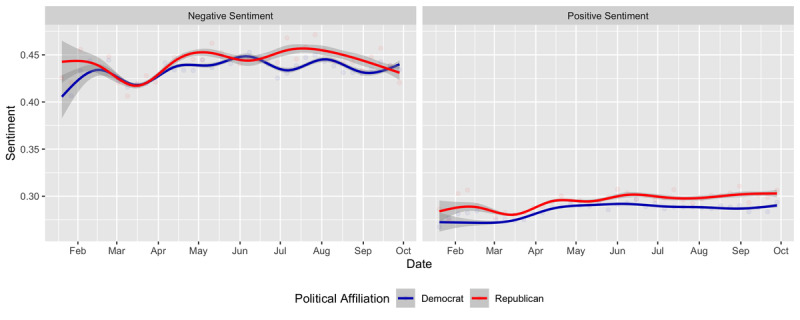
We examined the language used by the members of the US House and Senate during the first 10 months of the COVID-19 pandemic and measured content and sentiment based on the tweets that they shared.
We used Quorum (Quorum Analytics Inc) to access more than 300,000 tweets posted by US legislators from January 1 to October 10, 2020. We used differential language analyses to compare the content and sentiment of tweets posted by legislators based on their party affiliation.
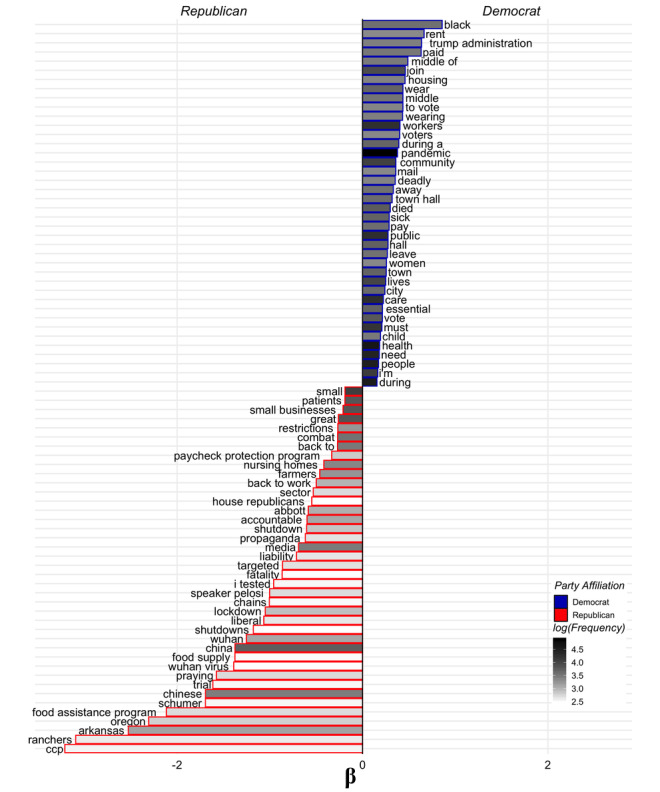
We found that health care-related themes in Democratic legislators' tweets focused on racial disparities in care (odds ratio [OR] 2.24, 95% CI 2.22-2.27; P<.001), health care and insurance (OR 1.74, 95% CI 1.7-1.77; P<.001), COVID-19 testing (OR 1.15, 95% CI 1.12-1.19; P<.001), and public health guidelines (OR 1.25, 95% CI 1.22-1.29; P<.001). The dominant themes in the Republican legislators' discourse included vaccine development (OR 1.51, 95% CI 1.47-1.55; P<.001) and hospital resources and equipment (OR 1.22, 95% CI 1.18-1.25). Nonhealth care-related topics associated with a Democratic affiliation included protections for essential workers (OR 1.55, 95% CI 1.52-1.59), the 2020 election and voting (OR 1.31, 95% CI 1.27-1.35), unemployment and housing (OR 1.27, 95% CI 1.24-1.31), crime and racism (OR 1.22, 95% CI 1.18-1.26), public town halls (OR 1.2, 95% CI 1.16-1.23), the Trump Administration (OR 1.22, 95% CI 1.19-1.26), immigration (OR 1.16, 95% CI 1.12-1.19), and the loss of life (OR 1.38, 95% CI 1.35-1.42). The themes associated with the Republican affiliation included China (OR 1.89, 95% CI 1.85-1.92), small business assistance (OR 1.27, 95% CI 1.23-1.3), congressional relief bills (OR 1.23, 95% CI 1.2-1.27), press briefings (OR 1.22, 95% CI 1.19-1.26), and economic recovery (OR 1.2, 95% CI 1.16-1.23).
Divergent language use on social media corresponds to the partisan divide in the first several months of the course of the COVID-19 public health crisis.
随着政策制定者继续制定应对 COVID-19 大流行的国家和地方政策,他们选择分享的信息以及他们构建内容的方式为公众和医疗保健系统提供了关键见解。
我们研究了 COVID-19 大流行的前 10 个月期间美国众议院和参议院议员使用的语言,并根据他们分享的推文衡量了内容和情绪。
我们使用 Quorum(Quorum Analytics Inc)访问了 2020 年 1 月 1 日至 10 月 10 日期间美国立法者发布的超过 30 万条推文。我们使用差异语言分析来比较立法者根据其党派关系发布的推文的内容和情绪。
我们发现,民主党立法者推文中与医疗保健相关的主题侧重于护理方面的种族差异(比值比[OR]2.24,95%置信区间[CI]2.22-2.27;P<.001)、医疗保健和保险(OR 1.74,95%CI 1.7-1.77;P<.001)、COVID-19 检测(OR 1.15,95%CI 1.12-1.19;P<.001)和公共卫生指南(OR 1.25,95%CI 1.22-1.29;P<.001)。共和党立法者话语中的主要主题包括疫苗开发(OR 1.51,95%CI 1.47-1.55;P<.001)和医院资源和设备(OR 1.22,95%CI 1.18-1.25)。与民主党关系相关的非医疗保健主题包括保护基本工人(OR 1.55,95%CI 1.52-1.59)、2020 年选举和投票(OR 1.31,95%CI 1.27-1.35)、失业和住房(OR 1.27,95%CI 1.24-1.31)、犯罪和种族主义(OR 1.22,95%CI 1.18-1.26)、公共市政厅(OR 1.2,95%CI 1.16-1.23)、特朗普政府(OR 1.22,95%CI 1.19-1.26)、移民(OR 1.16,95%CI 1.12-1.19)和生命损失(OR 1.38,95%CI 1.35-1.42)。与共和党关系相关的主题包括中国(OR 1.89,95%CI 1.85-1.92)、小企业援助(OR 1.27,95%CI 1.23-1.3)、国会救济法案(OR 1.23,95%CI 1.2-1.27)、新闻发布会(OR 1.22,95%CI 1.19-1.26)和经济复苏(OR 1.2,95%CI 1.16-1.23)。
社交媒体上截然不同的语言使用方式对应了 COVID-19 公共卫生危机最初几个月的党派分歧。