UniSA Clinical and Health Sciences, Health and Biomedical Innovation, University of South Australia, Adelaide 5000, Australia.
UniSA Clinical and Health Sciences, Health and Biomedical Innovation, University of South Australia, Adelaide 5000, Australia.
Sci Total Environ. 2021 Sep 1;785:147270. doi: 10.1016/j.scitotenv.2021.147270. Epub 2021 Apr 25.
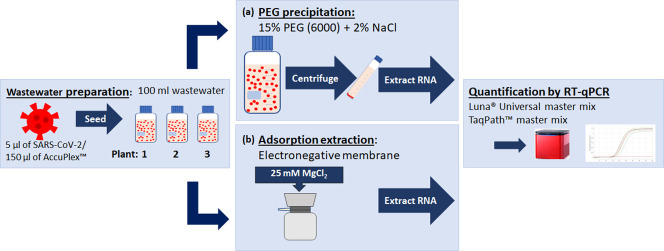
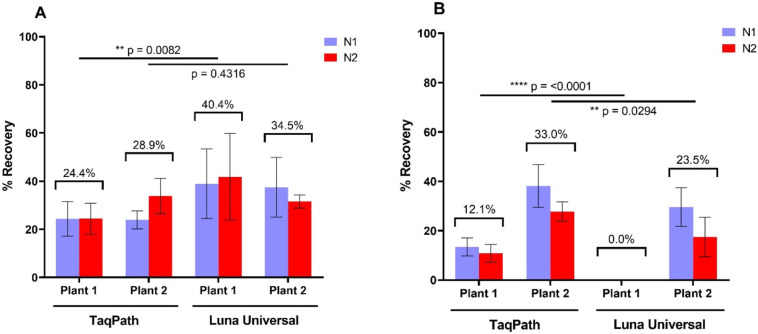
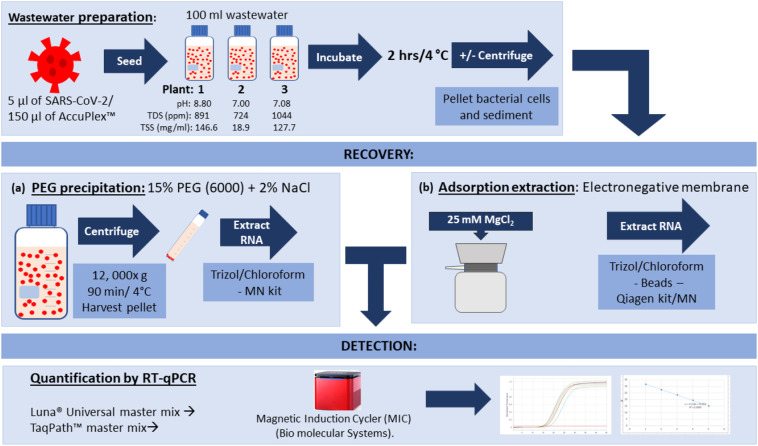
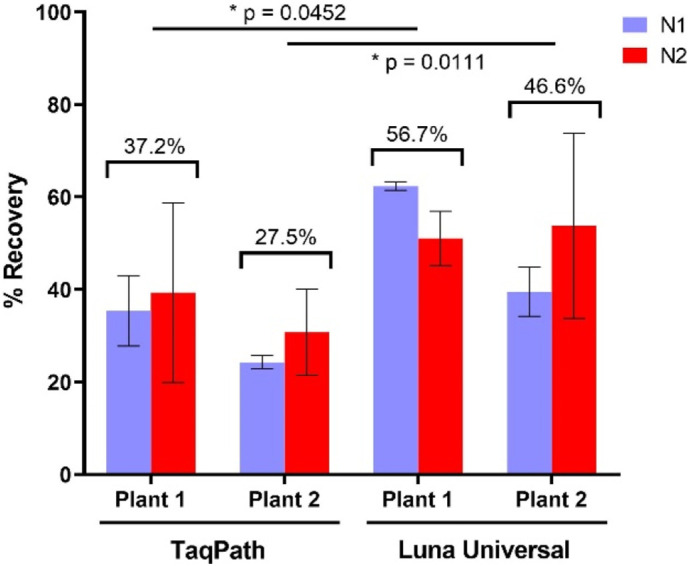
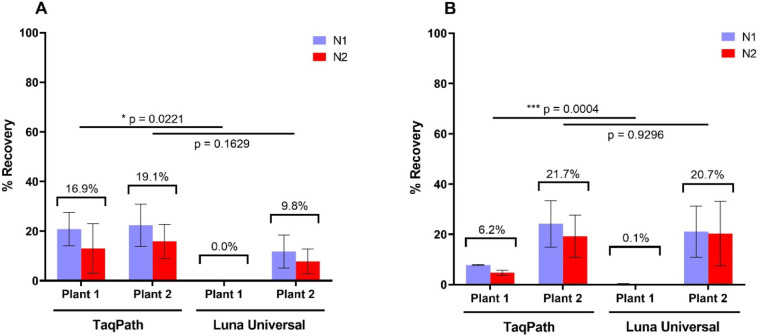
Wastewater-based epidemiology is currently being utilized to monitor the dissemination of the severe acute respiratory syndrome coronavirus 2 (SARS-CoV-2), on a population scale. The detection of SARS-CoV-2 in wastewater is highly influenced by methodologies used for its isolation, concentration and RNA extraction. Although various viral concentration methods are currently employed, including polyethylene glycol (PEG) precipitation, adsorption-extraction, ultracentrifugation and ultrafiltration, to our knowledge, none of these methods have been standardized for use with a variety of wastewater matrices and/or different kits for RNA extraction and quantification. To address this, wastewater with different physical characteristics was seeded with gamma-irradiated SARS-CoV-2 and used to test the efficiency of PEG precipitation and adsorption-extraction to concentrate the virus from three physiochemically different wastewater samples, sourced from three distinct wastewater plants. Efficiency of viral concentration and RNA extraction was assessed by reverse-transcriptase polymerase chain reaction and the recovery yields calculated. As co-purification of inhibitors can be problematic for subsequent detection, two commonly used commercial master mixes were assessed for their sensitivity and efficiency to detect two SARS-CoV-2 target nucleocapsid (N) gene sequences. Recovery rates varied greatly between wastewater matrices and concentration methods, with the highest and most reproducible recovery rates (46.6-56.7%) observed when SARS-CoV-2 was precipitated with PEG and detected by the Luna® Universal master mix. The adsorption-extraction method was less effective (0-21.7%). This study demonstrates that PEG precipitation is the more robust method, which translates well to varying wastewater matrices, producing consistent and reproducible recovery rates. Furthermore, it is compatible with different kits for RNA extraction and quantitation.
基于污水的流行病学目前正被用于监测新型冠状病毒 2(SARS-CoV-2)在人群中的传播情况。污水中 SARS-CoV-2 的检测受到其分离、浓缩和 RNA 提取方法的高度影响。虽然目前采用了多种病毒浓缩方法,包括聚乙二醇(PEG)沉淀、吸附提取、超速离心和超滤,但据我们所知,这些方法都没有针对各种污水基质和/或不同的 RNA 提取和定量试剂盒进行标准化。为了解决这个问题,我们用伽马辐照的 SARS-CoV-2 对具有不同物理特性的污水进行接种,并将其用于测试 PEG 沉淀和吸附提取法从三种物理化学性质不同的污水样本中浓缩病毒的效率,这些污水样本来自三个不同的污水处理厂。通过逆转录聚合酶链反应评估病毒浓缩和 RNA 提取的效率,并计算回收产率。由于共纯化的抑制剂可能会对后续检测造成问题,我们评估了两种常用的商业主混合物对检测两种 SARS-CoV-2 目标核衣壳(N)基因序列的敏感性和效率。在不同的污水基质和浓缩方法之间,病毒回收率差异很大,用 PEG 沉淀 SARS-CoV-2 并使用 Luna® Universal 主混合物检测时,回收率最高且最可重现(46.6-56.7%)。吸附提取法效果较差(0-21.7%)。本研究表明,PEG 沉淀是更稳健的方法,它可以很好地转化为不同的污水基质,产生一致且可重现的回收率。此外,它还与不同的 RNA 提取和定量试剂盒兼容。