The First Hospital Affiliated to Jinan University, The First People's Hospital of Guangzhou, Guangzhou, China.
Department of Cardiology, The Cardiovascular Center, Interventional Medical Center, Guangdong Provincial Key Laboratory of Biomedical Imaging and Guangdong Provincial Engineering Research Center of Molecular Imaging, The Fifth Affiliated Hospital, Sun Yat-sen University, Zhuhai, China.
Ann Noninvasive Electrocardiol. 2021 Jul;26(4):e12840. doi: 10.1111/anec.12840. Epub 2021 May 5.
The whole exome sequencing (WES) with targeted gene analysis is an effective diagnostic tool for cardiomyopathy. The early-onset sudden cardiac death (SCD) was commonly associated with dilated cardiomyopathy (DCM) induced by pathogenic genetic mutations.
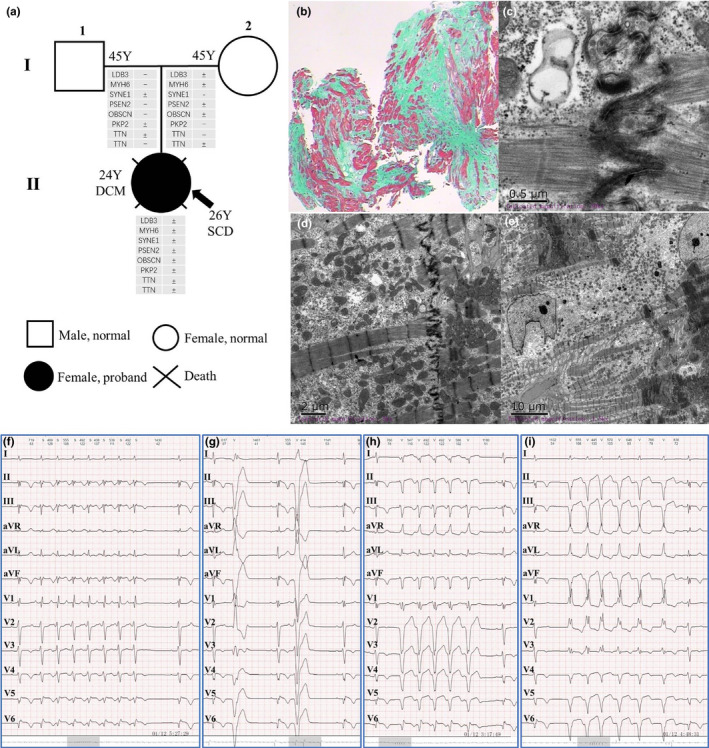
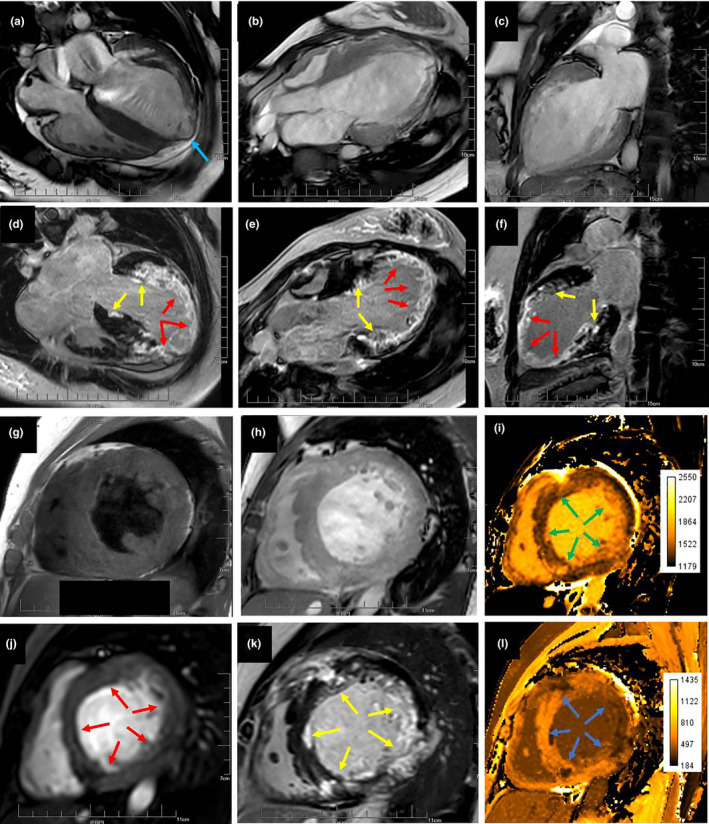
In a Chinese Han family, the patient of 24 years old occurred with early-onset and DCM and died of SCD associated with ICD storms induced by repetitive ventricular tachycardia/fibrillation (VT/F). Genomic DNA samples of peripheral blood were conducted for WES and Sanger sequence. Then, we performed bioinformatics analysis for 200 genes susceptible to cardiomyopathies and arrhythmias. Further, we analyzed how the potential pathogenic mutations affecting the secondary structure, hydrophobicity, and phosphorylation of amino acids, protein properties, and their joint pathogenicity by ProtParam, SOPMA, and ORVAL algorisms. The protein-protein interaction was analyzed by STRING algorism.
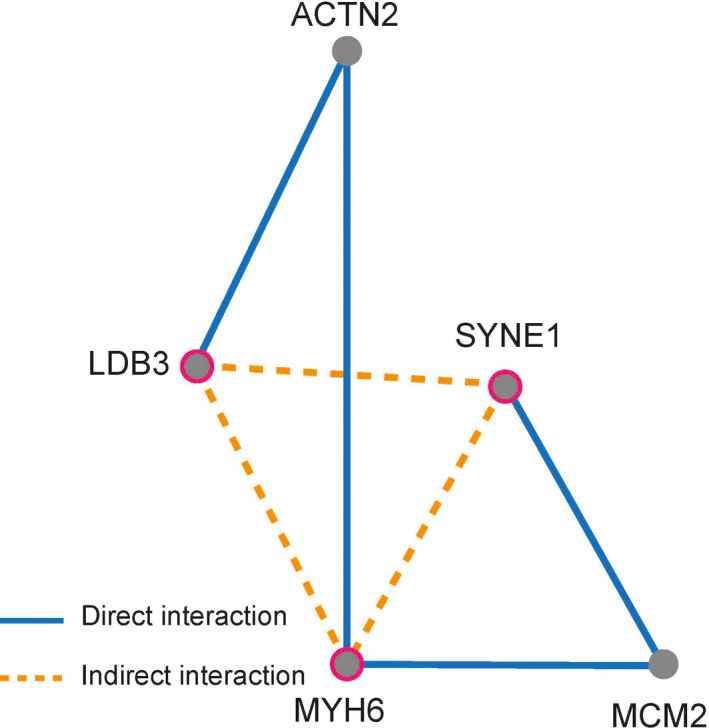
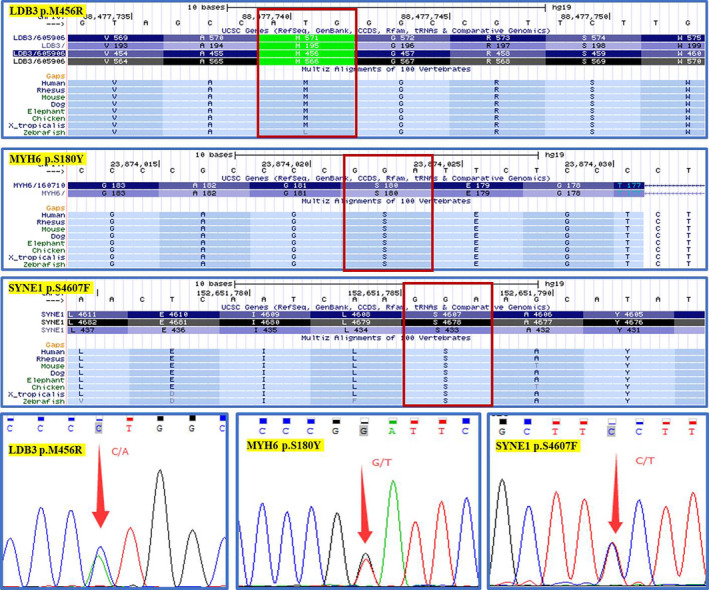
The mutations of LDB3 p.M456R, MYH6 p.S180Y, and SYNE1 p.S4607F were identified as "Damaging/Deleterious." The SYNE1 (p.S4607F) increased one of alpha helix and decreased one of beta sheet. The LDB3 (p.M456R) reduced one of beta sheet and increased one of beta turn. The MYH6 (p.S180Y) decreased two of beta sheets and four of beta turns, but significantly increased twelve coils. The hydrophobicity of amino acid residues and their adjacent sequences were decreased by LDB3 (p.M456R) and MYH6 (p.S180Y), and significantly increased by SYNE1 (p.S4607F). The mutations of LDB3 (p.M456R), SYNE1 (p.S4607F), and MYH6 (p.S180Y) resulted in the phosphorylation changes of the corresponding amino acid sites or the nearby amino acid sites. The pairwise combinations of LDB3, MYH6, and SYNE1 mutations have the high probability of causing disease, especially the highest probability for SYNE1 and LDB3 mutations. There was obviously indirect interaction of the proteins encoded by SYNE1, LDB3, and MYH6.
The multiple heterozygous mutations of SYNE1, LDB3, and MYH6 may be associated with young and early-onset of DCM and SCD.
全外显子测序(WES)结合靶向基因分析是诊断心肌病的有效工具。早发性心脏性猝死(SCD)通常与致病性基因突变引起的扩张型心肌病(DCM)有关。
在一个中国汉族家庭中,一名 24 岁的患者患有早发性 DCM 并因反复室性心动过速/颤动(VT/F)引起的 ICD 风暴导致 SCD。对外周血基因组 DNA 进行 WES 和 Sanger 测序。然后,我们对 200 个易患心肌病和心律失常的基因进行了生物信息学分析。此外,我们还通过 ProtParam、SOPMA 和 ORVAL 算法分析了潜在致病性突变如何影响氨基酸的二级结构、疏水性、磷酸化、蛋白质性质及其联合致病性。通过 STRING 算法分析蛋白质-蛋白质相互作用。
鉴定出 LDB3 p.M456R、MYH6 p.S180Y 和 SYNE1 p.S4607F 突变为“有害/有害”。SYNE1(p.S4607F)增加了一个α螺旋,减少了一个β片层。LDB3(p.M456R)减少了一个β片层,增加了一个β转角。MYH6(p.S180Y)减少了两个β片层和四个β转角,但显著增加了十二个螺旋。LDB3(p.M456R)和 MYH6(p.S180Y)使氨基酸残基及其相邻序列的疏水性降低,而 SYNE1(p.S4607F)则显著增加。LDB3(p.M456R)、SYNE1(p.S4607F)和 MYH6(p.S180Y)的突变导致相应氨基酸位点或附近氨基酸位点的磷酸化变化。LDB3、MYH6 和 SYNE1 突变的两两组合具有较高的致病概率,尤其是 SYNE1 和 LDB3 突变的概率最高。SYNE1、LDB3 和 MYH6 编码的蛋白质之间存在明显的间接相互作用。
SYNE1、LDB3 和 MYH6 的多种杂合突变可能与年轻和早发性 DCM 和 SCD 有关。