Azadi Nemam Ali, Ziapour Arash, Lebni Javad Yoosefi, Irandoost Seyed Fahim, Abbas Jaffar, Chaboksavar Fakhreddin
Department of Biostatistics, School of Health, Iran University of Medical Sciences, Tehran, Iran.
Research Center for Environmental Determinants of Health (RCEDH), Health Institute, Kermanshah University of Medical Sciences, Kermanshah, Iran.
Arch Public Health. 2021 May 5;79(1):69. doi: 10.1186/s13690-021-00594-4.
Hypertension is one of the major causes of many diseases, such as heart attack, strokes, kidney failure, and many internal disorders. This presentresearch study aimed to investigate the impact of educational programs based on the health belief model to promote hypertension prevention behavior of Iran University of Medical Sciences staff.
This study has incorporated pretest-posttest quasi-experimental based on 128 staff members and randomly assigned the recruited and involved participants to an intervention (n = 64) and a control group (n = 64). The data collection tool was based on a questionnaire related to health belief model constructs based on 42 questions. The study interpreted the results using ANCOVA and robust ANCOVA as suitable approaches.
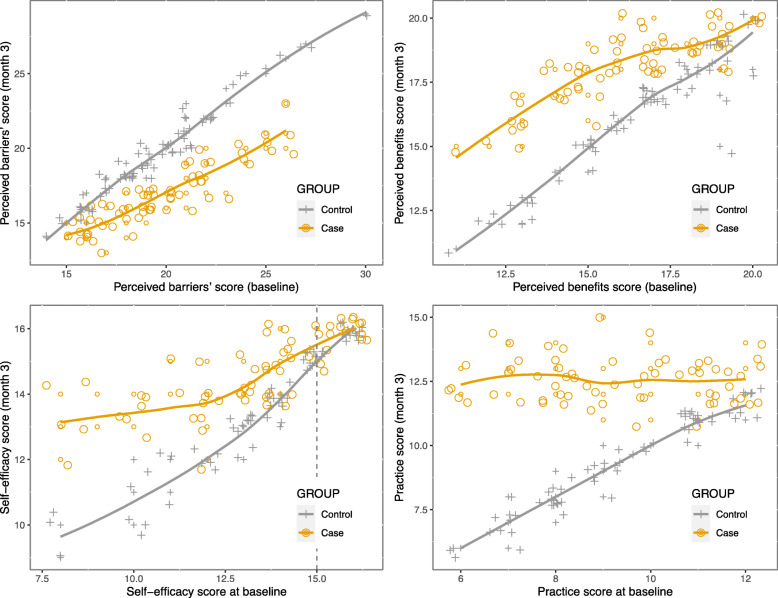
ANCOVA showed improvement in the cues to participants' action following educational interventional (p = 0.011). the robust ANCOVA specified that the intervention was successful for participants with low to moderate initial levels of knowledge, perceived susceptibility, perceived severity, perceived barriers, and self-efficacy scores. The levels of these components did not change in participants with very high baseline scores. Compared to a control group, regardless of baseline score, the perceived benefits and practice (behavior) of participants at the intervention group were improved significantly (P < 0.05).
This current study specified that the education-based health belief model effectively promotes hypertension preventive behaviors among Iran University of Medical Sciences staff.
高血压是导致多种疾病的主要原因之一,如心脏病发作、中风、肾衰竭以及许多内科疾病。本研究旨在调查基于健康信念模型的教育项目对促进伊朗医科大学教职工高血压预防行为的影响。
本研究采用基于128名教职工的前后测准实验,并将招募和参与的参与者随机分为干预组(n = 64)和对照组(n = 64)。数据收集工具基于一份与健康信念模型构建相关的问卷,共42个问题。该研究采用协方差分析(ANCOVA)和稳健协方差分析作为合适的方法来解释结果。
协方差分析显示,教育干预后参与者行动线索有所改善(p = 0.011)。稳健协方差分析表明,该干预对初始知识、感知易感性、感知严重性、感知障碍和自我效能得分处于低至中等水平的参与者是成功的。这些成分的水平在基线得分非常高的参与者中没有变化。与对照组相比,无论基线得分如何,干预组参与者的感知益处和实践(行为)均有显著改善(P < 0.05)。
本研究表明,基于教育的健康信念模型有效地促进了伊朗医科大学教职工的高血压预防行为。