Programa Centro Salud Pública, Facultad de Ciencias Médicas, Universidad de Santiago, Estación Central, Santiago, Chile.
Departamento de Enfermería, Facultad de Medicina, Universidad de Chile, Independencia, Santiago, Chile.
PLoS One. 2021 May 6;16(5):e0250707. doi: 10.1371/journal.pone.0250707. eCollection 2021.
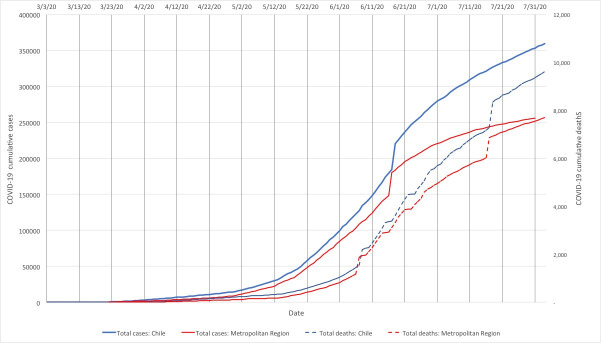
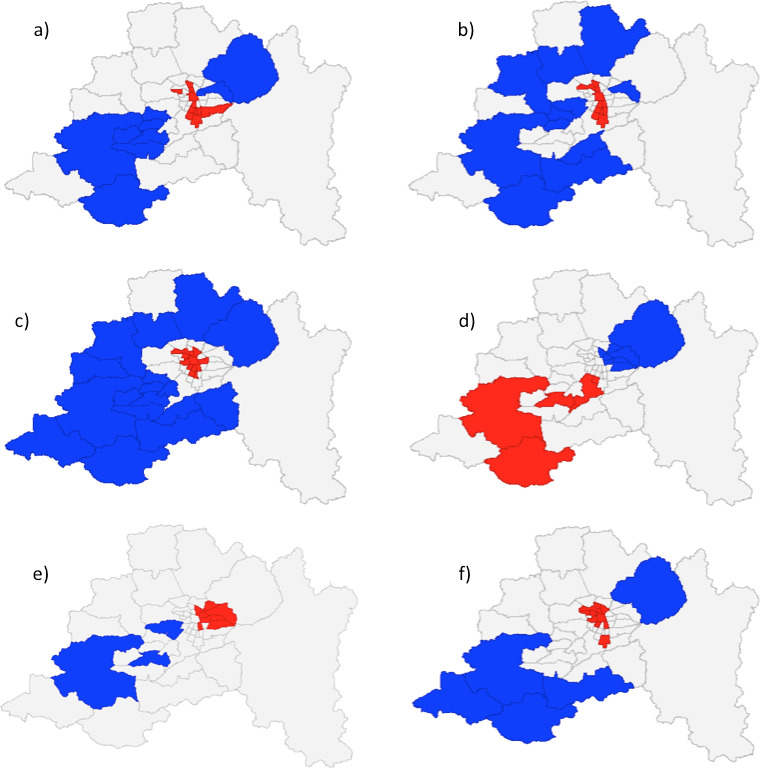
Demographic, health, and socioeconomic factors significantly inform COVID-19 outcomes. This article analyzes the association of these factors and outcomes in Chile during the first five months of the pandemic. Using the municipalities Metropolitan Region's municipalities as the unit of analysis, the study looks at the role of time dynamics, space, and place in cases and deaths over a 100-day period between March and July 2020. As a result, common and idiosyncratic elements explain the prevalence and dynamics of infections and mortality. Social determinants of health, particularly multidimensional poverty index and use of public transportation play an important role in explaining differences in outcomes. The article contributes to the understanding of the determinants of COVID-19 highlighting the need to consider time-space dynamics and social determinants as key in the analysis. Structural factors are important to identify at-risk populations and to select policy strategies to prevent and mitigate the effects of COVID-19. The results are especially relevant for similar research in unequal settings.
人口统计学、健康和社会经济因素对 COVID-19 的结果有重要影响。本文分析了智利在大流行的前五个月期间这些因素与结果之间的关联。该研究使用大都市地区的城市作为分析单位,考察了 2020 年 3 月至 7 月期间 100 天内病例和死亡的时间动态、空间和地点在病例和死亡中的作用。结果表明,共同和特殊因素可以解释感染和死亡率的流行和动态。健康的社会决定因素,特别是多维贫困指数和公共交通的使用,在解释结果差异方面发挥着重要作用。本文通过强调考虑时空动态和社会决定因素作为分析的关键,有助于理解 COVID-19 的决定因素。结构性因素对于确定高危人群和选择预防和减轻 COVID-19 影响的政策策略非常重要。研究结果对于不平等环境中的类似研究尤为重要。