Institute for Advanced Study, Shenzhen University, Shenzhen, China.
School of Public health, Shenzhen University Health Science Center, Shenzhen, China.
Lancet Digit Health. 2020 Aug;2(8):e417-e424. doi: 10.1016/S2589-7500(20)30165-5. Epub 2020 Jul 27.
Restricting human mobility is an effective strategy used to control disease spread. However, whether mobility restriction is a proportional response to control the ongoing COVID-19 pandemic is unclear. We aimed to develop a model that can quantify the potential effects of various intracity mobility restrictions on the spread of COVID-19.
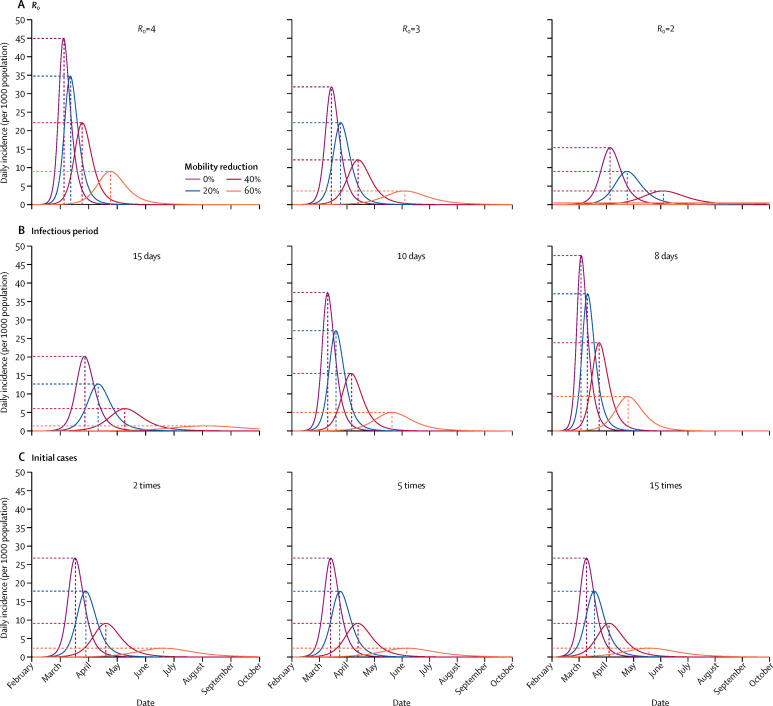
In this modelling study, we used anonymous and aggregated mobile phone sightings data to build a susceptible-exposed-infectious-recovered transmission model for COVID-19 based on the city of Shenzhen, China. We simulated how disease spread changed when we varied the type and magnitude of mobility restrictions in different transmission scenarios, with variables such as the basic reproductive number ( ), length of infectious period, and the number of initial cases.
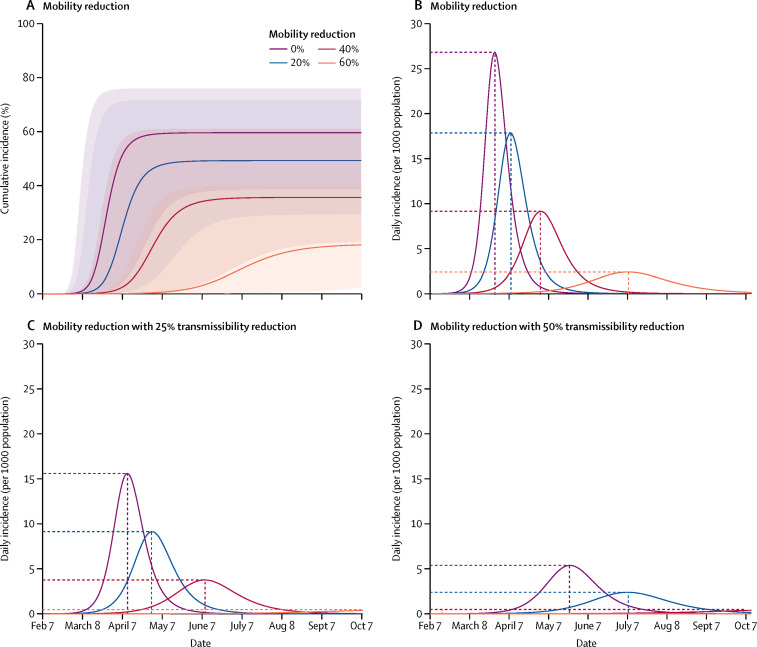
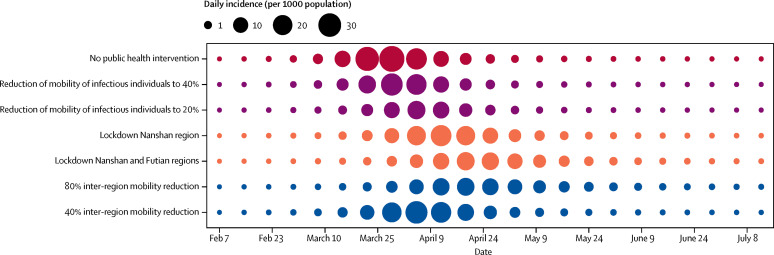
331 COVID-19 cases distributed across the ten regions of Shenzhen were reported on Feb 7, 2020. In our basic scenario ( of 2·68), mobility reduction of 20-60% within the city had a notable effect on controlling COVID-19 spread: a flattening of the peak number of cases by 33% (95% UI 21-42) and delay to the peak number by 2 weeks with a 20% restriction, 66% (48-75) reduction and 4 week delay with a 40% restriction, and 91% (79-95) reduction and 14 week delay with a 60% restriction. The effects of mobility restriction were increased when combined with reductions of 25% or 50% in transmissibility of the virus. In specific analyses of mobility restrictions for individuals with symptomatic infections and for high-risk regions, these measures also had substantial effects on reducing the spread of COVID-19. For example, the peak of the epidemic was delayed by 2 weeks if the proportion of individuals with symptomatic infections who could move freely was maintained at 20%, and by 4 weeks if two high-risk regions were locked down. The simulation results were also affected by various transmission parameters.
Our model shows the effects of various types and magnitudes of mobility restrictions on controlling COVID-19 outbreaks at the city level in Shenzhen, China. The model could help policy makers to establish the optimal combinations of mobility restrictions during the COVID-19 pandemic, especially to assess the potential positive effects of mobility restriction on public health in view of the potential negative economic and societal effects.
Guangdong Medical Science Fund, and National Natural Science Foundation of China.
限制人员流动是控制疾病传播的有效策略。然而,移动限制是否是控制当前 COVID-19 大流行的成比例反应尚不清楚。我们旨在开发一种模型,该模型可以量化各种城市内移动限制对 COVID-19 传播的潜在影响。
在这项建模研究中,我们使用匿名和汇总的手机观测数据,基于中国深圳市,建立了一个针对 COVID-19 的易感染-暴露-感染-恢复传播模型。我们模拟了在不同的传播场景下,改变移动限制的类型和幅度如何改变疾病的传播,变量包括基本繁殖数 ( )、感染期长度和初始病例数。
2020 年 2 月 7 日,在深圳市的十个区域共报告了 331 例 COVID-19 病例。在我们的基本情况下(基本繁殖数为 2.68),城市内移动减少 20-60%对控制 COVID-19 传播有显著影响:峰值病例数减少 33%(95%置信区间 21-42),峰值延迟 2 周,限制 20%;减少 66%(48-75)和延迟 4 周,限制 40%;减少 91%(79-95)和延迟 14 周,限制 60%。当结合病毒传播减少 25%或 50%时,移动限制的效果会增加。在对有症状感染个体和高风险区域的移动限制的具体分析中,这些措施也对减少 COVID-19 的传播产生了重大影响。例如,如果有症状感染的个体中可以自由移动的比例保持在 20%,则流行高峰期将延迟 2 周;如果封锁两个高风险区域,则高峰期将延迟 4 周。模拟结果还受到各种传播参数的影响。
我们的模型显示了各种类型和幅度的移动限制对控制中国深圳市城市 COVID-19 爆发的影响。该模型可以帮助决策者在 COVID-19 大流行期间建立最佳的移动限制组合,特别是鉴于潜在的负面经济和社会影响,评估移动限制对公共健康的潜在积极影响。
广东省医学科学基金和国家自然科学基金。