Laboratory of Digital and Computational Demography, Max Planck Institute for Demographic Research, Rostock, Germany
Laboratory of Digital and Computational Demography, Max Planck Institute for Demographic Research, Rostock, Germany.
BMJ Open. 2021 Oct 21;11(10):e050651. doi: 10.1136/bmjopen-2021-050651.
We investigate changes in social contact patterns following the gradual introduction of non-pharmaceutical interventions and their implications for infection transmission in the early phase of the pandemic.
DESIGN, SETTING AND PARTICIPANTS: We conducted an online survey based on targeted Facebook advertising campaigns across eight countries (Belgium, France, Germany, Italy, the Netherlands, Spain, UK and USA), achieving a sample of 51 233 questionnaires in the period 13 March-12 April 2020. Poststratification weights based on census information were produced to correct for selection bias.
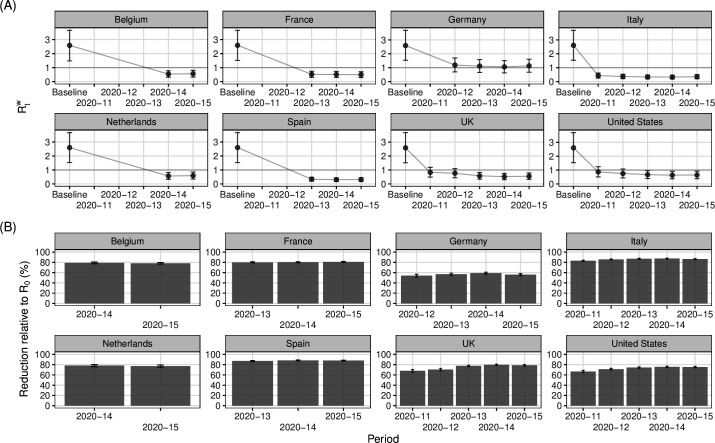
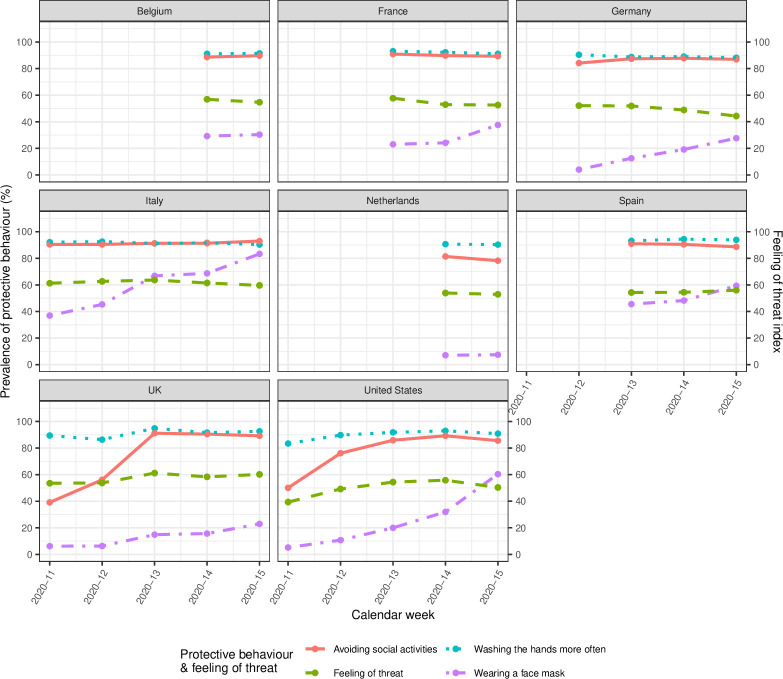
Participants provided data on social contact numbers, adoption of protective behaviours and perceived level of threat. These data were combined to derive a weekly index of infection transmission, the net reproduction number [Formula: see text] .
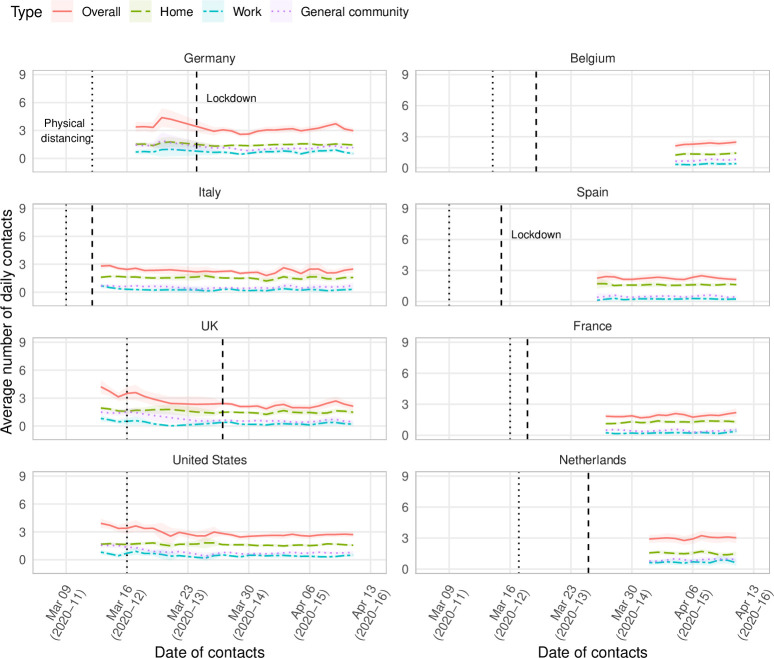
Evidence from the USA and UK showed that the number of daily contacts mainly decreased after governments issued the first physical distancing guidelines. In mid-April, daily social contact numbers had decreased between 61% in Germany and 87% in Italy with respect to pre-COVID-19 levels, mostly due to a contraction in contacts outside the home. Such reductions, which were uniform across age groups, were compatible with an [Formula: see text] equal or smaller than one in all countries, except Germany. This indicates lower levels of infection transmission, especially in a period of gradual increase in the adoption rate of the face mask outside the home.
We provided a comparable set of statistics on social contact patterns during the COVID-19 pandemic for eight high-income countries, disaggregated by week and other demographic factors, which could be leveraged by the scientific community for developing more realistic epidemic models of COVID-19.
我们研究了在非药物干预措施逐步实施后,社交接触模式的变化及其对大流行早期感染传播的影响。
设计、地点和参与者:我们在 2020 年 3 月 13 日至 4 月 12 日期间,通过在八个国家(比利时、法国、德国、意大利、荷兰、西班牙、英国和美国)的有针对性的 Facebook 广告活动进行了一项在线调查,共获得了 51233 份问卷。根据人口普查信息制作的后分层权重用于纠正选择偏差。
参与者提供了社交接触次数、采取保护行为和感知威胁程度的数据。这些数据结合起来,得出了每周感染传播指数,即有效繁殖数[公式:见正文]。
我们为八个高收入国家提供了一套可比的 COVID-19 大流行期间社交接触模式的统计数据,按周和其他人口统计因素进行了细分,科学界可以利用这些数据来开发更符合实际情况的 COVID-19 流行模型。