Postgraduate Department, Instituto Tecnológico Superior de Lerdo, 35150 Lerdo DGO, Mexico.
Medical Familiar Unit, Instituto de Seguridad y Servicios Sociales de Los Trabajadores del Estado, 27268 Torreón COAH, Mexico.
J Healthc Eng. 2021 Apr 29;2021:8869372. doi: 10.1155/2021/8869372. eCollection 2021.
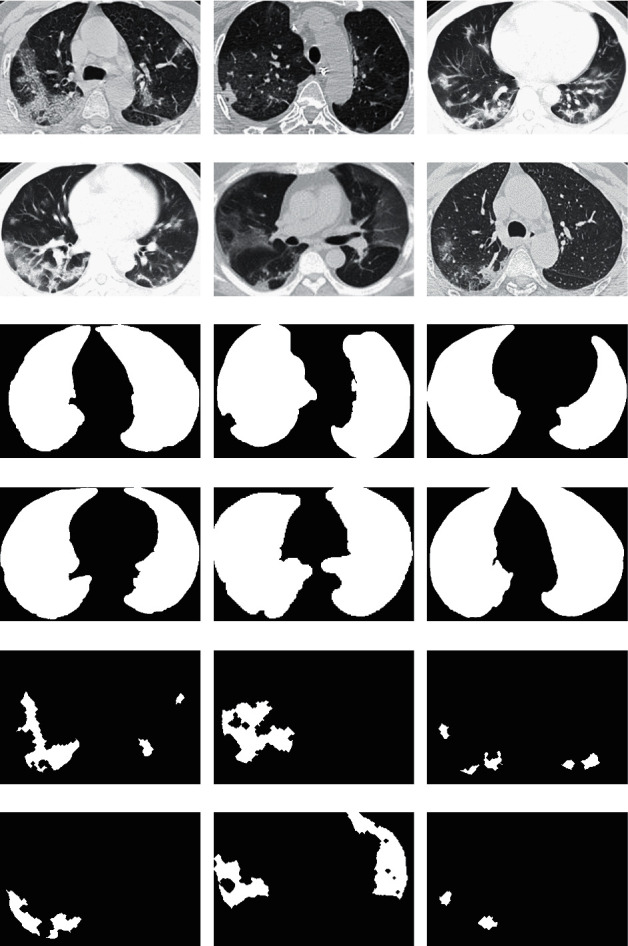
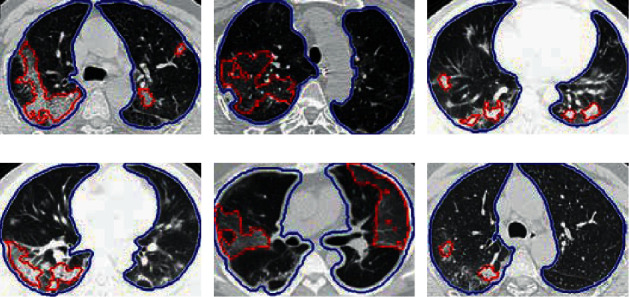
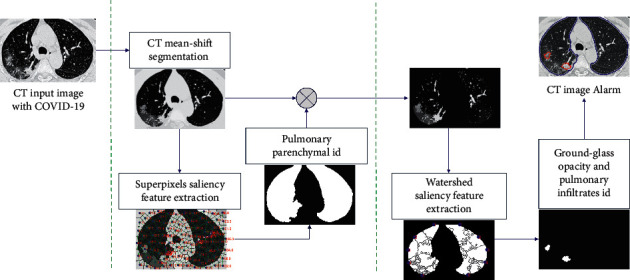
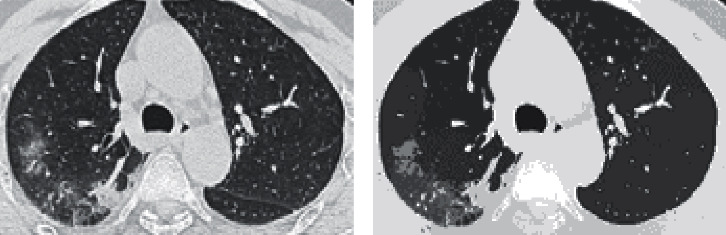
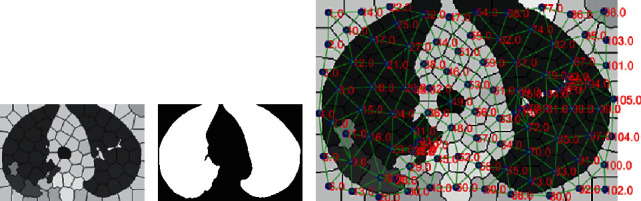
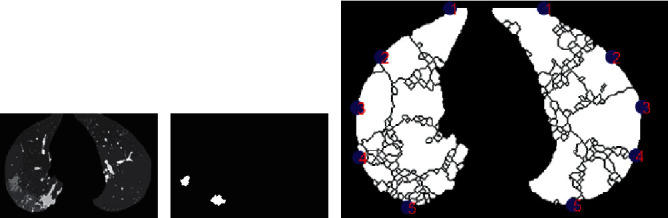
The rapid worldwide spread of the COVID-19 pandemic has infected patients around the world in a short space of time. Chest computed tomography (CT) images of patients who are infected with COVID-19 can offer early diagnosis and efficient forecast monitoring at a low cost. The diagnosis of COVID-19 on CT in an automated way can speed up many tasks and the application of medical treatments. This can help complement reverse transcription-polymerase chain reaction (RT-PCR) diagnosis. The aim of this work is to develop a system that automatically identifies ground-glass opacity (GGO) and pulmonary infiltrates (PIs) on CT images from patients with COVID-19. The purpose is to assess the disease progression during the patient's follow-up assessment and evaluation. We propose an efficient methodology that incorporates oversegmentation mean shift followed by superpixel-SLIC (simple linear iterative clustering) algorithm on CT images with COVID-19 for pulmonary parenchyma segmentation. To identify the pulmonary parenchyma, we described each superpixel cluster according to its position, grey intensity, second-order texture, and spatial-context-saliency features to classify by a tree random forest (TRF). Second, by applying the watershed segmentation to the mean-shift clusters, only pulmonary parenchyma segmentation-identified zones showed GGO and PI based on the description of each watershed cluster of its position, grey intensity, gradient entropy, second-order texture, Euclidean position to the border region of the PI zone, and global saliency features, after using TRF. Our classification results for pulmonary parenchyma identification on CT images with COVID-19 had a precision of over 92% and recall of over 92% on twofold cross validation. For GGO, the PI identification showed 96% precision and 96% recall on twofold cross validation.
COVID-19 大流行在全球范围内迅速蔓延,在短时间内感染了世界各地的患者。感染 COVID-19 的患者的胸部计算机断层扫描(CT)图像可以提供早期诊断和高效的预测监测,成本低廉。以自动化方式对 CT 上的 COVID-19 进行诊断可以加快许多任务和医疗处理的应用。这有助于补充逆转录-聚合酶链反应(RT-PCR)诊断。这项工作的目的是开发一种系统,该系统可以自动识别 COVID-19 患者 CT 图像上的磨玻璃密度(GGO)和肺部浸润(PI)。目的是在患者的随访评估和评估期间评估疾病进展。我们提出了一种有效的方法,该方法将 oversegmentation mean shift 与 COVID-19 患者 CT 图像上的 superpixel-SLIC(简单线性迭代聚类)算法结合使用,用于肺部实质分割。为了识别肺部实质,我们根据每个超像素簇的位置、灰度强度、二阶纹理和空间上下文显著性特征来描述每个超像素簇,然后通过树随机森林(TRF)进行分类。其次,通过将分水岭分割应用于均值移位簇,仅在根据每个分水岭簇的位置、灰度强度、梯度熵、二阶纹理、PI 区域边界区域的欧几里得位置和全局显著性特征对其进行描述后,才能识别出肺部实质分割识别的区域中的 GGO 和 PI。我们对 COVID-19 患者 CT 图像上的肺部实质识别的分类结果在两次交叉验证中,精度超过 92%,召回率超过 92%。对于 GGO,PI 识别在两次交叉验证中的准确率为 96%,召回率为 96%。