Chiang Felicia, Mazdiyasni Omid, AghaKouchak Amir
Department of Civil and Environmental Engineering, University of California, Irvine, CA, USA.
Department of Earth System Science, University of California, Irvine, CA, USA.
Nat Commun. 2021 May 12;12(1):2754. doi: 10.1038/s41467-021-22314-w.
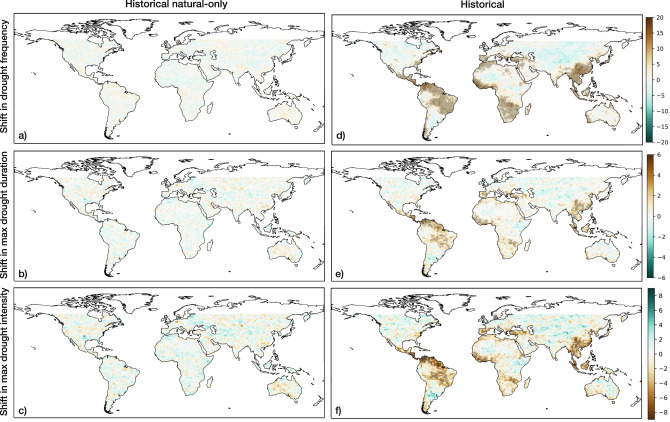
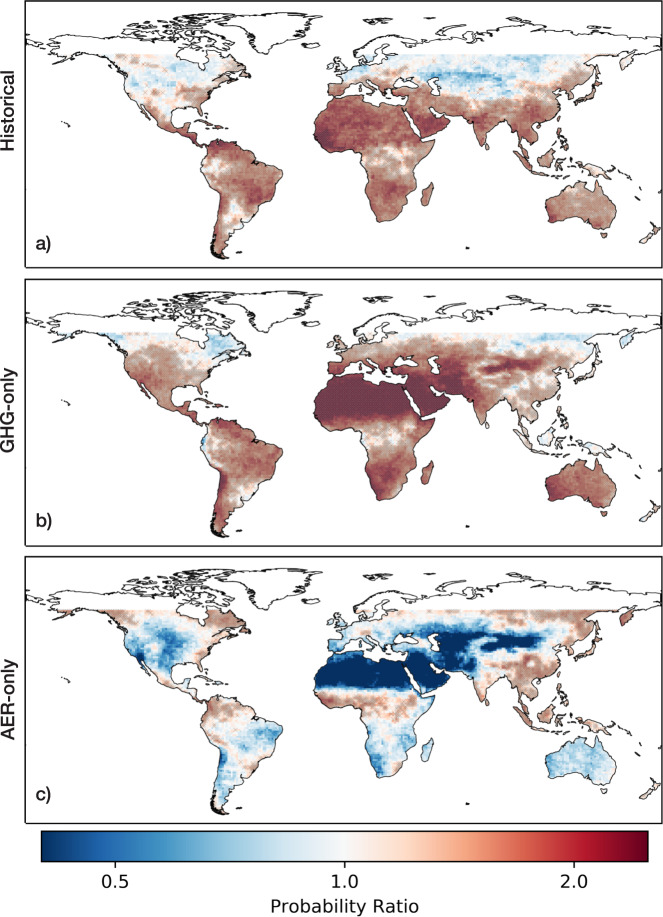
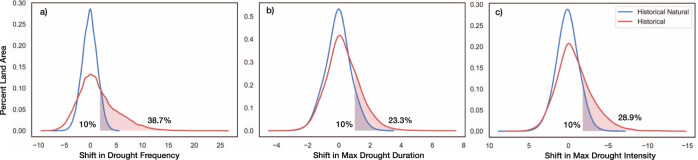
Most climate change detection and attribution studies have focused on mean or extreme temperature or precipitation, neglecting to explore long-term changes in drought characteristics. Here we provide evidence that anthropogenic forcing has impacted interrelated meteorological drought characteristics. Using SPI and SPEI indices generated from an ensemble of 9 CMIP6 models (using 3 realizations per model), we show that the presence of anthropogenic forcing has increased the drought frequency, maximum drought duration, and maximum drought intensity experienced in large parts of the Americas, Africa, and Asia. Using individual greenhouse gas and anthropogenic aerosol forcings, we also highlight that regional balances between the two major forcings have contributed to the drying patterns detected in our results. Overall, we provide a comprehensive characterization of the influence of anthropogenic forcing on drought characteristics, providing important perspectives on the role of forcings in driving changes in drought events.
大多数气候变化检测和归因研究都集中在平均或极端温度或降水方面,而忽略了对干旱特征长期变化的探索。在此,我们提供证据表明,人为强迫已经影响了相互关联的气象干旱特征。利用由9个CMIP6模型集合(每个模型使用3个实现)生成的SPI和SPEI指数,我们表明,人为强迫的存在增加了美洲、非洲和亚洲大部分地区经历的干旱频率、最大干旱持续时间和最大干旱强度。利用单个温室气体和人为气溶胶强迫,我们还强调,这两种主要强迫之间的区域平衡促成了我们结果中检测到的干旱模式。总体而言,我们全面描述了人为强迫对干旱特征的影响,为强迫在驱动干旱事件变化中的作用提供了重要观点。