Doctoral School of Health Sciences, University of Pécs, Pécs, Hungary.
Institute of Bioanalysis, Medical School, University of Pécs, Pécs, Hungary.
BMC Womens Health. 2021 May 15;21(1):202. doi: 10.1186/s12905-021-01352-y.
Female breast cancer was the most diagnosed cancer in 2020, with more than two million new cases worldwide. Access to scientifically correct information can assist patients in early detection or prevention of the disease. However, misinformation on social networking sites (SNSs) about breast cancer can be propagated rapidly, posing a threat to health communication efforts. The aim of this study is to analyse the characteristics of the most shared news stories referencing the disease that circulated on SNSs, including the credibility of this content.
This is an exploratory quali-quantitative study. Data collection was conducted between June 2019 and June 2020. We performed statistical and content analysis of the stories that had at least 1,000 total shares. Each story was classified in accordance to the following aspects: credibility; type of rumour; source; content type; mentions prevention or early detection/screening exams.
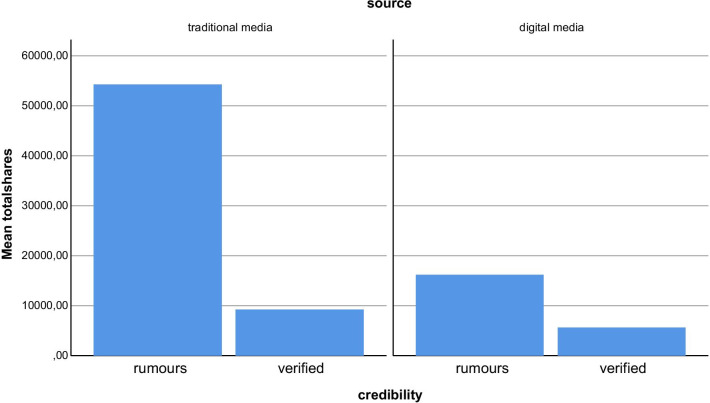
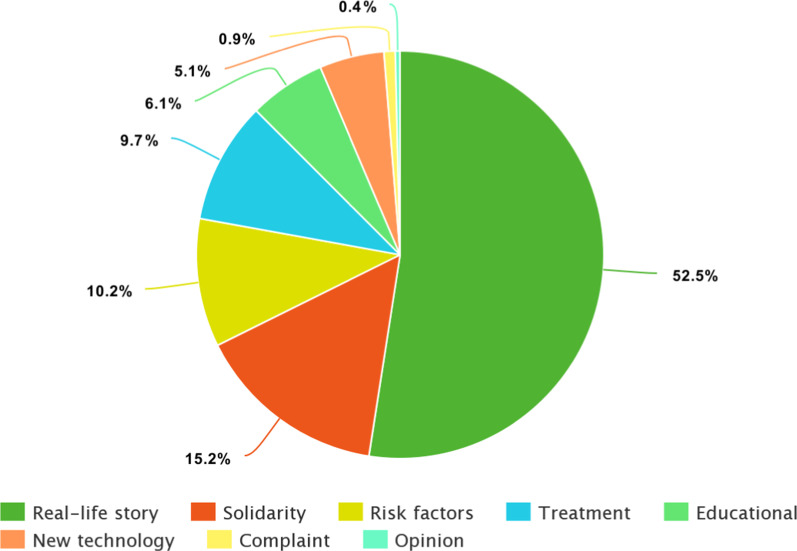
The abundance of news stories in our sample (n = 1,594) were not classified according to their credibility, as they do not address science, risk factors, prevention, treatment, or other aspects which can be assessed for scientific accuracy. However, content classified as "rumours" are 3.29 times more shared than those considered scientifically correct. Regarding content type, most stories are classified as 'real-life story' or 'solidarity' (67.69%). In our sample, 5.08% of the total comment on prevention and 19.7% reference early detection.
We consider it can be a good strategy, in SNSs, to combine content of greater popularity, such as real-life stories, with subjects that can make a difference in a patient's life, such as early detection, breast cancer symptoms and disease prevention strategies. Doctors, scientists and health journalists can expand the dialogue with the lay public regarding breast cancer, helping to counteract online misinformation.
女性乳腺癌是 2020 年最常见的癌症,全球有超过 200 万例新发病例。获得科学正确的信息可以帮助患者早期发现或预防疾病。然而,社交网络(SNS)上关于乳腺癌的错误信息可能会迅速传播,对健康传播工作构成威胁。本研究旨在分析在 SNS 上传播的、引用该疾病的最常分享的新闻报道的特点,包括这些内容的可信度。
这是一项探索性的质化研究。数据收集于 2019 年 6 月至 2020 年 6 月之间进行。我们对至少有 1000 次总分享的报道进行了统计和内容分析。每个故事都根据以下方面进行分类:可信度、谣言类型、来源、内容类型、提及预防或早期检测/筛查检查。
我们样本中的新闻报道数量丰富(n=1594),但没有按照可信度进行分类,因为它们没有涉及科学、风险因素、预防、治疗或其他可以评估科学准确性的方面。然而,被归类为“谣言”的内容被分享的次数是被认为是科学正确的内容的 3.29 倍。关于内容类型,大多数故事被归类为“真实故事”或“团结”(67.69%)。在我们的样本中,有 5.08%的评论涉及预防,19.7%的评论提到早期检测。
我们认为,在 SNS 上,结合更受欢迎的内容(如真实故事)与可以对患者生活产生影响的主题(如早期检测、乳腺癌症状和疾病预防策略)是一个很好的策略。医生、科学家和健康记者可以与非专业人士扩大有关乳腺癌的对话,有助于对抗网络上的错误信息。