Dawczynski Christine, Cullen Paul M, Schlattmann Peter, Lorkowski Stefan
Research Group Nutritional Concepts, Institute of Nutritional Sciences, Friedrich Schiller University Jena, Dornburger Str. 29, 07743, Jena, Germany.
Competence Cluster for Nutrition and Cardiovascular Health (nutriCARD) Halle-Jena-Leipzig, Dornburger Str. 25, 07743, Jena, Germany.
Contemp Clin Trials Commun. 2021 Apr 29;22:100761. doi: 10.1016/j.conctc.2021.100761. eCollection 2021 Jun.
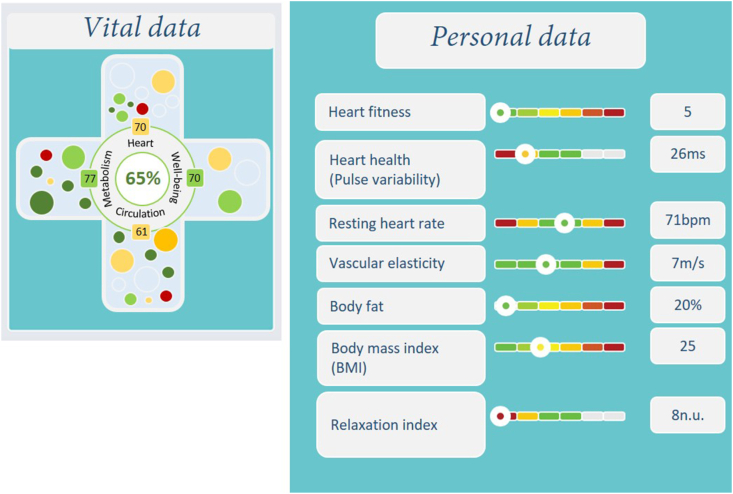
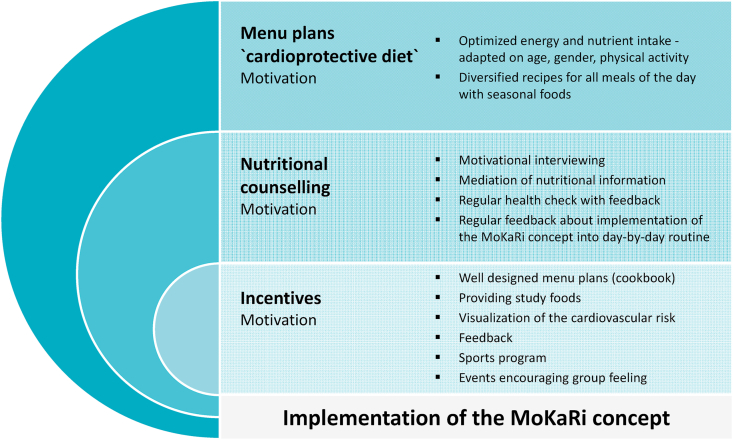
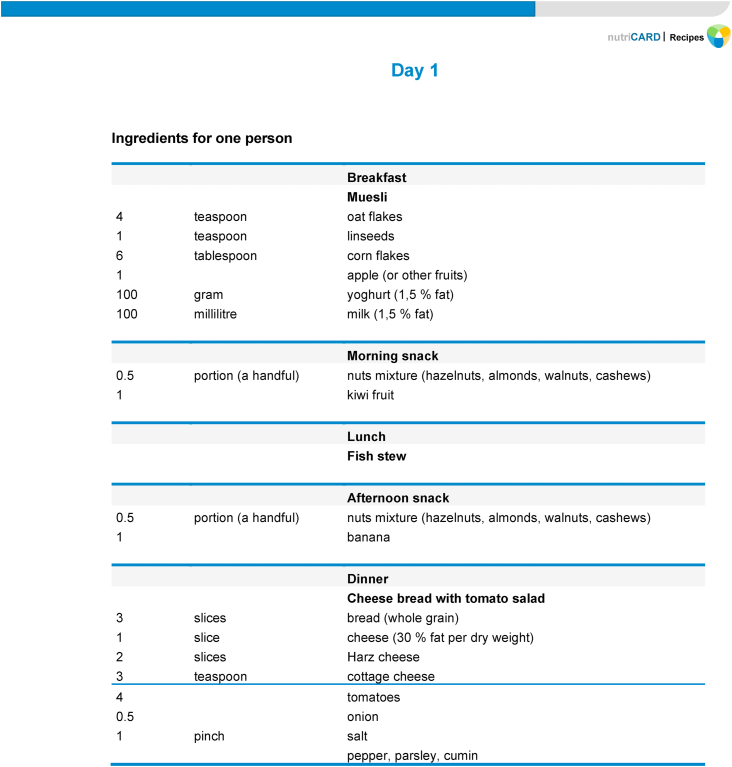
Changes in dietary habits and lifestyle can reduce the risk of cardiovascular disease which is the leading cause of death worldwide. Objectives of the MoKaRi study The MoKaRi (modulation of cardiovascular risk factors) intervention study is designed to evaluate the effectiveness and potential of the developed MoKaRi concept. The MoKaRi concept comprises three components, each designed to improve dietary behavior. The first component entails using daily menu plans to implement a defined "cardioprotective diet". This diet consists of seasonal menu plans which are characterized by:(i) a personalized energy supply depending on his or her age, gender, level of physical activity.(ii) an adequate intake of carbohydrates, protein, fat, vitamins, minerals, and trace elements according to the guidelines of the German Society of Nutrition (DGE).(iii) a recommended intake of saturated fatty acids (SFA; < 7% of caloric intake (En%)), monounsaturated fatty acids (MUFA; > 10 En%), polyunsaturated fatty acids.(PUFA; approx. 10 En%), and long-chain n-3 PUFA (≥500 mg per day).(iv) measures to encourage consumption of vegetables and fruits, and.(v) eating more than 40 g dietary fiber every day.Half of the participants will be scheduled to consume an additional 3 g of long-chain n- 3 PUFA every day in the form of fish oil.The second component consists of regular one-on-one nutritional counseling, while a variety of further incentives make up the third component of the MoKaRi concept.The MoKaRi study will provide essential insights into the relationship between defined nutrient intake, markers of food intake and health status. Our specific aim is to investigate the influence of dietary and lifestyle choices have on cardiovascular health.The information and practical tools suitable for daily use, such as the personalized menu plans, could help to transfer knowledge on nutritional facts to the general population. In this way, the validated MoKaRi concept may contribute to the prevention and therapy of cardiovascular diseases.
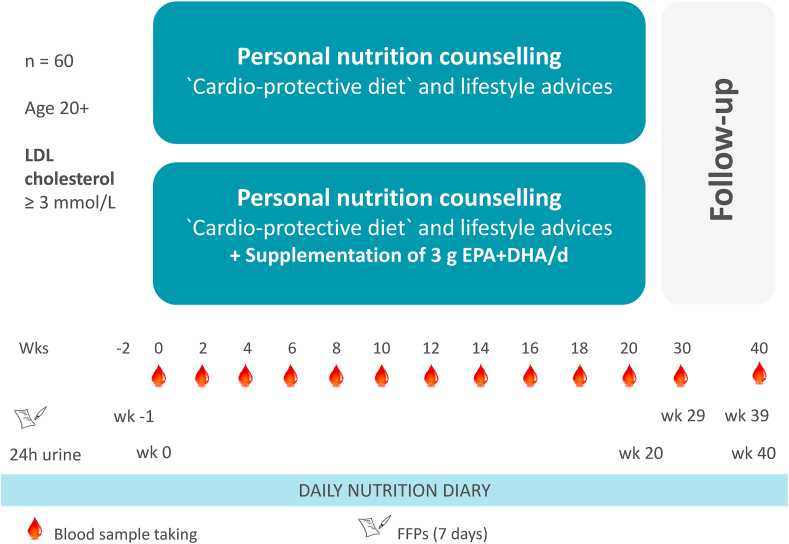
In line with our power calculation, we will enroll 60 participants and randomly assign them to one of two parallel arms. Each participant will receive personalized menu plans for each day of the study and will be provided with one-on-one nutritional counseling sessions every two weeks for a study period of 20 weeks (140 days). During this period, blood samples will be taken every 14 days (11 time points) and twice during a 20-weeks follow-up period. Incentives such as a supply of foods approved according t the standards of the study, a sports program, individual feedback on study parameters reflecting health status, and group activities round off the MoKaRi concept.Low-density cholesterol is the primary outcome measure of the MoKaRi study, and the secondary endpoints comprise markers of nutrient status (e.g. fatty acid distribution in plasma and erythrocyte lipids), a metabolomic profiling, diabetes risk markers, clotting markers, and further cardiovascular risk factors, such as blood lipids, homocysteine and high-sensitive c-reactive protein.The MoKaRi study was registered before launch at ClinicalTrials.gov (identifier NCT02637778; https://clinicaltrials.gov/ct2/show/NCT02637778).
饮食习惯和生活方式的改变可降低心血管疾病的风险,而心血管疾病是全球主要的死亡原因。莫卡里(MoKaRi)研究的目标 莫卡里(调节心血管危险因素)干预研究旨在评估所开发的莫卡里概念的有效性和潜力。莫卡里概念包括三个组成部分,每个部分都旨在改善饮食行为。第一个组成部分是使用每日菜单计划来实施特定的“心脏保护饮食”。这种饮食由季节性菜单计划组成,其特点是:(i)根据年龄、性别、身体活动水平提供个性化的能量供应。(ii)根据德国营养学会(DGE)的指南,适量摄入碳水化合物、蛋白质、脂肪、维生素、矿物质和微量元素。(iii)推荐摄入饱和脂肪酸(SFA;热量摄入的<7%)、单不饱和脂肪酸(MUFA;>10%热量摄入)、多不饱和脂肪酸(PUFA;约10%热量摄入)和长链n-3多不饱和脂肪酸(每天≥500毫克)。(iv)鼓励食用蔬菜和水果的措施,以及(v)每天摄入超过40克膳食纤维。一半的参与者将计划每天额外摄入3克长链n-3多不饱和脂肪酸,以鱼油的形式。第二个组成部分包括定期的一对一营养咨询,而各种进一步的激励措施构成了莫卡里概念的第三个组成部分。莫卡里研究将为确定的营养素摄入、食物摄入标志物与健康状况之间的关系提供重要见解。我们的具体目标是研究饮食和生活方式选择对心血管健康的影响。适合日常使用的信息和实用工具,如个性化菜单计划,有助于将营养知识传授给普通人群。通过这种方式,经过验证的莫卡里概念可能有助于心血管疾病的预防和治疗。
根据我们的功效计算,我们将招募60名参与者,并将他们随机分配到两个平行组中的一组。每位参与者将在研究的每一天收到个性化菜单计划,并在为期20周(140天)的研究期间每两周接受一次一对一的营养咨询。在此期间,每14天(11个时间点)采集一次血样,并在20周的随访期内采集两次。诸如根据研究标准批准的食物供应、运动计划、反映健康状况的研究参数的个人反馈以及团体活动等激励措施完善了莫卡里概念。低密度胆固醇是莫卡里研究的主要结局指标,次要终点包括营养状况标志物(如血浆和红细胞脂质中的脂肪酸分布)、代谢组学分析、糖尿病风险标志物、凝血标志物以及其他心血管危险因素,如血脂、同型半胱氨酸和高敏C反应蛋白。莫卡里研究在启动前已在ClinicalTrials.gov注册(标识符NCT02637778;https://clinicaltrials.gov/ct2/show/NCT02637778)。