Department of Cardiology CHA Bundang Medical CenterCHA University Seongnam Republic of Korea.
Division of Cardiology Department of Internal Medicine Yonsei University College of Medicine Seoul Republic of Korea.
J Am Heart Assoc. 2021 Jun;10(11):e019482. doi: 10.1161/JAHA.120.019482. Epub 2021 May 15.
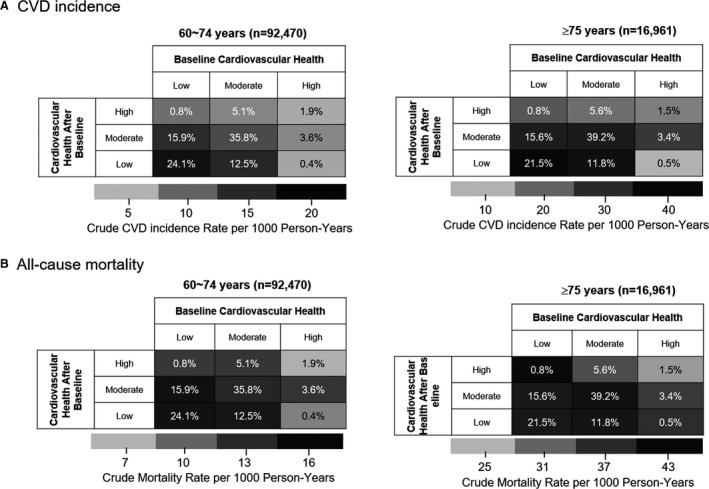
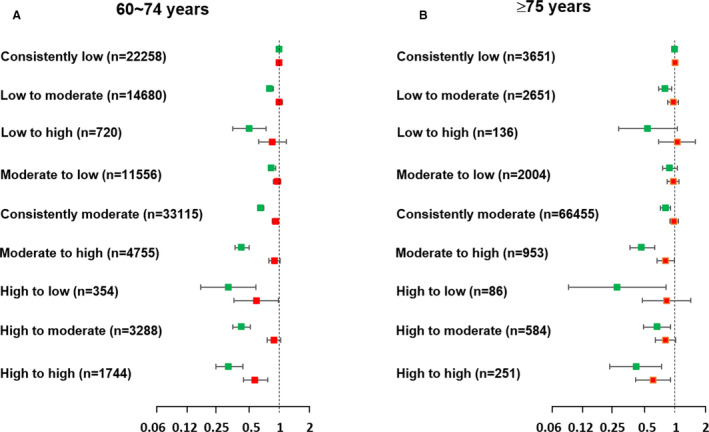
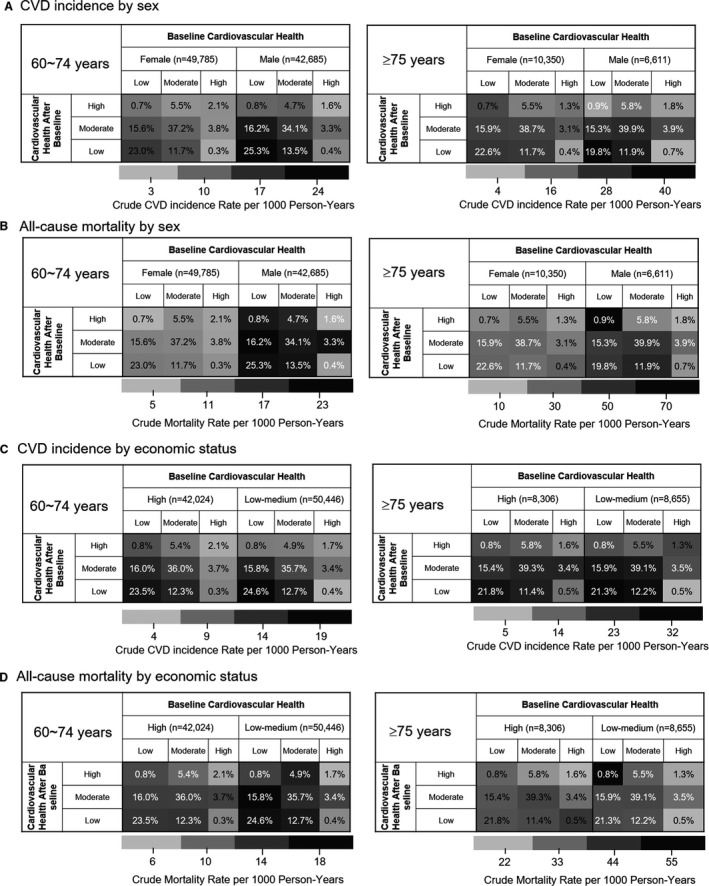
Background This study examines changes in the ideal cardiovascular health (CVH) status and whether these changes are associated with incident cardiovascular disease (CVD) and mortality in the elderly Asian population. Methods and Results In the Korea National Health Insurance Service-Senior cohort aged ≥60 years, 208 673 participants without prior CVD, including 109 431 who showed changes in CVH status, were assessed. The association of the changes in cardiovascular risk factors with incident CVD was assessed from 2004 to 2014 in the elderly (aged 60-74 years) and very elderly (≥75 years) groups. During the follow-up period (7.1 years for CVD and 7.2 years for mortality), 19 429 incident CVD events and 24 225 deaths occurred. In both the elderly and very elderly participants, higher CVH status resulted in a lower risk of CVD and mortality. In the very elderly participants, compared with consistently low CVH, consistently high CVH (subhazard ratio, 0.41; 95% CI, 0.23-0.73) was associated with a lower risk of CVD. This trend was consistently observed in the elderly population. In the very elderly participants, total cholesterol level was not informative enough for the prediction of CVD events. In both the elderly and very elderly groups, body mass index and total cholesterol were not informative enough for the prediction of all-cause mortality. Conclusions In both the elderly and very elderly Asian populations without CVD, a consistent relationship was observed between the improvement of a composite metric of CVH and the reduced risk of CVD. Body mass index and total cholesterol were not informative enough for the prediction of all-cause mortality in both the elderly and very elderly groups.
背景 本研究旨在探讨理想心血管健康(CVH)状况的变化,以及这些变化是否与老年亚洲人群中心血管疾病(CVD)事件和死亡率的发生相关。
方法和结果 在韩国国家健康保险服务-老年队列中,年龄≥60 岁且无 CVD 病史的 208673 例参与者(其中 109431 例 CVH 状况发生变化)纳入研究。评估了从 2004 年至 2014 年心血管危险因素变化与老年(60-74 岁)和非常老年(≥75 岁)人群 CVD 事件发生的相关性。在随访期间(CVD 为 7.1 年,死亡率为 7.2 年),共发生 19429 例 CVD 事件和 24225 例死亡。在老年和非常老年参与者中,CVH 状况较高与 CVD 和死亡率降低相关。在非常老年参与者中,与持续低 CVH 相比,持续高 CVH(亚危险比,0.41;95%置信区间,0.23-0.73)与 CVD 风险降低相关。这一趋势在老年人群中也得到了一致观察。在非常老年参与者中,总胆固醇水平对于 CVD 事件的预测不够充分。在老年和非常老年组中,体重指数和总胆固醇对于全因死亡率的预测均不够充分。
结论 在无 CVD 的老年和非常老年亚洲人群中,CVH 综合指标的改善与 CVD 风险降低之间存在一致关系。体重指数和总胆固醇对于老年和非常老年组全因死亡率的预测均不够充分。