Chien Pei-Li, Liu Chi-Feng, Huang Hui-Ting, Jou Hei-Jen, Chen Shih-Ming, Young Tzuu-Guang, Wang Yi-Feng, Liao Pei-Hung
Public Affairs Office, Taiwan Adventist Hospital, No. 424, Sec. 2, Bade Road., Songshan District, Taipei City 10556, Taiwan.
School of Nursing, National Taipei University of Nursing and Health Sciences, No. 365, Ming-te Road, Peitou District, Taipei City 112, Taiwan.
Evid Based Complement Alternat Med. 2021 Apr 30;2021:5530717. doi: 10.1155/2021/5530717. eCollection 2021.
This study conducted exploratory research using artificial intelligence methods. The main purpose of this study is to establish an association model between metabolic syndrome and the TCM (traditional Chinese medicine) constitution using the characteristics of individual physical examination data and to provide guidance for medicated diet care.
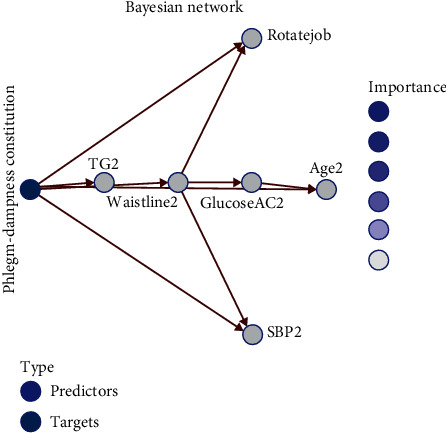
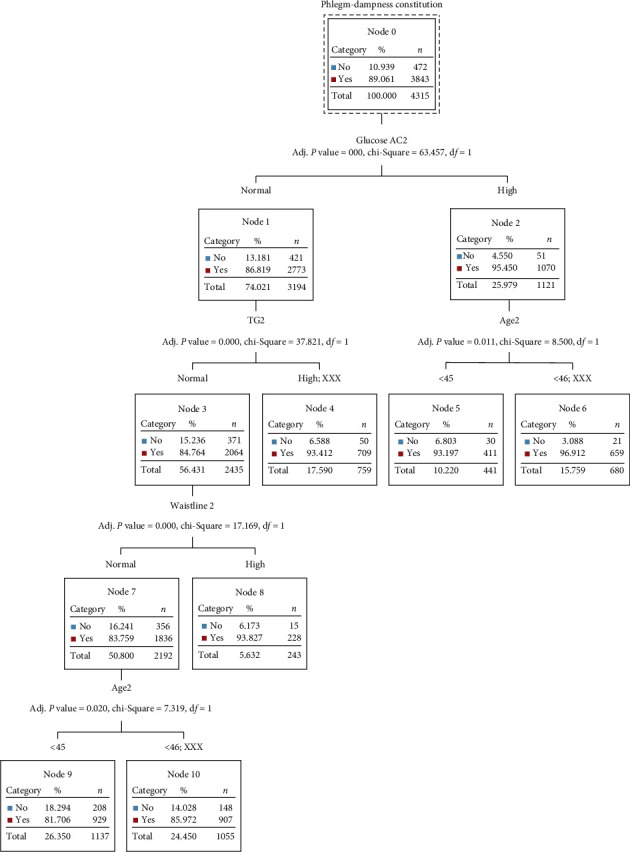
Basic demographic and laboratory data were collected from a regional hospital health examination database in northern Taiwan, and artificial intelligence algorithms, such as logistic regression, Bayesian network, and decision tree, were used to analyze and construct the association model between metabolic syndrome and the TCM constitution. . It was found that the phlegm-dampness constitution (90.6%) accounts for the majority of TCM constitution classifications with a high risk of metabolic syndrome, and high cholesterol, blood glucose, and waist circumference were statistically significantly correlated with the phlegm-dampness constitution. This study also found that the age of patients with metabolic syndrome has been advanced, and shift work is one of the risk indicators. Therefore, based on the association model between metabolic syndrome and TCM constitution, in the future, metabolic syndrome can be predicted through the syndrome differentiation of the TCM constitution, and relevant medicated diet care schemes can be recommended for improvement.
In order to increase the public's knowledge and methods for mitigating metabolic syndrome, in the future, nursing staff can provide nonprescription medicated diet-related nursing guidance information via the prediction and assessment of the TCM constitution.
本研究采用人工智能方法进行探索性研究。本研究的主要目的是利用个体体检数据的特征,建立代谢综合征与中医体质之间的关联模型,并为药膳护理提供指导。
从台湾北部某地区医院健康体检数据库中收集基本人口统计学和实验室数据,并采用逻辑回归、贝叶斯网络和决策树等人工智能算法,分析构建代谢综合征与中医体质之间的关联模型。结果发现,痰湿体质(90.6%)在代谢综合征高危的中医体质分类中占多数,高胆固醇、血糖和腰围与痰湿体质在统计学上有显著相关性。本研究还发现,代谢综合征患者的年龄已趋老龄化,轮班工作是风险指标之一。因此,基于代谢综合征与中医体质的关联模型,未来可通过中医体质辨证预测代谢综合征,并推荐相关药膳护理方案进行改善。
为了增加公众对缓解代谢综合征的认识和方法,未来护理人员可通过中医体质的预测和评估,提供非处方药膳相关的护理指导信息。