Institut des Sciences Moléculaires d'Orsay, Université Paris-Saclay, CNRS, Orsay, France.
Abbelight, Cachan, France.
Nat Commun. 2021 May 24;12(1):3077. doi: 10.1038/s41467-021-23405-4.
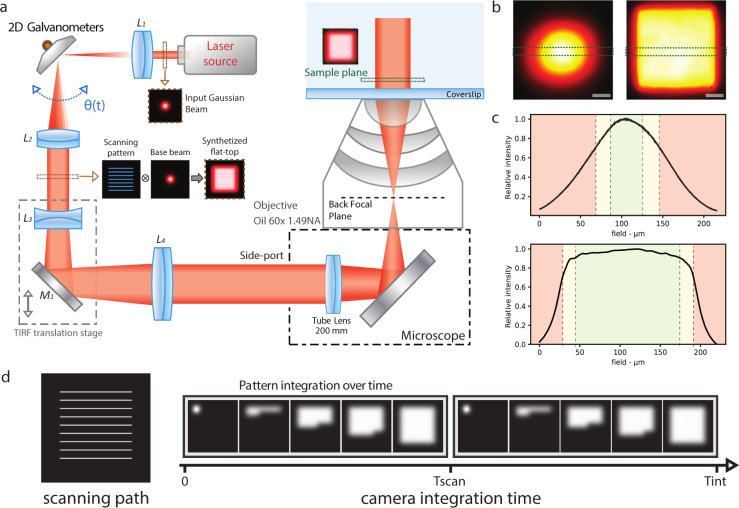
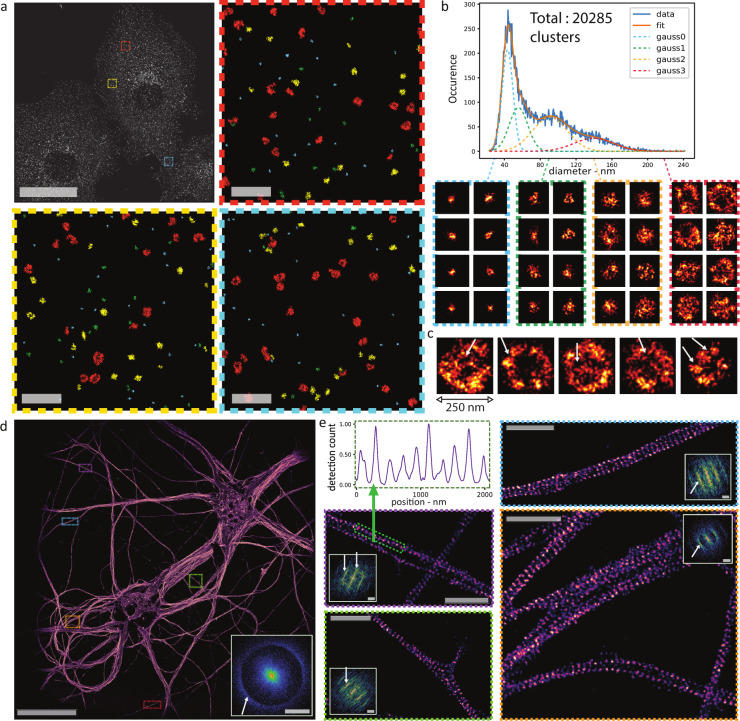
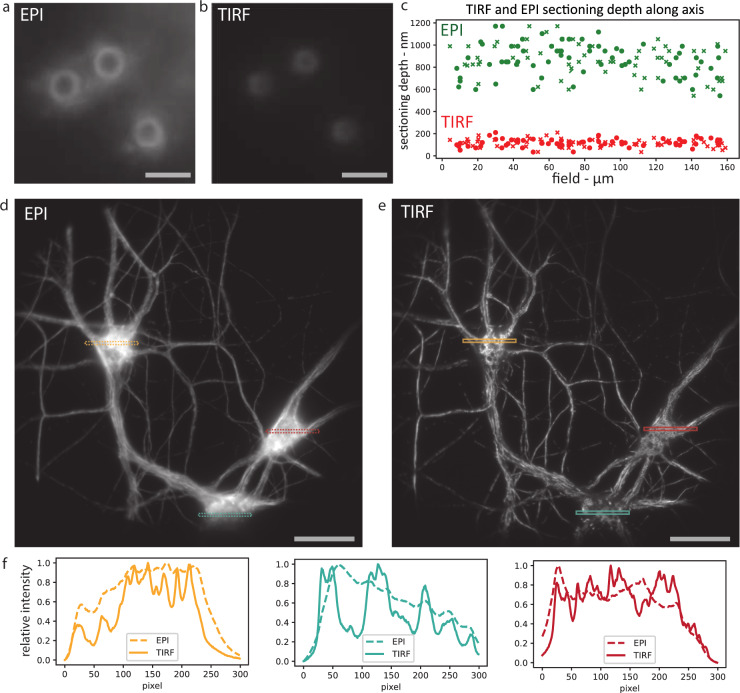
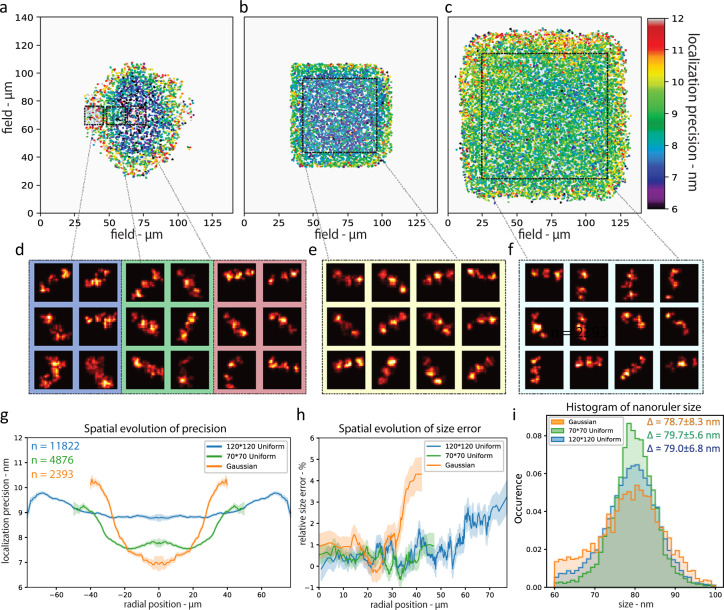
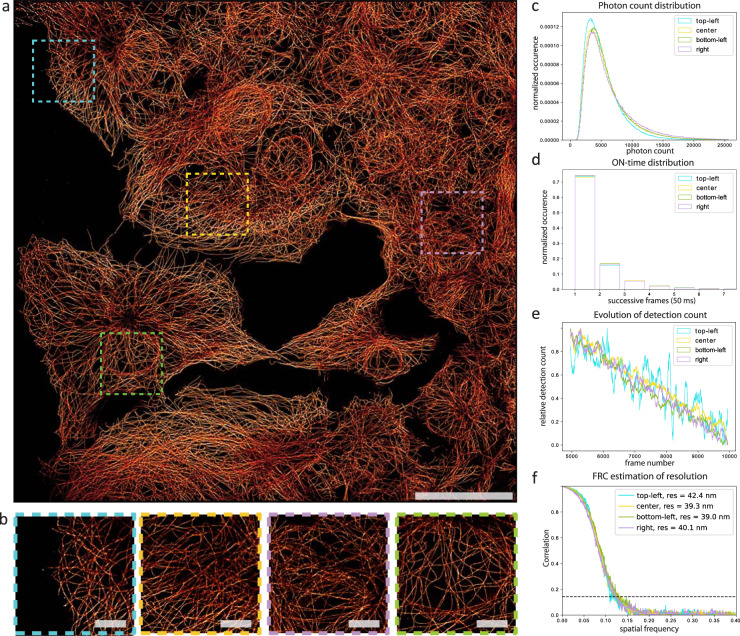
Non-uniform illumination limits quantitative analyses of fluorescence imaging techniques. In particular, single molecule localization microscopy (SMLM) relies on high irradiances, but conventional Gaussian-shaped laser illumination restricts the usable field of view to around 40 µm × 40 µm. We present Adaptable Scanning for Tunable Excitation Regions (ASTER), a versatile illumination technique that generates uniform and adaptable illumination. ASTER is also highly compatible with optical sectioning techniques such as total internal reflection fluorescence (TIRF). For SMLM, ASTER delivers homogeneous blinking kinetics at reasonable laser power over fields-of-view up to 200 µm × 200 µm. We demonstrate that ASTER improves clustering analysis and nanoscopic size measurements by imaging nanorulers, microtubules and clathrin-coated pits in COS-7 cells, and β2-spectrin in neurons. ASTER's sharp and quantitative illumination paves the way for high-throughput quantification of biological structures and processes in classical and super-resolution fluorescence microscopies.
非均匀照明限制了荧光成像技术的定量分析。特别是,单分子定位显微镜(SMLM)依赖于高辐照度,但传统的高斯形状激光照明将可用视场限制在约 40μm×40μm 左右。我们提出了自适应扫描可调激发区域(ASTER),这是一种通用的照明技术,可产生均匀且可调节的照明。ASTER 还与全内反射荧光(TIRF)等光学切片技术高度兼容。对于 SMLM,ASTER 在合理的激光功率下在高达 200μm×200μm 的视场中提供均匀的闪烁动力学。我们通过在 COS-7 细胞中成像纳米标尺、微管和网格蛋白包被凹陷以及神经元中的β2- spectrin 来证明 ASTER 可以改善聚类分析和纳米级尺寸测量。ASTER 的锐利和定量照明为在经典和超分辨率荧光显微镜中对生物结构和过程进行高通量定量铺平了道路。