Monisha J, Peter Elbe, Ani G Suja
Department of Orthodontics, Government Dental College, Kottayam, Kerala, India.
J Int Soc Prev Community Dent. 2021 Apr 15;11(2):207-215. doi: 10.4103/jispcd.JISPCD_443_20. eCollection 2021 Mar-Apr.
A culturally adapted and validated Oral Health-Related Quality of Life (OHRQoL) inventory helps to reliably compare patient perceptions among different populations. The Psychosocial Impact of Dental Aesthetics Questionnaire (PIDAQ) evaluates the impact of dental aesthetics on OHRQoL. This study aimed to develop a regional version of PIDAQ (PIDAQ) for the Indian population and to assess differences in perceptions due to malocclusion in different population groups.
PIDAQ was derived through the translation process and pilot-tested to assess test-retest reliability. Psychometric properties were tested on 285 subjects (31.2% males, 68.8% females; age range 18-25 years). Normative treatment need was assessed using Index of Orthodontic Treatment Need (IOTN)-Dental Health Component and subjective assessment using IOTN-Aesthetic Component (AC) and Perception of Occlusion Scale (POS). PIDAQ mean domain scores were compared with those of the previously validated versions to assess difference in perceptions.
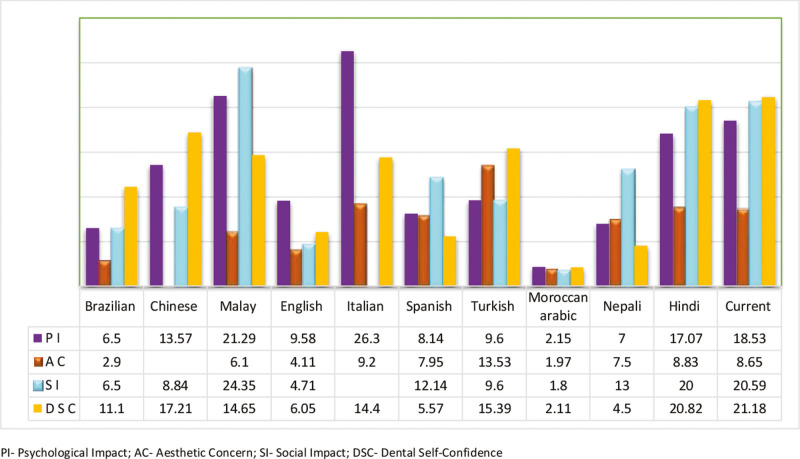
Internal consistency and test-retest reliability were good (Cronbach's = 0.83-0.88; Intraclass Correlation Coefficient = 0.74-0.91). IOTN-AC and POS scores showed significant correlation with PIDAQ scores ensuring convergent validity ( < 0.001). Discriminant validity was confirmed by statistically significant differences ( < 0.001) in PIDAQ scores between subjects with no treatment need and moderate/definite need. Factor analysis derived four domains with one item showing cross-loading. Difference in mean domain scores among the previously validated versions of PIDAQ confirmed socio-cultural differences in perceptions due to malocclusion.
PIDAQ was found to be reliable and valid for the Indian subjects and can be used as a condition-specific OHRQoL measure. Socio-cultural differences in perceptions were brought to light using the translated scale.
经过文化调适并经验证有效的口腔健康相关生活质量(OHRQoL)量表有助于可靠地比较不同人群的患者认知情况。牙科美学心理社会影响问卷(PIDAQ)评估牙科美学对OHRQoL的影响。本研究旨在为印度人群开发PIDAQ的地区版本(PIDAQ),并评估不同人群组中错牙合畸形导致的认知差异。
PIDAQ通过翻译过程得出,并进行预测试以评估重测信度。对285名受试者(男性占31.2%,女性占68.8%;年龄范围18 - 25岁)测试心理测量特性。使用正畸治疗需求指数(IOTN)-口腔健康成分评估规范治疗需求,并使用IOTN-美学成分(AC)和咬合感知量表(POS)进行主观评估。将PIDAQ平均领域得分与先前验证版本的得分进行比较,以评估认知差异。
内部一致性和重测信度良好(Cronbach'sα = 0.83 - 0.88;组内相关系数 = 0.74 - 0.91)。IOTN-AC和POS得分与PIDAQ得分显示出显著相关性,确保了收敛效度(P < 0.001)。无治疗需求和中度/明确需求受试者之间PIDAQ得分的统计学显著差异(P < 0.001)证实了区分效度。因子分析得出四个领域,有一项显示出交叉载荷。PIDAQ先前验证版本之间平均领域得分的差异证实了因错牙合畸形导致的认知方面的社会文化差异。
发现PIDAQ对印度受试者可靠且有效,可作为特定情况的OHRQoL测量工具。使用翻译后的量表揭示了认知方面的社会文化差异。