Tinawi Mohammad
Nephrology, Nephrology Specialists, Munster, USA.
Internal Medicine, Indiana University School of Medicine Northwest-Gary, Gary, USA.
Cureus. 2021 Apr 21;13(4):e14619. doi: 10.7759/cureus.14619.
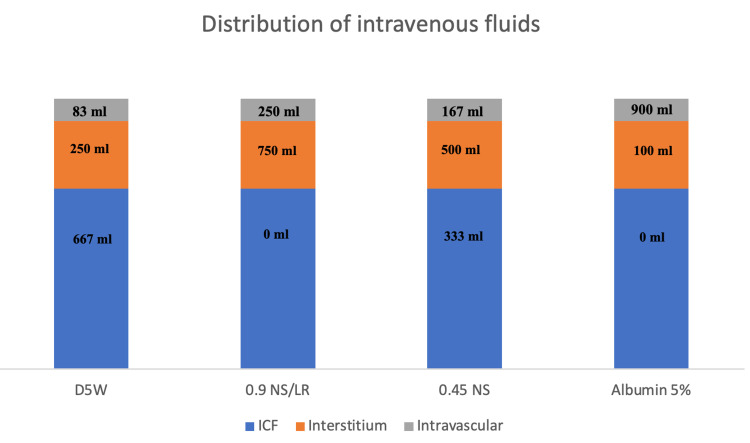
Intravenous fluids (IVFs) are the most commonly used drugs in hospitalized patients. Knowledge of the indications and pharmacokinetics of IVFs is critical for all medical disciplines. Isotonic saline (normal saline, 0.9% NS) is the most utilized intravenous solution. Isotonic saline effectively expands the intravascular compartment, as one-quarter of the infusate goes intravascularly, while the remaining three-quarters go into the interstitial space. The proper use of IVFs in different clinical scenarios is paramount. IVFs differ with regard to their half-life, intravascular volume expansion, preparation, and cost. Crystalloids are more commonly utilized due to their relatively low cost and availability. Colloids are very advantageous in cases of shock or hemorrhage, as they remain in the intravascular space, thus facilitating an increase in blood pressure (BP) prior to blood administration. Colloids are also advantageous in cases of burns and severe hypoglobulinemia. Human albumin (5%, 20%, and 25%) is the most used colloid solution. It remains intravascularly provided and there is no capillary leak as in systematic inflammation. The goal in hospitalized patients is timely and adequate intravenous fluid resuscitation. Utilization of a large volume of isotonic saline may lead to hypervolemia, hypernatremia, hyperchloremia, metabolic acidosis, and hypokalemia. The use of balanced intravenous solutions has been advocated to avoid these complications.
静脉输液(IVFs)是住院患者最常用的药物。了解静脉输液的适应证和药代动力学对所有医学学科都至关重要。等渗盐水(生理盐水,0.9% NS)是最常用的静脉溶液。等渗盐水能有效扩充血管内液量,因为四分之一的输注液进入血管内,而其余四分之三进入组织间隙。在不同临床场景中正确使用静脉输液至关重要。静脉输液在半衰期、血管内容量扩充、制剂和成本方面存在差异。晶体液因其成本相对较低且易于获取而更常用。胶体液在休克或出血情况下非常有利,因为它们留在血管内,从而在输血前有助于提高血压(BP)。胶体液在烧伤和严重低蛋白血症情况下也有优势。人白蛋白(5%、20%和25%)是最常用的胶体溶液。它留在血管内,不像全身炎症时那样存在毛细血管渗漏。住院患者的目标是及时且充分地进行静脉液体复苏。大量使用等渗盐水可能导致高血容量、高钠血症、高氯血症、代谢性酸中毒和低钾血症。有人主张使用平衡静脉溶液以避免这些并发症。